

Internet & Web Technology for GATE: Syllabus Mapping, Weightage Method and Preparation Order
Map Internet and Web Technology to the right Computer Networks boundary, trace a complete HTTPS request, audit past papers honestly, and study it in 12 focused hours.
KnowledgeGate Team
Exam prep & CS education
Updated 8 Nov 20265 min read

You may see “Internet & Web Technology” in notes or question banks and assume it carries a fixed standalone weightage in GATE. That shortcut creates a scope problem. A better approach is to map useful material to its Computer Networks boundary, measure its presence in completed papers without inventing a percentage, and follow a compact preparation order.
First Fix the Boundary: Study Label Versus GATE Subject
The official GATE 2027 Computer Science and Information Technology syllabus places DNS and HTTP within Computer Networks; it does not name Internet & Web Technology as a standalone subject. Start with Internet & Web Technology for GATE: Syllabus Boundary, Weightage Method and Prep Order for the full boundary decision and its 15-hour sequence. Then use the three-ring filter here for a narrower five-paper audit, object-level HTTPS trace, and 12-hour revision sprint.
For revision, focus on Internet-facing Computer Networks concepts. Compare this map with the current official GATE syllabus and completed official papers before finalising your scope. The GATE CS Exam Preparation category gives you the broader catalogue around this subject.
Map the Syllabus in Three Rings
Ring | Topics | Preparation decision |
|---|---|---|
1, named application-layer topics | DNS and HTTP | Master for GATE 2027 |
2, named network prerequisites | Layering, switching, performance metrics, data link, Ethernet, routing, IPv4, fragmentation, CIDR, NAT, TCP, and socket API | Build in prerequisite order |
3, adjacent web context not named in the syllabus | HTTPS/TLS, FTP, email protocols, URLs, browsers, web servers, HTML/CSS/JavaScript, hosting, web security, cloud, and IoT | Retain only for conceptual support or another target exam |
For GATE 2027, Rings 1 and 2 come directly from the official CS syllabus. Ring 3 is not named there; retain only the pieces that clarify DNS, HTTP, TCP, or another exam you are preparing for. Practice-bank groupings do not change the official boundary.
For revision, distinguish four pairs: a URL from DNS, an IP address from a port, a browser from a web server, and HTTP from the transport below it.
Worked Web Request: DNS, TCP, TLS and HTTP with Exact Values
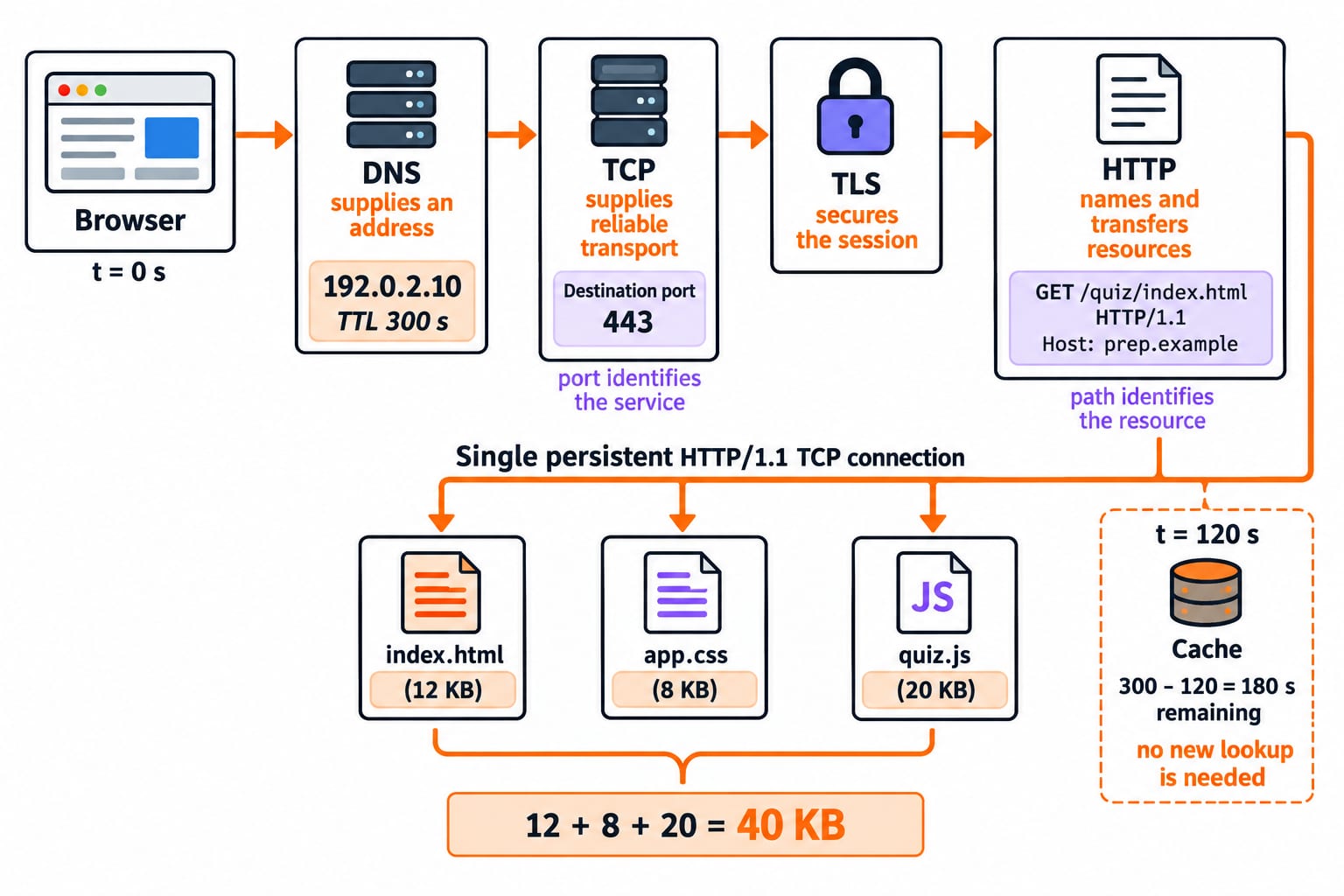
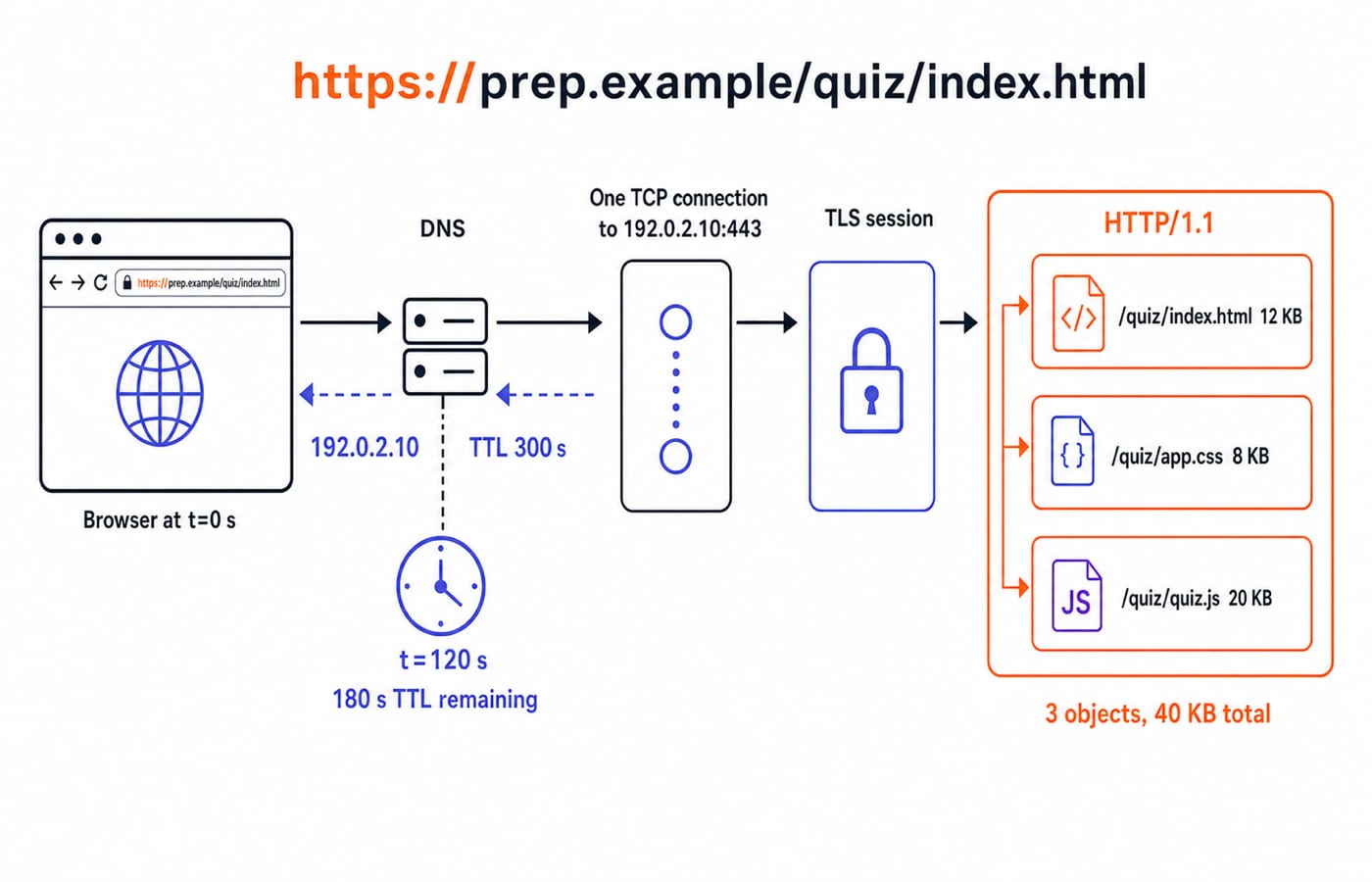
Take the teaching-only URL https://prep.example/quiz/index.html. At t = 0 s, DNS returns the documentation address 192.0.2.10 with TTL 300 s. The browser opens TCP to destination port 443, completes TLS, then sends GET /quiz/index.html HTTP/1.1 with Host: prep.example.
The response document index.html is 12 KB and references app.css of 8 KB and quiz.js of 20 KB. Therefore, the browser fetches three objects with total payload 12 + 8 + 20 = 40 KB. Under this example's persistent HTTP/1.1 assumption, all three requests reuse one TCP connection. At t = 120 s, the cached DNS record has 300 - 120 = 180 s remaining, so no new lookup is needed.
DNS supplies an address, TCP supplies reliable transport, TLS secures the session, and HTTP names and transfers resources. The port identifies the service, while the path identifies the resource. These invented values train protocol-role and cache arithmetic; they are not evidence from a past GATE paper.
Calculate Weightage Without Inventing a Trend
Across five completed official papers, freeze the Ring 1 and Ring 2 boundary before counting. Record each match by paper, topic, type, and marks. Separate uncertain overlaps, and never count one question twice.
Using invented practice totals [0, 2, 1, 3, 0], the sum is 0 + 2 + 1 + 3 + 0 = 6. The mean is 6 / 5 = 1.2 marks per paper. Sorted values are [0, 0, 1, 2, 3], so the median is 1 and the observed range is 0 to 3. The zeros and spread make a fixed-weightage claim dishonest. Apply the evidence-first method in GATE CS Subject Weightage to your completed-paper audit.
How GATE-Style Questions Probe This Boundary
Questions can ask you to order the DNS-to-HTTP sequence, distinguish recursive and iterative DNS, identify a protocol or port's role, compare persistent and non-persistent HTTP, or connect an application-layer action to TCP or UDP behaviour. If the DNS cache expires or the connection is not persistent, determine what changes in the request sequence.
For deeper protocol teaching, revise DNS, HTTP, and email as separate application-layer roles before solving focused questions. KnowledgeGate's Internet & Web Technology practice bank provides focused practice, but its size does not prove GATE frequency or marks.
A 12-Hour Preparation Order That Respects the Boundary
Phase 1: Three
75-minutesessions on TCP/IP, addressing, ports, and client-server flow:3 × 75 = 225 minutes.Phase 2: Three
75-minutesessions tracing DNS, HTTP, TCP connection reuse, and cache behaviour:225 minutes.Phase 3: Two
60-minutesessions on optional HTTPS/TLS, URLs, browsers, hosting, and other retained web context:120 minutes.Phase 4: Two
45-minutepractice sets and two30-minuteerror reviews:90 + 60 = 150 minutes.
The full plan is 225 + 225 + 120 + 150 = 720 minutes = 12 hours. Classify each miss as boundary, concept, calculation, or recall, then redo only the weak category. If you miss a day, resume at the next unfinished session. Then use the GATE Test Series: Mocks and Topic-wise Tests for broader Computer Networks testing.
Five Traps That Waste Study Time
Trap | What goes wrong | Better move |
|---|---|---|
Assuming a standalone subject | Scope expands | Check the current syllabus |
Copying a weightage percentage | Evidence stays hidden | Audit completed papers |
Treating question-bank volume as frequency | Practice becomes a false trend | Verify with papers |
Memorising protocol names | The request chain breaks | Trace DNS, TCP, TLS, and HTTP |
Starting with broad web-stack detail | The network core stays weak | Secure the core, then revise errors |
One extra check: 443 is the destination service port in this HTTPS trace, 192.0.2.10 is the destination IP, and /quiz/index.html is the resource path. Swapping them exposes memorisation without a working model.
Internet & Web Technology for GATE: The Short Version
Map the label to Computer Networks. Master the web-request chain. Audit completed papers instead of trusting a fixed percentage. Study the broader web stack only after checking scope.
Use GATE Guidance by Sanchit Sir for a structured full-subject route, or redraw the three-ring map, reproduce the 40 KB request trace from memory, and complete the two timed practice sets yourself.
Go deeper with the full courseGATE Guidance by Sanchit Sir
Keep learning
Internet & Web Technology for GATE: Syllabus Boundary, Weightage Method and Prep Order
Treat Internet and Web Technology as an overlap area, not a promised standalone subject. Build scope, paper-audit, URL-tracing and subnetting skills in a 12-session plan.
Updated 30 Oct 20265 min readGATE Strategy & Roadmap
Internet Fundamentals for GATE: DNS, HTTP and a Worked Web Request Trace
Connect Internet, Web, DNS, IP, ports and HTTP in one request lifecycle. Trace a cold HTTPS request and calculate latency, cache freshness and DNS expiry.
Updated 29 Oct 20266 min readGATE Strategy & Roadmap

Internet Protocols and Web Services: DNS, HTTP, Email and FTP with Worked Examples
Trace a browser request through DNS, TCP and HTTP, then separate email from FTP.
Updated 11 Nov 20265 min readGATE Strategy & Roadmap

Server-Side and Web Security: HTTP Sessions, Attacks, and Defences
Follow one illustrative login request from browser to proxy, application, and database, then map sessions, status codes, and common attacks to the controls that stop them.
Updated 3 Nov 20266 min readGATE Strategy & Roadmap