Ambiguous Grammars and Inherent Ambiguity: Worked CFG Examples for GATE
Learn what two derivations really prove, resolve expression ambiguity with precedence, and trace the classic inherently ambiguous language through aabbcc.
KnowledgeGate Team
Exam prep & CS education
Updated 1 Oct 20266 min read
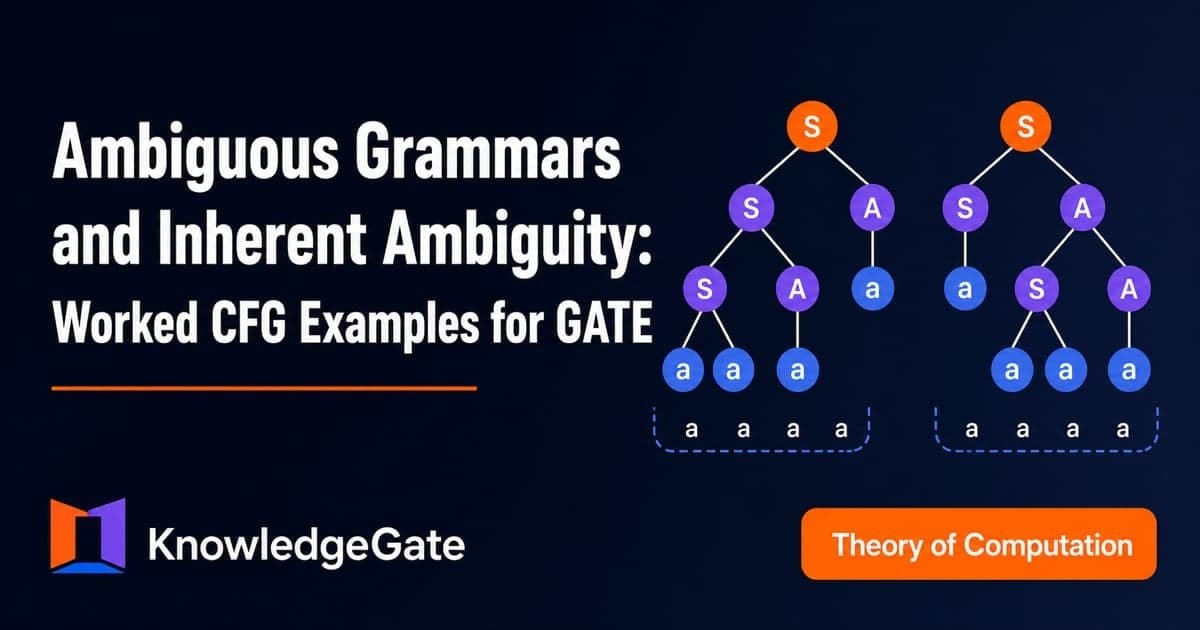
Finding two derivations for one grammar does not automatically show that its language is inherently ambiguous. Worse, one leftmost derivation and one rightmost derivation may describe the same parse tree. Grammar ambiguity can be removable or inherent: id+id*id, with values 2, 3, and 4, illustrates removable ambiguity, while the classic language L = {a^i b^j c^k | i = j or j = k, i,j,k >= 1} illustrates inherent ambiguity. For grammar notation, derivation basics, and the wider CFG toolkit, use Grammar and CFG in Compiler Design. The dedicated ambiguity task separates a witness for one grammar, a grammar repair, and the universal claim of inherent ambiguity.
Ambiguous grammar, unambiguous language, and inherently ambiguous language
A context-free grammar is ambiguous if at least one terminal string has two distinct parse trees. Prove it with two distinct leftmost derivations or two distinct rightmost derivations of that string. One of each is not enough, because every parse tree has both.
Ambiguity is a property of a particular grammar. A language is inherently ambiguous only when every CFG that generates it is ambiguous. One ambiguous grammar therefore does not prove inherent ambiguity.
The witness rules are decisive:
One string with two parse trees proves that a grammar is ambiguous.
One unambiguous CFG for a language proves that the language is not inherently ambiguous.
Failing to find a second tree proves neither claim.
Worked example: two parses for id+id*id
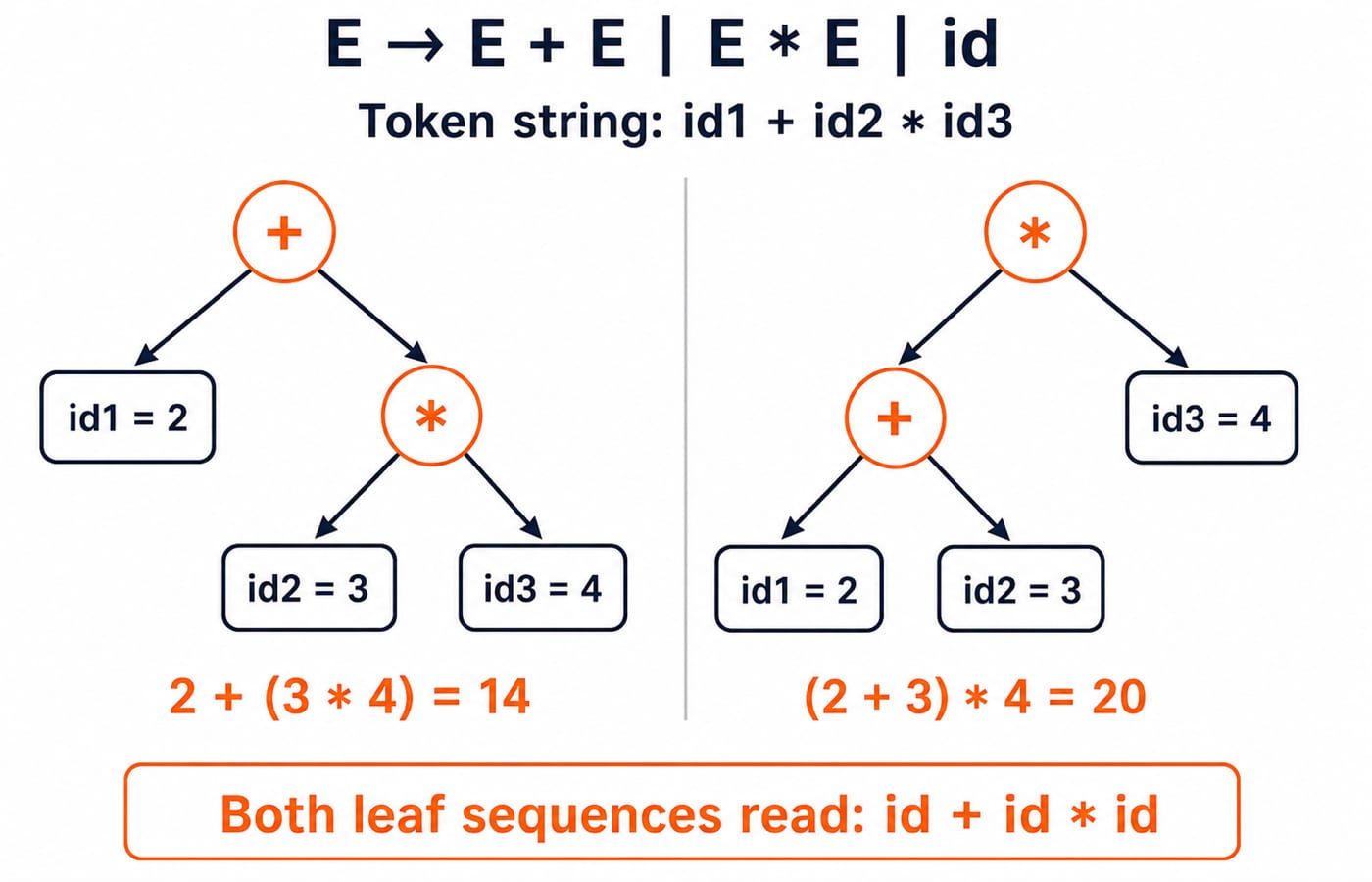
Take the grammar E -> E + E | E * E | id. Let the three operands be id1 = 2, id2 = 3, and id3 = 4.
The first leftmost derivation is:
E => E + E => id + E => id + E * E => id + id * E => id + id * id
The root operator is +, so this tree means 2 + (3 * 4). Multiplication gives 3 * 4 = 12, then addition gives 2 + 12 = 14.
The second leftmost derivation is:
E => E * E => E + E * E => id + E * E => id + id * E => id + id * id
Here the root operator is *, so the grouping is (2 + 3) * 4. Addition gives 2 + 3 = 5, then multiplication gives 5 * 4 = 20.
The leaf sequence is identical, but the roots differ. These distinct leftmost derivations prove the grammar ambiguous.
Removing ambiguity with precedence and associativity
Replace the expression grammar with:
E -> E + T | TT -> T * F | FF -> id | (E)
Multiplication is nested at the T level, so it binds more tightly than addition. Left recursion in E and T makes repeated operators left-associative.
Now derive the same token string:
E => E + T => T + T => F + T => id + T => id + T * F => id + F * F => id + id * F => id + id * id
With the same values, the grammar selects 2 + (3 * 4) = 2 + 12 = 14. It still generates the unparenthesised terminal string id+id*id, but gives it the intended parse. Ambiguity must be settled before deterministic predictive parsing because an LL(1) table needs at most one production choice in each cell. Removing left recursion alone does not, by itself, remove ambiguity.
Inherent ambiguity: the classic union language and aabbcc
Consider the standard inherently ambiguous context-free language:
L = {a^i b^j c^k | i = j or j = k, i,j,k >= 1}
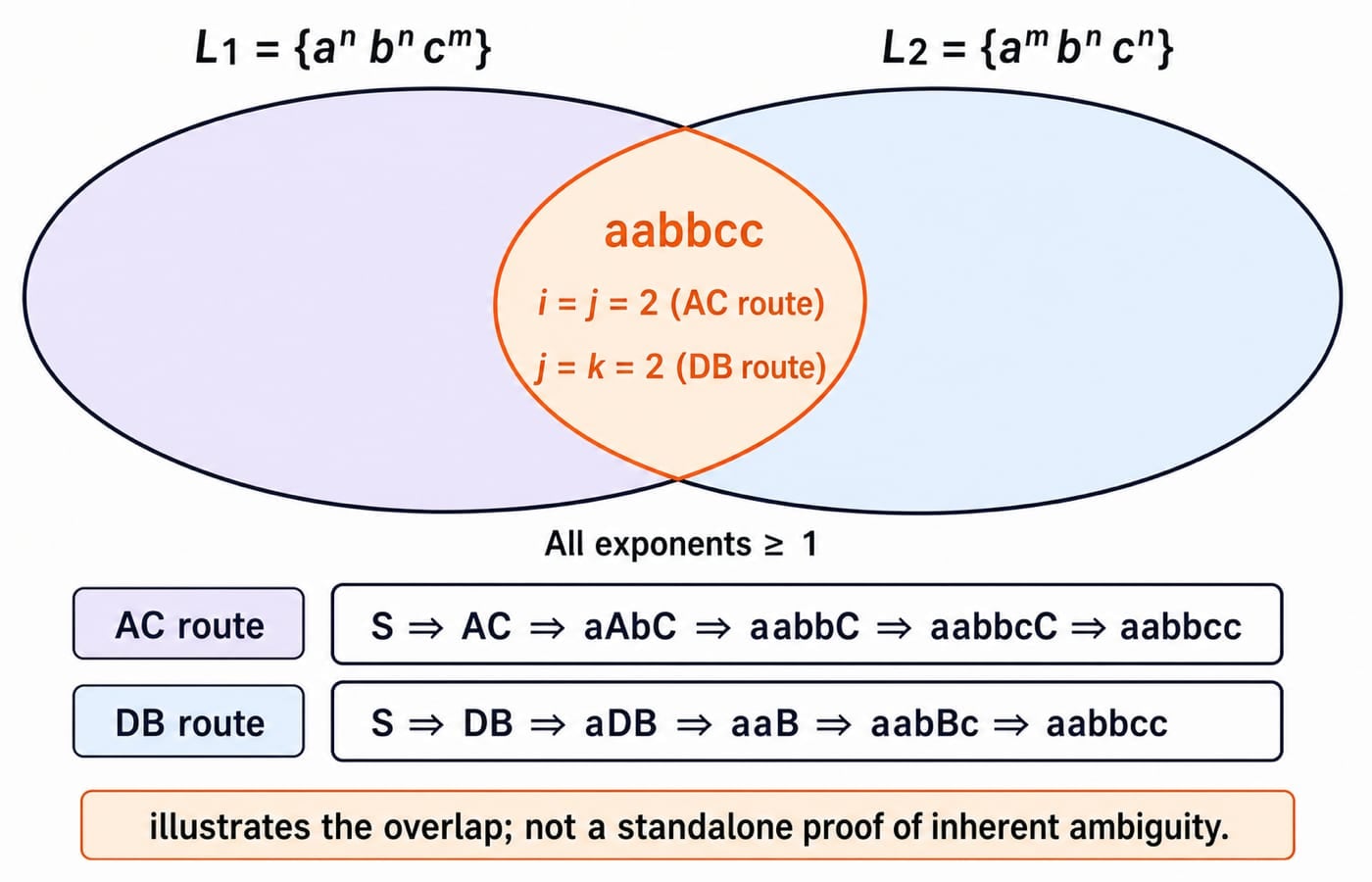
Split it into L1 = {a^n b^n c^m | n,m >= 1} and L2 = {a^m b^n c^n | m,n >= 1}. Their intersection contains every string a^n b^n c^n. For n = 2, that string is aabbcc.
One union grammar is S -> AC | DB, with A -> aAb | ab, C -> cC | c, D -> aD | a, and B -> bBc | bc. The first branch derives the string as:
S => AC => aAbC => aabbC => aabbcC => aabbcc
The second branch derives it as:
S => DB => aDB => aaB => aabBc => aabbcc
These routes prove only that this union grammar is ambiguous. They show the overlap, but not that every CFG for L is ambiguous. The stronger result is a theorem: L is inherently ambiguous, so no unambiguous CFG generates it. The two branch derivations explain the overlap; they are not a proof of that universal result. Use Formal Grammar and Chomsky Hierarchy for GATE for tuple definitions and production-class classification; ambiguity questions instead ask what a witness does and does not establish.
A proof checklist for ambiguity questions
Use this decision sequence:
Identify whether the question asks about one grammar or an entire language.
Choose a short candidate terminal string.
Keep the convention fixed: compare leftmost with leftmost, or rightmost with rightmost.
Compare parse-tree roots or the key production choices.
State exactly what the witness proves.
For the expression grammar, root + versus root * proves ambiguity. In the precedence grammar, the only valid root for id+id*id is the top-level +. Yet one checked string does not prove the whole grammar unambiguous.
Inherent ambiguity carries a stronger burden. One witness proves a grammar ambiguous, but the language claim is universal over all CFGs. In an objective question, use a known theorem or an explicit unambiguous alternative grammar instead of trying derivations indefinitely.
Traps that cost marks
Trap | Why it fails | Correct move |
|---|---|---|
Treating two arbitrary derivations as two parses | They may encode one tree | Compare two leftmost or two rightmost derivations |
Calling every ambiguous grammar inherently ambiguous | Another unambiguous grammar may exist | Separate grammar and language claims |
Assuming left recursion means ambiguity | Some unambiguous grammars are left-recursive | Search for two parse trees |
Assuming removing left recursion fixes ambiguity | That transformation does not settle ambiguity | Encode the intended structure |
Changing the terminal language while claiming only a fix | The new grammar may define another language | Compare their terminal strings |
Applying familiar operator precedence automatically | Habit does not define a grammar | Read its nonterminals and productions |
An ambiguous grammar cannot be LL(1), and it cannot be LR(k) for any fixed k. The same language may still have a different unambiguous grammar suitable for deterministic parsing. Keep practising that distinction with Parsing MCQs: Top-Down and Bottom-Up.
How GATE-style questions test the distinction
A GATE-style item may ask you to select an ambiguous grammar, find a string with two leftmost derivations, choose the parse imposed by precedence, separate a grammar claim from a language claim, or recognise the classic inherently ambiguous union language.
For a 30-second expression check, scan for E -> E op E, try three operands, compare possible root operators, and calculate both groupings. Here that is 2 + (3 * 4) = 14 against (2 + 3) * 4 = 20.
For the wider subject route, use GATE CS Exam Preparation to place grammar and parsing inside your study plan.
Ambiguity and inherent ambiguity: the short version and next step
Two parse trees for one terminal string make a grammar ambiguous. Ordinary ambiguity can sometimes be removed by supplying another unambiguous grammar, and operator precedence and associativity must be encoded in that grammar's structure. An inherently ambiguous language is different: it has no unambiguous CFG at all.
Now reproduce both leftmost derivations of id+id*id, redraw the precedence grammar, and explain in one sentence why the two aabbcc routes do not prove the universal claim by themselves. Check that your values are 14 and 20. Use GATE Guidance by Sanchit Sir for a sequenced Compiler Design route, then move to timed practice after the concept is stable.
Keep learning
Intermediate Code Generation in Compiler Design: TAC, Backpatching and DAGs
Connect expressions, short-circuit control flow and local optimisation through a single worked translation, from source code to resolved TAC and a reusable DAG.
Updated 5 Oct 20265 min readCompiler Design
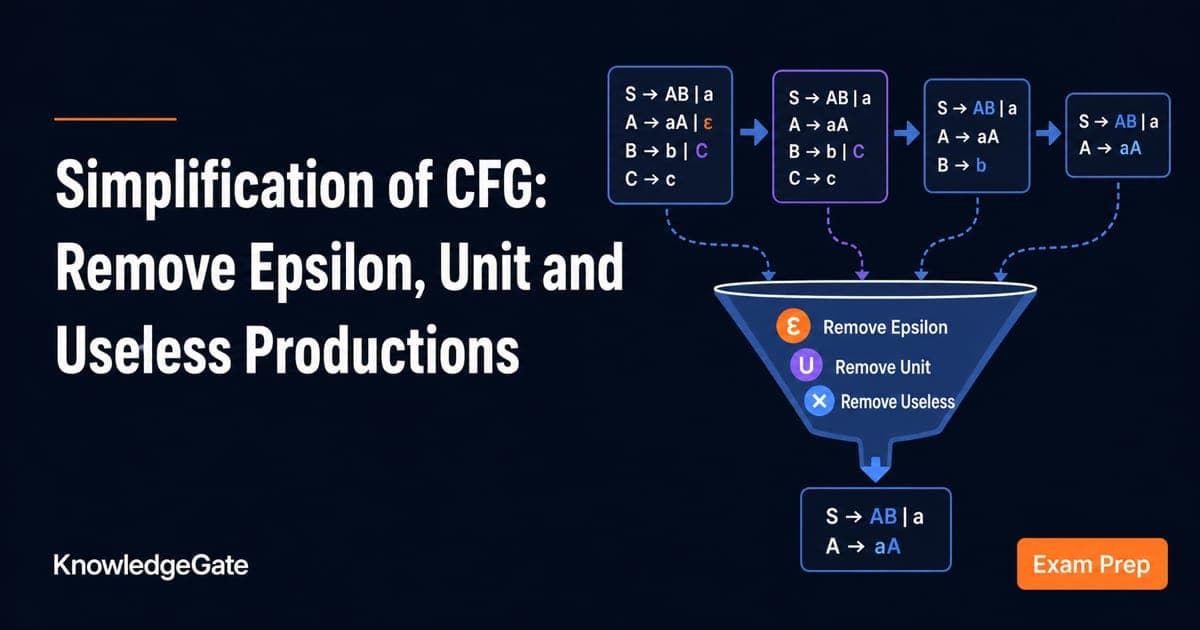
Simplification of CFG: Remove Epsilon, Unit and Useless Productions Step by Step
Simplify one context-free grammar from nine nonterminals to six. See each intermediate grammar, complete unit closures, symbol checks and final derivations.
Updated 26 Sep 20266 min readCompiler Design
Phases of Compiler Explained: Worked Example from Tokens to Target Code
Follow one four-line program through lexical, syntax and semantic analysis, then see its intermediate code optimized to a final stored value of 24.0.
Updated 24 Sep 20266 min readCompiler Design
Normal Forms and BNF in Compiler Design: CNF, GNF and Worked CFG Conversions
Separate grammar notation from production restrictions, then convert one CFG into CNF and GNF with exact derivations and rule-by-rule checks.
Updated 23 Sep 20266 min readCompiler Design