Normal Forms and BNF in Compiler Design: CNF, GNF and Worked CFG Conversions
Separate grammar notation from production restrictions, then convert one CFG into CNF and GNF with exact derivations and rule-by-rule checks.
KnowledgeGate Team
Exam prep & CS education
Updated 23 Sep 20266 min read
BNF, CFG, CNF and GNF are often memorised as four unrelated abbreviations. That makes it easy to mix up notation with production-rule restrictions. BNF is notation; CNF and GNF restrict production shapes. Language-preserving conversions produce CNF and GNF grammars, while exact derivations verify representative strings. These CS Fundamentals support compiler design and theory of computation.
BNF and normal forms describe different things
A context-free grammar is G = (V, Sigma, P, S): variables V, terminal alphabet Sigma, productions P, and start variable S.
We use V = {S}, Sigma = {a, b}, P = {S -> aSb, S -> ab}, and start variable S. It generates L = {a^n b^n | n >= 1}.
In Backus-Naur Form, the same grammar is:
<S> ::= "a" <S> "b" | "a" "b"<S> names a variable, ::= means "is defined as", | separates alternatives, and quotes mark terminals. BNF is notation, not a restricted CFG class. CNF and GNF restrict production shapes while preserving the language. See context-free grammars and pushdown automata for the wider recognition connection.
BNF reading: derive a real expression
Consider this compiler-style BNF:
<expr> ::= <expr> "+" <term> | <term>
<term> ::= <term> "*" <factor> | <factor>
<factor> ::= "(" <expr> ")" | "id"
Variables are <expr>, <term> and <factor>; terminals are +, *, (, ) and id. The layers give * tighter binding than +. Left recursion makes this unsuitable for a naive recursive-descent parser until rewritten.
The complete leftmost derivation of id + id * id is:
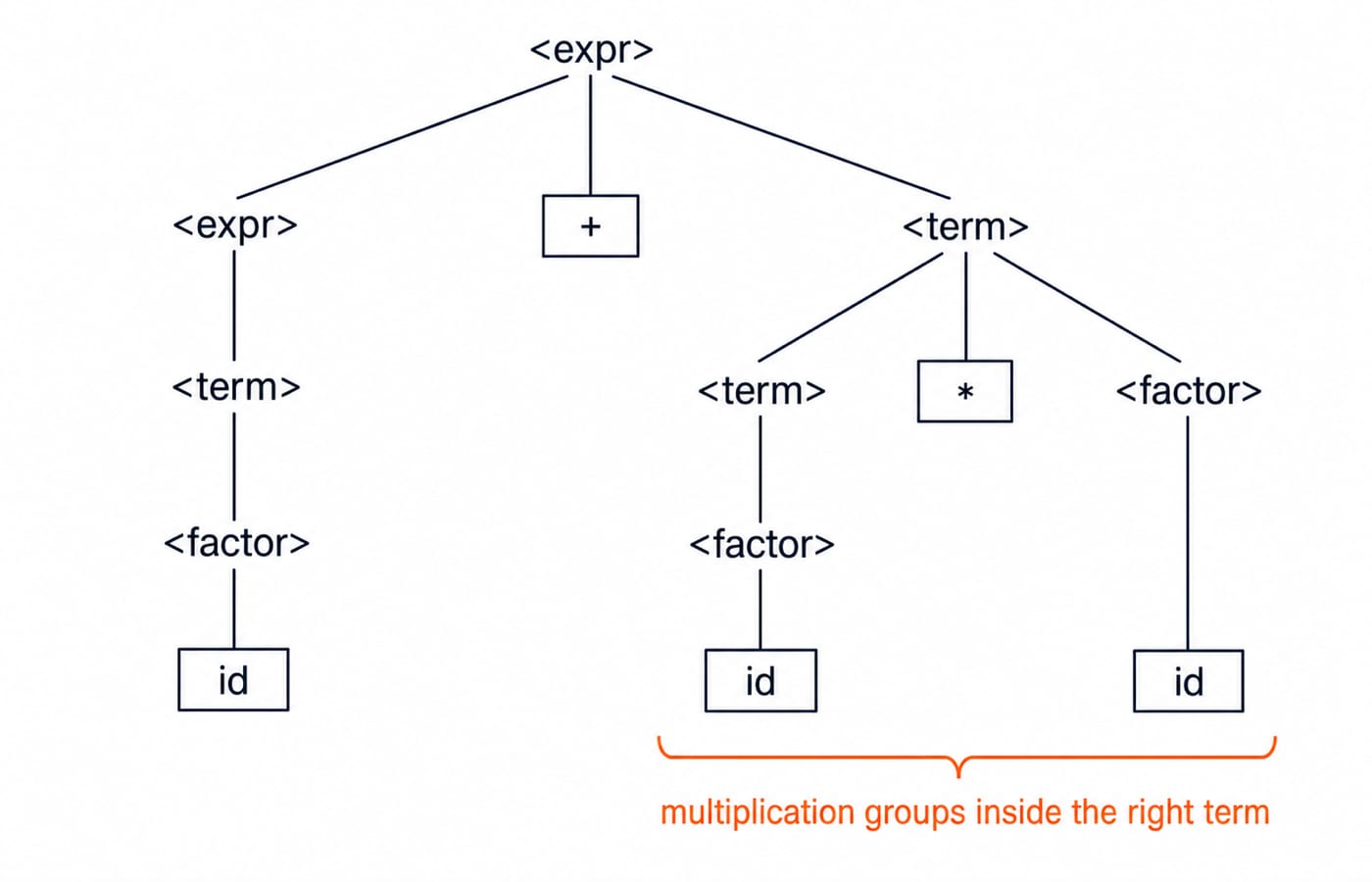
<expr> => <expr> + <term> => <term> + <term> => <factor> + <term> => id + <term> => id + <term> * <factor> => id + <factor> * <factor> => id + id * <factor> => id + id * idReading the arrows left to right, each replacement targets the current leftmost variable:
<expr> -> <expr> + <term><expr> -> <term><term> -> <factor><factor> -> id<term> -> <term> * <factor><term> -> <factor><factor> -> id<factor> -> id
So the left operand of + is id, while its right operand is one <term> containing id * id.
CNF and GNF: allowed production shapes
In CNF, every production is A -> BC or A -> a, where uppercase symbols are variables and a is one terminal. If the language contains the empty string, the controlled exception is S0 -> epsilon; under the strict convention here, fresh S0 never appears on a right-hand side.
In GNF, every production is A -> aA1A2...Ak: a terminal comes first, followed by zero or more variables.
form | allowed shape | valid sample | invalid sample | why useful |
|---|---|---|---|---|
CNF |
|
|
| standardises rules into binary variable steps or one terminal |
GNF | terminal first, then zero or more variables |
|
| makes every production step introduce a terminal first |
BNF does not belong in this comparison because it is notation, not a production-shape restriction.
CFG to CNF: convert S -> aSb | ab
Start with G0: S -> aSb | ab. It has no epsilon-production, unit production or useless symbol. However, both alternatives mix terminals into longer strings, and aSb has length three.
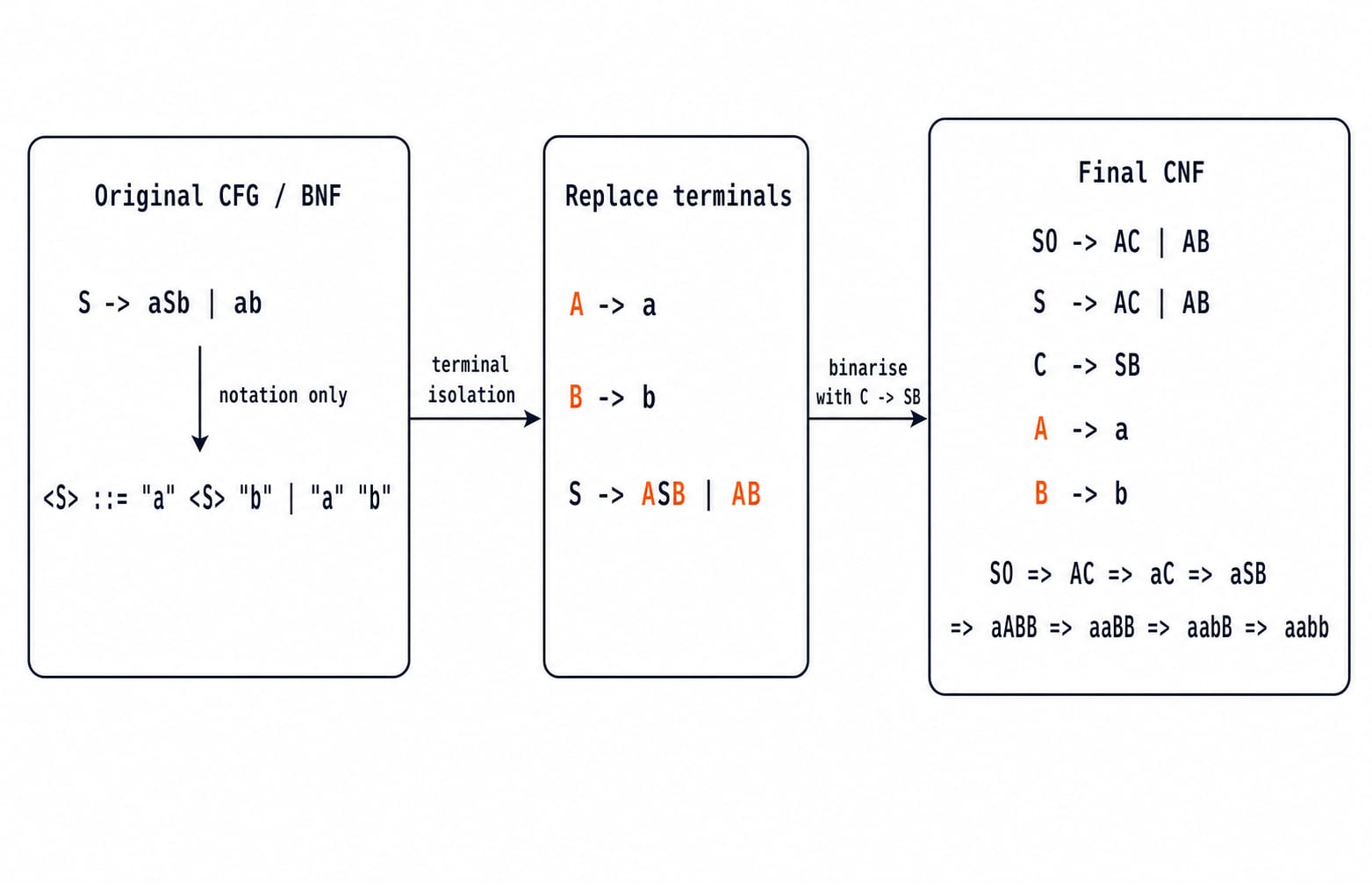
Protect the start with
S0 -> S.Isolate terminals using
A -> aandB -> b, soS -> ASB | AB.Remove the new unit production by copying the alternatives to
S0 -> ASB | AB.Binarise the length-three sequence using
C -> SB.
The final CNF is exactly:
S0 -> AC | AB
S  -> AC | AB
C  -> SB
A  -> a
B -> bAC, AB and SB are variable pairs; a and b are single terminals. Every rule passes the CNF test.
Now verify aabb and name each production used:
S0 => AC => aC => aSB => aABB => aaBB => aabB => aabbThe steps use S0 -> AC, A -> a, C -> SB, S -> AB, A -> a, B -> b, then B -> b. The shortest string also survives: S0 => AB => aB => ab.
CFG to GNF: reuse the same grammar
In S -> aSb | ab, both alternatives already start with terminal a. Only the later b needs a variable. Introduce B -> b:
S -> aSB | aB
B -> b
aSB starts with terminal a followed only by variables S, B. aB starts with a followed by B, and b is a single terminal. All fit GNF. In contrast, aSB and aB are invalid in CNF.
The same string follows as S => aSB => aaBB => aabB => aabb. One more recursive use generates aaabbb. The string abab is not in {a^n b^n | n >= 1} because every a must precede every b, with equal counts.
Normal-form traps that cost easy marks
trap | why it happens | what goes wrong | correct check |
|---|---|---|---|
Calling BNF a normal form | abbreviations look related | notation is mistaken for a restriction | ask whether rule shapes are constrained |
Treating | it has only two symbols | terminal and variable are mixed | CNF needs |
Treating | both are variables | no leading terminal appears | GNF must begin with a terminal |
Leaving terminals in long rules | the original rule looks readable | CNF is violated | isolate each terminal |
Leaving | start protection is confused with completion | a unit rule remains | copy alternatives, then remove it |
Expecting the same parse tree | equivalence is misunderstood | valid conversions seem wrong | compare generated languages |
For a general CNF conversion, protect the start when required, remove epsilon-productions, remove unit productions, remove useless symbols, isolate terminals in long rules, then binarise. Our compact grammar skipped the cleanup stages only because inspection found nothing to remove.
Equivalence preserves the generated language, not production spellings, derivation length or parse-tree shape. Checking ab and aabb is a useful sanity test, not a proof for every string.
Normal forms and BNF exam patterns: classify, convert, derive
The four common formats are classify a rule, convert a small CFG, follow a leftmost derivation, and test string membership. A quick drill is: A -> BC is CNF only, A -> aB is GNF only, A -> a fits both, and A -> BCd fits neither.
Use this 60-second verification order: scan for epsilon, unit rules and useless variables; check terminal placement and right-hand-side length; then test the shortest two generated strings. Our CNF passes these scans and derives ab and aabb exactly.
The broader Grammar and CFG in Compiler Design guide develops ambiguity, parse trees, FIRST, FOLLOW and left-recursion removal. Normal-form conversion has a narrower goal: change production shapes while preserving the generated language.
Normal forms and BNF: the short version
BNF = notation
CFG = language definition
CNF = two variables or one terminal
GNF = terminal first
Conversion preserves language
Verify with exact derivations
CNF | GNF |
|---|---|
|
|
|
|
|
After reviewing the rules, practise by classifying single productions and converting two or three short grammars into CNF and GNF yourself. For a GATE-oriented subject sequence, continue with GATE Guidance by Sanchit Sir. For a broader core-CS route, use the Zero to Hero Complete CS Course.
Keep learning

Intermediate Code Generation in Compiler Design: TAC, Backpatching and DAGs
Connect expressions, short-circuit control flow and local optimisation through a single worked translation, from source code to resolved TAC and a reusable DAG.
Updated 5 Oct 20265 min readCompiler Design
Ambiguous Grammars and Inherent Ambiguity: Worked CFG Examples for GATE
Learn what two derivations really prove, resolve expression ambiguity with precedence, and trace the classic inherently ambiguous language through aabbcc.
Updated 1 Oct 20266 min readCompiler Design
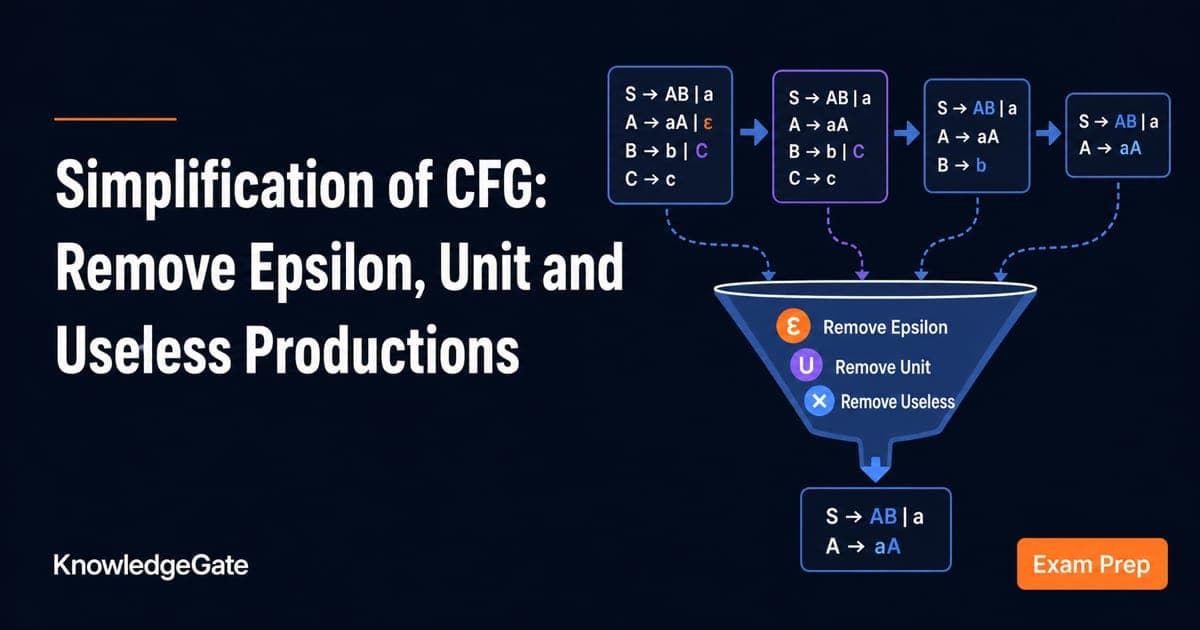
Simplification of CFG: Remove Epsilon, Unit and Useless Productions Step by Step
Simplify one context-free grammar from nine nonterminals to six. See each intermediate grammar, complete unit closures, symbol checks and final derivations.
Updated 26 Sep 20266 min readCompiler Design
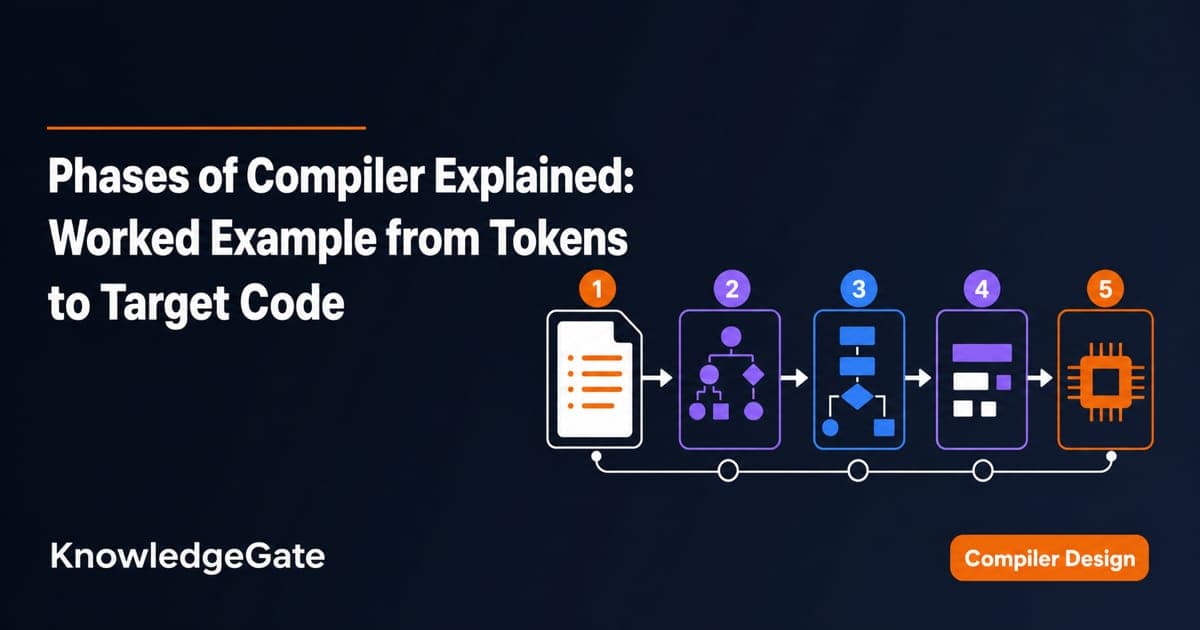
Phases of Compiler Explained: Worked Example from Tokens to Target Code
Follow one four-line program through lexical, syntax and semantic analysis, then see its intermediate code optimized to a final stored value of 24.0.
Updated 24 Sep 20266 min readCompiler Design