Cognizant Interview Process: Assessment, Technical and HR Round Preparation
Use your current Cognizant invitation to build a focused plan, then rehearse aptitude, coding, SQL, project defence and behavioural answers that survive follow-up questions.
KnowledgeGate Team
Exam prep & CS education
Updated 18 Aug 20267 min read
Most Cognizant preparation goes wrong the same way: you rehearse a remembered pattern, then the invitation arrives asking for something else. Your invitation is the only document that names the sections you actually face, so read it before deciding what to revise. Then work every practice problem down to a number you can defend, because the follow-up question lands on the step you skipped.
Related reading: Wipro interview process and Infosys interview process.
Start with Cognizant's official route, then map your preparation to it
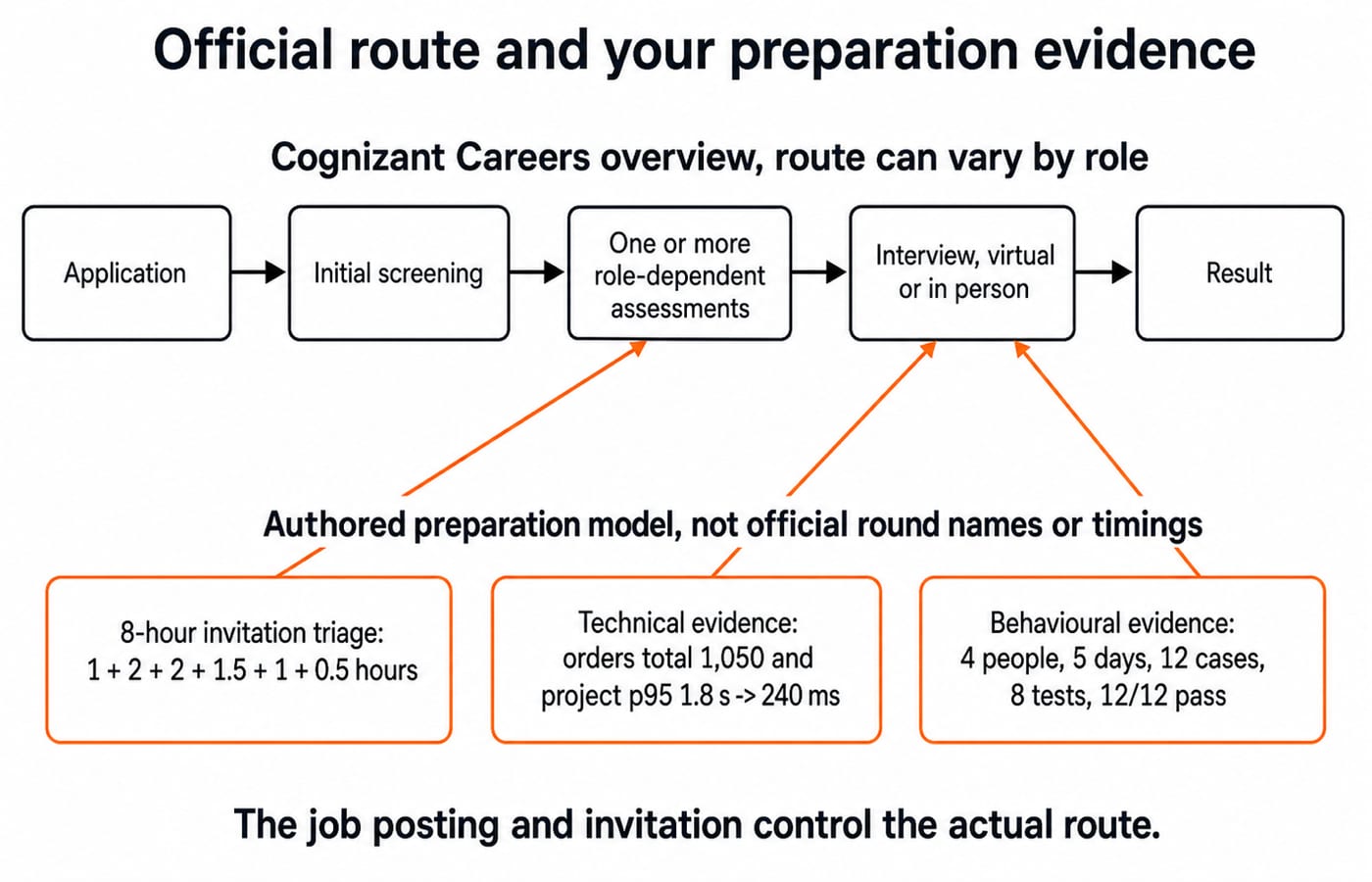
Cognizant's India GenC careers overview lays the route out as application, initial screening, one or more role-dependent assessments, interview, and result. Role-dependent is the operative word: two candidates on different GenC tracks in the same drive can be sent different sections, and the interview may be virtual or in person. Treat the sequence as the shape of the journey and your invitation as the specification.
Official high-level stage | What the candidate must confirm | Preparation evidence |
|---|---|---|
Application and screening | Posting's role, location, eligibility, route | Accurate resume |
Assessment | Invitation's sections, platform, deadline, technical requirements | Matched aptitude, communication or coding drill |
Interview | Mode, time, documents | Project defence, CS fundamentals, behavioural examples |
Result | Cognizant's update channel | Monitor registered email, placement officer or platform, not rumours |
If you have not settled on a track, the Cognizant GenC role tracks and study plan breaks the GenC family down and gives you an eight-week schedule. The company-specific placement courses collect the drill sets that company drives lean on, which is useful once you know which sections your invitation names.
Decode the invitation before choosing what to revise
Open the invitation and write down six things: the role or track, the campus or off-campus route, the assessment sections it names, the deadline with its time zone, the platform plus any device or proctoring rules, and the documents you must have ready. Anything it leaves blank goes to the contact address printed on it, not to a seniors' group still circulating last year's pattern.
Assume three days' notice and eight usable hours. Spend 1 hour parsing the invitation and testing the device, 2 on aptitude and communication, 2 on coding and CS fundamentals, 1.5 on project defence, 1 on two behavioural answers, and 0.5 on login, ID and connectivity: 1 + 2 + 2 + 1.5 + 1 + 0.5 = 8 hours. If two hours vanish to a class, protect the logistics half hour and the sections your invitation names, and cut general revision instead. The Cognizant Superset course carries recorded lessons and practice tests for the aptitude and CS blocks.
Assessment practice: show the method, not a guessed pattern
Because the set is role-dependent, practise the components your invitation names rather than a section count you heard second hand. What transfers across every version is method: a percentage question you can decompose out loud, and a coding question whose cost you can state before being asked.
Take a typical accuracy question. A pipeline runs 800 jobs at a 92% success rate and a fix recovers 75% of the failures; what is the new rate? In order: 800 x 0.92 = 736 successes, so 800 - 736 = 64 failures. The fix recovers 64 x 0.75 = 48, giving 736 + 48 = 784, and 784 / 800 x 100 = 98%. Three traps: adding 75 to 92 as points, forgetting the original 736, and dividing by 784 instead of 800.
The coding counterpart is first-unique. For tickets = [4, 2, 7, 2, 4, 9], one pass builds the frequency map {4: 2, 2: 2, 7: 1, 9: 1}, and a second pass over the original list returns 7, the first value with a count of 1 and ahead of 9. That is O(n) time and O(n) space. Then say the sentence most candidates skip: what your function returns when every value repeats, whether -1, None or a raised error.
Technical discussion: connect the answer to assumptions and trade-offs
Answer in five moves. Clarify what is being asked and state your assumption. Name the concept it tests. Give the result. Volunteer the edge case that breaks it. Finish with the trade-off you accepted. Interviewers weigh the last two hardest, because they separate a memorised answer from a used one. For the revision underneath, across OS, DBMS, CN and OOP, work through the technical interview CS subjects guide.
The SQL question usually takes this shape. Given orders(customer_id, amount) holding (1, 600), (1, 450), (2, 300) and (2, 700), return each customer whose total is strictly above 1,000:
SELECT customer_id, SUM(amount) AS total
FROM orders
GROUP BY customer_id
HAVING SUM(amount) > 1000;
Customer 1 totals 600 + 450 = 1,050, which clears the bar; customer 2 totals 300 + 700 = 1,000, which does not, because the comparison is strict. One row comes back. Say the distinction out loud: WHERE filters rows before grouping, HAVING filters groups after aggregation, which is why this condition cannot move into a WHERE clause. Then add the edge case unprompted, that SUM ignores NULL, so a customer whose amounts are all NULL yields a NULL total and fails rather than counting as zero.
Project questions reward the same discipline. The template: on a 10,000-row jobs table, p95 fell from 1.8 seconds to 240 ms after a composite index on (student_id, status). Substitute your own project and your own measured numbers, then prepare the five follow-ups: how you measured the baseline, which part was yours, why the columns sit in that order, what the read gain cost in storage, and what it cost on every write. A number you cannot source is worse than no number.
HR-style questions: convert claims into checkable evidence
Treat the HR round as a set of questions, not a slot on a timetable. They often arrive inside the same interview as the technical questions, so do not save them for a stage that may never be announced. Beforehand, line the posting up against your own constraints on role, work mode, location, joining date and documents.
A STAR answer built to survive follow-up looks like this. Situation: a four-person team had a demo in five days and login failed in twelve token-expiry cases. Task: you owned the diagnosis and the refresh-token fix. Action: you reproduced all twelve, changed the expiry handling, added eight tests, and paired with the deployment owner. Result: twelve of twelve passed and the demo shipped on time. Prepare the follow-up too, which is always what your change did and how you knew it held. Then rebuild it from something you really did; the numbers are what gets probed.
For “Why Cognizant?”, budget 45 seconds and put three things in it: one reason from the posting itself, one detail from Cognizant's own GenC or learning material that you actually read, and one piece of personal evidence that you have done work of that kind. Praise for the company's size or culture is what everyone else says. For more structures, plus resume review and mock practice, use the HR interview answer guide and the Interview and Resume Preparation course.
Run one handoff mock instead of three disconnected sessions
Run it once end to end in a single 75-minute sitting: 20 minutes on the percentage and coding drills, 25 on the SQL question and the project defence, 20 on two behavioural answers, 10 to review what broke. 20 + 25 + 20 + 10 = 75 minutes. Three half-hour sessions across three evenings will not surface the same faults, because the faults live in the handoffs.
Move straight from why the frequency map costs O(n) space into defending the 1.8 seconds to 240 ms index change, then into separating your contribution from the four-person team's, with no pause to reset. The transition, not any single answer, is what a real interview tests.
Prompt | Evidence I gave | What broke under follow-up |
|---|---|---|
Percentage calculation | 98% | Denominator error |
SQL aggregate | Customer 1 at 1,050 | Confused WHERE and HAVING |
Project | p95 fell to 240 ms | Could not state measurement method |
STAR | 12/12 cases and 8 tests | Blurred personal and team contribution |
Final check: official communication, evidence packet, next action
Re-open the posting and the invitation and confirm the stages, platform, deadline and documents.
Keep one page carrying the 98% accuracy chain, first-unique 7, the 1,050 SQL total, one project metric set you measured yourself, and two STAR stories you actually lived.
Test the device and the contact route, then delete any answer you could not defend under a second question.
For more practice on these shapes, KnowledgeGate's question bank carries more than 56,000 published questions across aptitude, CS fundamentals and databases. Volume alone gets nobody selected, so use it to find where your method breaks, not to run up an attempt count.
The short version: let Cognizant's own communication define the route, practise the sections it names, defend every number with the method that produced it, and keep your evidence truthful enough to survive a second question. Start with the Cognizant Superset course, and check the official Cognizant GenC India page again the week your invitation lands.
Keep learning
Accenture Coding Questions: 4 Patterns with Solved Dry Runs
Stop memorising company-question lists. Learn four reusable coding patterns through precise examples involving strings, arrays, digits, and matrices.
Updated 2 Oct 20265 min readCompany-Specific Prep
Accenture Placement Preparation: 4-Week, 56-Hour Study Plan
Turn four preparation lanes into a practical weekly calendar. Start with a baseline, move hours towards your errors, and recover missed sessions without cramming.
Updated 27 Sep 20265 min readCompany-Specific Prep
Capgemini Interview Questions: Technical and HR Rounds with Model Answers
Practise clear technical and HR answers through Java, SQL, a coding trace and one consistent project story. Each example shows what to say and how to support it.
Updated 25 Sep 20265 min readCompany-Specific Prep
Capgemini Drive Mistakes: Stage-by-Stage Rejection Risks and Fixes
Diagnose the controllable evidence gaps behind common Capgemini drive risks. Repair your CV, timed practice, code traces, project proof and behavioural stories with worked drills.
Updated 24 Sep 20266 min readCompany-Specific Prep