

Salesforce Interview Questions: Technical Examples and HR Model Answers
Practise explaining a two-sum solution, preserving missing SQL records and defending a booking design. Then build HR answers around your own contribution and evidence.
KnowledgeGate Team
Exam prep & CS education
Updated 20 Nov 20266 min read
You can memorise answers yet struggle to explain code, defend a project decision or show evidence of teamwork. Salesforce software-engineering interviews can probe coding, data and design, project ownership, and behavioural reasoning. Interview prompts vary by role, so adapt practice questions to your invitation. For a Salesforce-platform developer role, prioritise Apex and SOQL alongside these software-engineering fundamentals.
What Salesforce technical and HR discussions can test
Salesforce Trailhead describes engineering interviews combining technical and behavioural questions and encourages candidates to explain their reasoning in Own Your Onsite Interview.
The format depends on your role and invitation; ask the recruiter what to prepare. Prepare across three lenses:
Coding: Can you produce a correct solution and explain its efficiency?
Data and design: Can you preserve required results and defend trade-offs?
Projects and HR: Can you explain your contribution, choices and teamwork?
An HR-style question can arise inside a technical conversation. Explaining how you resolved a disagreement about a design tests both engineering judgement and communication. Prepare to move between code and the reasons behind it. For broader fundamentals, use the Placement Preparation category.
Coding question: find two different indices with a target sum
Prompt: Given nums = [2, 7, 11, 15] and target = 9, return the zero-based indices of two different elements whose sum is 9. Return an empty list if no pair exists.
First clarify whether one result is enough and whether duplicate values are allowed. Here, both answers are yes. Nested loops examine up to n(n-1)/2 pairs: 4 * 3 / 2 = 6. That takes O(n²) time and O(1) extra space.
A map stores previously visited values and their indices:
def two_sum(nums, target):
    seen = {}
    for i, value in enumerate(nums):
        need = target - value
        if need in seen:
            return [seen[need], i]
        seen[value] = i
    return []
At index 0, value = 2, so need = 9 - 2 = 7. The map is {}: miss. Store {2: 0}. At index 1, value = 7, so need = 9 - 7 = 2. The map contains 2 at index 0. Return [0, 1]; 2 + 7 = 9.
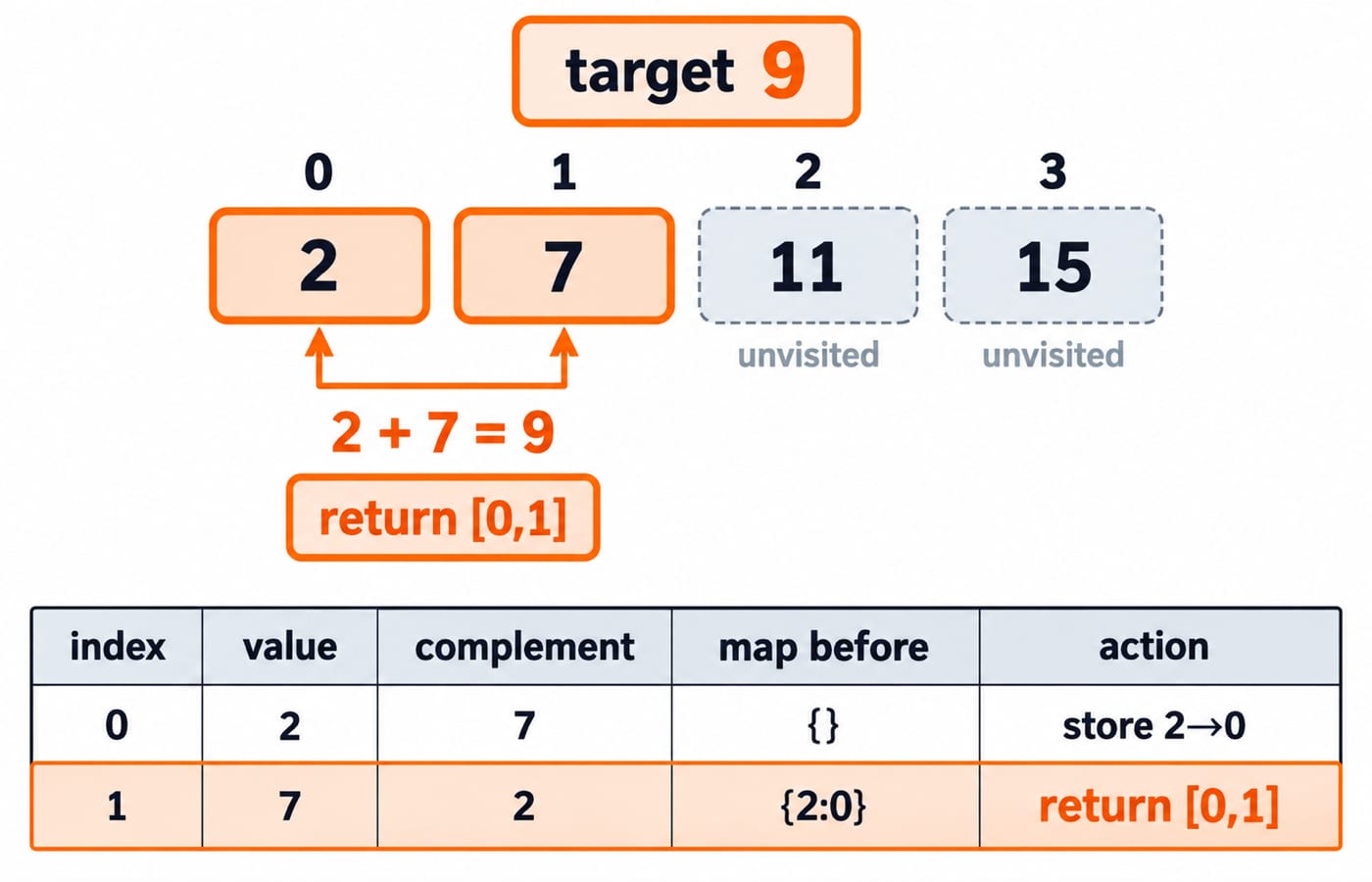
Lookup before insertion prevents reusing the same index. Expected time is O(n), assuming average constant-time hash operations; extra space is O(n).
Test duplicates ([3, 3], target 6 → [0, 1]), a single element ([3], target 6 → []) and negatives ([-2, 11], target 9 → [0, 1]).
Say: “I trade a map for faster lookup, check the complement before inserting, and test duplicates and no-solution inputs.” Continue with DSA interview questions for placements: the patterns freshers must know.
SQL question: keep accounts that have no orders
Prompt: Return every account and its total order amount, including accounts without orders.
Use these sample records:
accounts(id, name):(1, 'Asha'), (2, 'Bilal'), (3, 'Charu')orders(id, account_id, amount):(101, 1, 500), (102, 1, 700), (103, 2, 300)
This is plain SQL, not SOQL:
SELECT a.id, a.name,
       COALESCE(SUM(o.amount), 0) AS total_amount
FROM accounts a
LEFT JOIN orders o ON o.account_id = a.id
GROUP BY a.id, a.name
ORDER BY a.id;
id | name | total_amount |
|---|---|---|
1 | Asha | 1200 |
2 | Bilal | 300 |
3 | Charu | 0 |
Asha's total is 500 + 700 = 1200; Bilal has 300. LEFT JOIN preserves Charu even without a matching order. Her aggregate is NULL, which COALESCE converts to zero.
Follow-up: How many orders does each account have? COUNT(o.id) gives 2, 1, 0. COUNT(*) gives 2, 1, 1 because Charu still has a joined row. Count the matching order identifier, not every output row.
Project and OOP questions: defend a decision with evidence
Why use an interface for notifications?
“Define Notifier.send(message) and inject EmailNotifier or SmsNotifier into the booking service. A fake notifier records calls during tests. The service depends on a contract, so delivery implementation can change without changing booking logic.”
That is a concrete benefit; abstraction does not automatically improve every design.
Two users try to book the last seat. What happens?
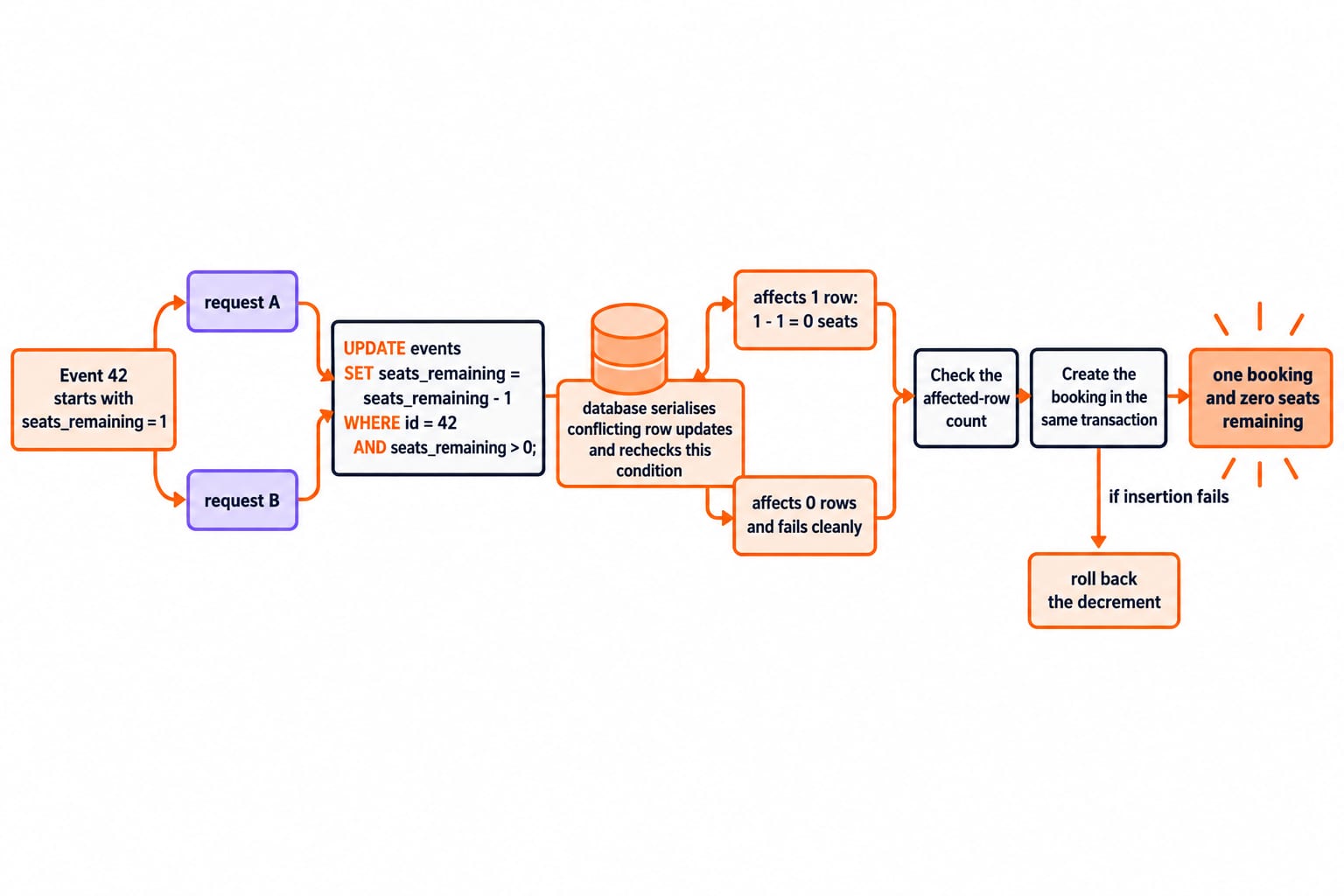
Event 42 starts with seats_remaining = 1:
UPDATE events
SET seats_remaining = seats_remaining - 1
WHERE id = 42 AND seats_remaining > 0;
In a database that serialises conflicting row updates and rechecks this condition, request A affects 1 row: 1 - 1 = 0 seats. Request B affects 0 rows and fails cleanly. Check the affected-row count. Create the booking in the same transaction; roll back the decrement if insertion fails.
Explain: “A separate read of 1 followed by an unconditional write can oversell. I would test two concurrent requests and verify one booking and zero seats remaining.” Separate what you implemented from a proposed improvement.
HR questions: give specific, truthful model answers
Tell me about yourself. A model answer:
“I am a final-year CS student interested in backend engineering. In a three-person booking project, I owned the reservation endpoint and the tests for concurrent requests. I am looking for a role where I can improve reliable service design and learn through code review.”
Give relevance and evidence, not your entire biography.
Why Salesforce and this role?
“I want to work on software used in customer-facing workflows. If this role involves backend services, my reservation project gives me a relevant starting point in data integrity, and I want to deepen that skill with experienced engineers.”
Replace the conditional with a verified responsibility from your actual job description.
Tell me about a disagreement or failure. A STAR model answer:
Situation: Three teammates disagreed about caching a timetable API.
Task: I needed to help us decide using evidence.
Action: I proposed comparing 20 repeated requests before and after caching on the same local setup.
Result: Median response time fell from 180 ms to 90 ms. The reduction was
(180 - 90) / 180 * 100 = 90 / 180 * 100 = 50%. One stale-data case showed we needed invalidation when the timetable changed.
The lesson is measurement plus correctness, not winning an argument. Substitute real evidence; never borrow these metrics as personal achievements. Practise with HR interview questions for freshers: how to answer the standard ones honestly.
Answer traps that weaken an otherwise correct response
Silence during coding hides assumptions and trade-offs. Say, “I will first confirm the output, then explain the baseline, optimise and test.” For two-sum, that means confirming indices, describing pair checks and explaining why lookup comes before insertion.
Memorised SQL labels conceal errors. An INNER JOIN removes Charu; COUNT(*) gives her an incorrect order count of 1. Predict all three output rows before explaining the query.
Inflated ownership and rehearsed HR metrics collapse under follow-ups. State your personal contribution, one limitation and a real lesson. If a teammate wrote the concurrency test, explain your contribution accurately.
Finally, use the job description to distinguish general software engineering preparation from Apex-specific preparation. Neither track fits every role merely because Salesforce appears in its name.
The short version and your next practice session
Set yourself a 30-minute rehearsal:
Spend 12 minutes solving and narrating two-sum.
Spend 8 minutes deriving the SQL output, including Charu.
Spend 10 minutes rehearsing one project defence and one truthful STAR answer.
That is 12 + 8 + 10 = 30 minutes of your own practice. Aim to explain why each choice works, then test an edge case without looking at the model.
For structured general interview preparation, explore the Interview & Resume Preparation Course. Record the rehearsal and identify one unclear explanation to redo.
Keep learning
Tech Mahindra Interview Questions: Technical, Coding and HR Model Answers
Practise realistic Tech Mahindra interview question shapes across CS fundamentals, coding, SQL, projects and HR. Each model answer shows the evidence and follow-ups you should be ready to explain.
Updated 5 Nov 20265 min readCompany-Specific Prep
Capgemini Interview Questions: Technical and HR Rounds with Model Answers
Practise clear technical and HR answers through Java, SQL, a coding trace and one consistent project story. Each example shows what to say and how to support it.
Updated 25 Sep 20265 min read74 viewsCompany-Specific Prep
Cognizant Interview Questions: Technical and HR Model Answers
Prepare clear technical and HR responses through worked programming, SQL, project and STAR examples, then test them in a timed self-review mock.
Updated 22 Sep 20266 min readCompany-Specific Prep
TCS Interview Questions: Technical and HR Model Answers for Freshers
Prepare for technical follow-ups and HR evidence checks with worked SQL, coding, project, introduction and behavioural practice fixtures.
Updated 8 Sep 20266 min read103 viewsCompany-Specific Prep