TCS NQT Interview Process: Test, Shortlisting, Technical and HR Round Prep
Understand what the NQT score does, what your interview invite controls, and how to rehearse evidence for each round without assuming a fixed process.
KnowledgeGate Team
Exam prep & CS education
Updated 31 Jul 20266 min read
You have taken or cleared an NQT assessment, but an interview is not automatically waiting next. You still need to know whether a company has shortlisted you, which rounds the invite names, and what evidence each conversation seeks. The score and the interview are separate gates: TCS iON runs the test, and every company that accepts the score runs its own filtering and its own rounds. Your job notice and interview invite are the authority on the shortlist, round names, order, mode and documents.
TCS NQT interview process starts with the NQT-versus-hiring distinction
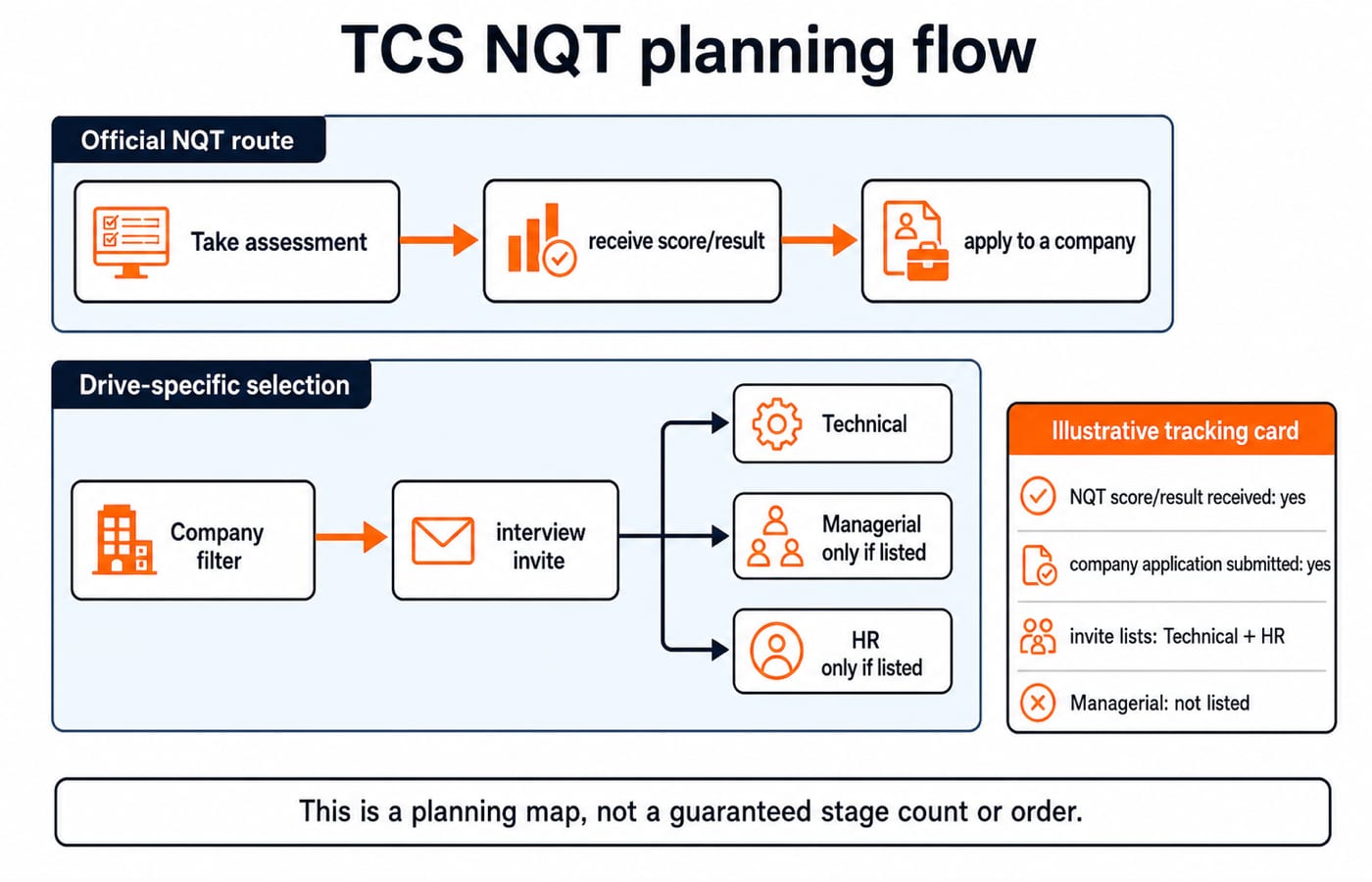
TCS iON NQT is an assessment that produces a section-wise scorecard. The TCS iON NQT official portal lays the route out in five steps: appear for the test, receive your score, apply to jobs on the iON job board, apply on individual corporates' own sites as well, and get hired on the basis of that score and your suitability for the role. Applying to companies is a separate step you have to take, and each company sets its own eligibility, filtering and selection criteria. So the planning flow is:
Take the relevant assessment -> receive the score/result -> apply through the route in the job notice -> wait for company shortlisting -> attend only the rounds in the invite
Scoring well in NQT does not by itself produce a TCS interview or an offer; it produces a credential a company can filter on. Because the scorecard reports every section separately and the test can be taken again to improve a score, one weak section is a repair job rather than a closed door. Work that section with TCS NQT & TCS Exams Preparation, and read the current scorecard validity window and passing-year eligibility on the portal itself, since those change by cycle.
TCS NQT test tracks and shortlisting: what each track proves
Before you plan a single round, copy these eight fields out of your notice or invite: role and hiring route, stated eligibility, application status, shortlist channel, interview mode or venue, exact round names, reporting details, and requested documents. Someone else's placement post describes a different drive; those eight lines describe yours.
NQT track | What the portal says it proves | What to build before an invite |
|---|---|---|
Cognitive | Numerical, reasoning and verbal ability | Timed arithmetic, reasoning patterns, reading speed |
IT | Advanced coding plus basic and advanced aptitude, with a psychometric section | One language you can debug under pressure, on top of the cognitive core |
Non Tech | General quantitative, verbal and mental ability | The cognitive core, plus the vocabulary of the role you are applying to |
BFSI | Financial markets and services knowledge with basic aptitude | A banking-awareness reading habit alongside aptitude practice |
Your track decides which employers can see you, and therefore which invites are even possible: an IT-track score reaches software roles that a cognitive-only score does not. For the assessment itself, section by section, read TCS NQT Exam Structure, Explained Section by Section before you book a slot.
TCS technical round prep: make resume claims demonstrable
Build evidence in four buckets: one usable programming language; OS, DBMS, CN and OOP; one or two projects you own end to end; and step-by-step problem solving. Any resume claim may be probed, so unsupported breadth is risky.
Rehearse one measurable change end to end. Take a slow query on a library-loan API of 10,000 rows, timed on one fixed test setup: 1.2 seconds = 1,200 ms. Add a composite index on (student_id, due_date) and it returns in 180 ms. The reduction is 1,200 - 180 = 1,020 ms, which is 1,020 / 1,200 x 100 = 85%, and all 14/14 integration tests still pass.
That answer carries a problem, a measurement, a change and a result, and it admits the cost: every write to the table now maintains an extra index, and the index takes disk space. Be ready for the follow-up on column order too. (student_id, due_date) serves a lookup of one student's loans inside a date range because the leading column is matched for equality first and the second column is already in order within it; (due_date, student_id) cannot serve the same query that way, because the student filter would only apply after scanning the date range. Use Technical Interview: OS, DBMS, CN & OOP Prep for focused core-CS revision.
TCS managerial round, when listed: show judgement and ownership
A managerial conversation probes six things: how you prioritise, how you handle conflict, how you talk about failure, what you learned from it, how you act under ambiguity, and where you took responsibility. Not every NQT-linked drive lists a managerial round, so read your invite before you spend a day building one.
Build one STAR story around a real deadline. A four-person team has 48 hours until a demo. Its 37-test suite has 9 failures: 5 authentication plus 4 validation, so 5 + 4 = 9 and 37 - 9 = 28 tests pass at the start. You freeze new features, put two people on each cluster, and review after 6 hours. The suite reaches 37/37 by hour 41, leaving 48 - 41 = 7 hours of buffer. The decision protects the demo and defers two low-priority enhancements. Name your own contribution, your own decision and the lesson, not just the team result.
TCS HR round prep: keep every answer honest and consistent
Prepare six answer families: introduction, role and company fit, proven strengths, weakness plus repair habit, constraints, and interviewer questions. Avoid memorised claims about culture, salary, posting or timelines.
Read this model introduction for its structure, then rebuild it from your own project:
I am a final-year computer science student who enjoys backend problem solving. In my library API project, I indexed a 10,000-row loans table and reduced one slow query from 1.2 seconds to 180 milliseconds while keeping 14 integration tests passing. That work strengthened my SQL, debugging and communication because I had to explain the change to three teammates. I am looking for an entry-level software role where I can keep learning and contribute to reliable systems.
In under eighty words it lands four things: identity, one measured proof, teamwork, and the role being asked for. Practise the remaining families with HR Interview Questions for Freshers & Answers, and keep every answer consistent with your resume, your application form and your technical round.
A 14-hour TCS interview rehearsal plan after the invite
Day | Time | Work |
|---|---|---|
1 | 2 hours | Read the invite and audit every resume line |
2 | 2 hours | Retrieve OS, DBMS, CN and OOP concepts |
3 | 2.5 hours | Explain projects and complete one coding drill |
4 | 2 hours | Take a technical mock and correct errors |
5 | 1.5 hours | Build two managerial stories |
6 | 1.5 hours | Rehearse HR answers and check documents |
7 | 2.5 hours | Run one full rehearsal and final error review |
Check: 2 + 2 + 2.5 + 2 + 1.5 + 1.5 + 2.5 = 14 hours.
Finish with two project explanations under 3 minutes, one 45-minute technical mock, two STAR stories, six HR cards and an invite-matched document checklist. If Day 4 is lost, move a 60-minute technical mock into Day 7, remove 60 minutes of new questions, and preserve correction time. Do not create an exhausted four-hour catch-up day.
TCS interview-day checklist: carry evidence, not extra claims
For an online round, test the invite link, device, browser, camera, microphone, power and backup connectivity early. Keep the submitted resume and application saved locally. In person, carry only the identity, academic or employment documents the invite names, in the originals-and-copies form it asks for, plus spare resumes.
Prepare a one-page rehearsal pack with 3 project or coursework proofs, 2 ownership or failure stories, 1 honest weakness-and-repair example, and 5 questions to ask if time permits. Follow three stop rules: do not guess a resume technology, do not invent a team result, and do not argue with the stated process. When you do not know, say what you do know, name the gap, and reason from first principles.
The short version: follow the invite, then prepare proof
Separate the NQT score from company shortlisting. Read the current notice and invite, build technical evidence you can measure, add managerial stories only when a managerial round is named, keep HR answers consistent with your paperwork, and rehearse examples that carry numbers. The TCS Preparation Live Course combines assessment practice, coding, and technical, managerial and HR interview work with mock interviews. If your invite exposes only one weak area, use the relevant guide above instead of treating the whole course as mandatory.
Keep learning
Accenture Coding Questions: 4 Patterns with Solved Dry Runs
Stop memorising company-question lists. Learn four reusable coding patterns through precise examples involving strings, arrays, digits, and matrices.
Updated 2 Oct 20265 min readCompany-Specific Prep
Accenture Placement Preparation: 4-Week, 56-Hour Study Plan
Turn four preparation lanes into a practical weekly calendar. Start with a baseline, move hours towards your errors, and recover missed sessions without cramming.
Updated 27 Sep 20265 min readCompany-Specific Prep
Capgemini Interview Questions: Technical and HR Rounds with Model Answers
Practise clear technical and HR answers through Java, SQL, a coding trace and one consistent project story. Each example shows what to say and how to support it.
Updated 25 Sep 20265 min readCompany-Specific Prep
Capgemini Drive Mistakes: Stage-by-Stage Rejection Risks and Fixes
Diagnose the controllable evidence gaps behind common Capgemini drive risks. Repair your CV, timed practice, code traces, project proof and behavioural stories with worked drills.
Updated 24 Sep 20266 min readCompany-Specific Prep