TCS NQT Interview Preparation: Lessons from Candidate Reports
Use six candidate reports as preparation signals: defend every resume claim, build one project story, revise core fundamentals and rehearse uncertainty honestly.
KnowledgeGate Team
Exam prep & CS education
Updated 20 Aug 20266 min read
Search for TCS NQT interview experiences and you meet a contradiction. Resume, project, technical and HR themes recur, but the reported panel arrangement, depth and order change. Six dated reports are enough to tell you what to prepare and not enough to tell you what you will be asked, so drill the themes that recur and let your own TCS invitation and portal instructions settle the process details. Wider placement drills sit in KnowledgeGate's Placement Preparation courses.
Read interview experiences as signals, not a leaked question paper
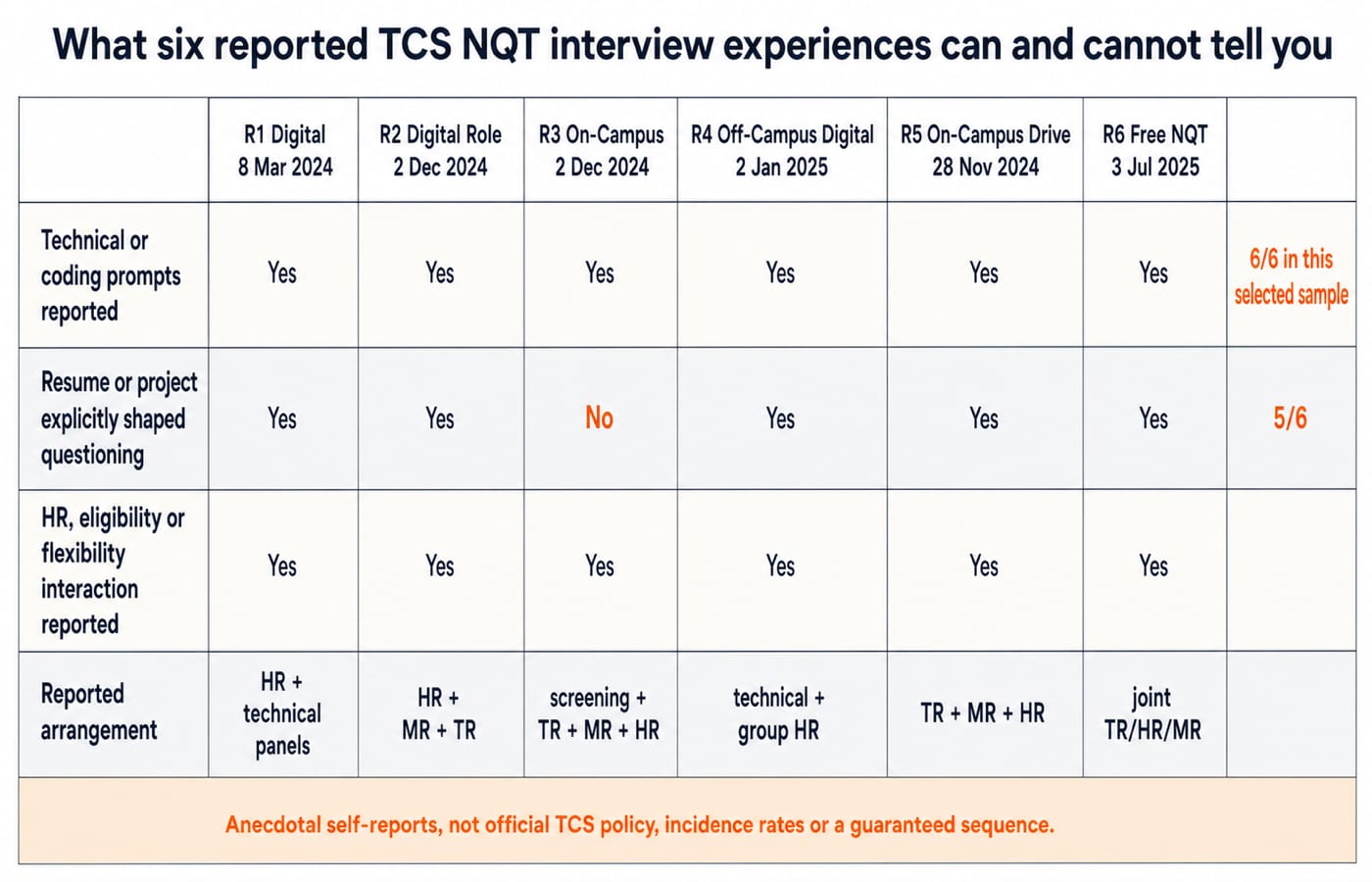
The six are candidate self-reports published on GeeksforGeeks: Digital, updated 8 March 2024; Digital Role and On-Campus, both updated 2 December 2024; Off-Campus Digital, updated 2 January 2025; On-Campus Drive, updated 28 November 2024; and Free NQT Off-Campus, updated 3 July 2025.
Across those six, all six candidates reported technical or coding prompts, five explicitly reported resume-led or project-led questioning, and all six reported an HR, eligibility or flexibility interaction. Arrangements varied: two panels, three named functions, a joint panel or a group HR check, so the tidy Technical, Managerial and HR trio is a label for the functions that keep appearing rather than a fixed running order. Six self-reports cannot tell you how common any of this is, which is the reason to prepare the recurring themes and stay loose about the shape.
Treat every resume line as a route into follow-up questions
Resume-led questioning is actionable because you control the claims. Reports mention JavaScript and React, a Flutter project, team responsibilities, internships, Linux, databases and hobbies. Instead of adding keywords, remove any claim you cannot explain, demonstrate and defend two levels deep.
Audit each line as claim, proof, follow-up:
Java: one program you can write without an IDE; JDK vs JRE vs JVM, then
StringvsStringBuilder.DBMS: a schema you designed; primary vs unique key, then normalisation.
React: one component and its state flow; one hook, then virtual DOM.
Team project: your own commit or module; your role, then one failure you fixed.
Four claims with two follow-ups each create 4 x 2 = 8 answer cards. If only five answers are clean, readiness is 5/8; repair the remaining 8 - 5 = 3 cards or remove the unsupported claims.
Build one project story that survives a five-minute drill-down
Here is the shape of a story that holds up under a drill-down. A three-person team built a campus interview-slot booking API. You owned its Node.js endpoint and PostgreSQL schema. A concurrency test sent 50 repeat requests and created 7 duplicates. You added a transaction and a unique constraint on (student_id, slot_id). The retest stored 1 booking and returned 49 handled conflicts, so 1 + 49 = 50 requests are accounted for.
Tell it in this order: 20 seconds for the user problem and scope, 40 for architecture, 60 for personal ownership, 60 for the failure, 60 for the transaction and constraint, 40 for the measured retest, and 20 for the next improvement. Total: 20 + 40 + 60 + 60 + 60 + 40 + 20 = 300 seconds = 5 minutes.
A disabled button cannot stop concurrent or retried server requests. The composite constraint enforces one booking per student per slot at the database boundary. Here, a duplicate receives 409 Conflict. Your work was the schema, endpoint, test and fix, not the whole project.
Revise a compact technical spine, then practise output on paper
Build a compact spine, not a guessed syllabus: one language, OOP, DBMS and SQL, OS, your project stack, DSA, and short code or query writing. Reported prompts include TCP vs UDP, Linux, SQL joins, normalisation, JavaScript, hashing and prime-number code. Use Technical Interview: OS, DBMS, CN and OOP Prep for revision.
Suppose the schema is Employee(emp_id INT PRIMARY KEY, email VARCHAR(100) UNIQUE, name VARCHAR(50)). To change employee 17 from Ravi to Asha:
UPDATE Employee SET name = 'Asha' WHERE emp_id = 17;emp_id identifies the row. email is unique but is not the primary identifier. Without WHERE, every row changes. Expect 1 affected row. For 0, check the identifier and transaction; for more than 1, roll back and inspect the schema and query.
Run 6 closed-book prompts on language, OOP, DBMS or SQL, OS, DSA and project stack for 6 x 8 = 48 minutes. Review each for four minutes: 6 x 4 = 24. Total: 48 + 24 = 72 minutes. Keep guessed answers in the repair queue.
Rehearse HR and managerial answers without inventing flexibility
Reported prompts cluster around introductions, projects or teamwork, interest in TCS or a role, and relocation, shifts or another role. Prepare structure without inventing constraints.
Candidate A can relocate anywhere after 15 days and should say so. Candidate B can relocate only to Bengaluru, Hyderabad or Pune and needs 30 days; that answer should state those limits calmly. Both are fine to say out loud. The answer that costs you later is an invented “anywhere, immediately” you cannot honour.
For “Tell me about yourself”, use 20 seconds for education, 30 for one project contribution, 20 for a technical strength with evidence, and 20 for fit: 20 + 30 + 20 + 20 = 90 seconds. For an unknown technical question, state what you know, name the uncertainty and do not bluff. Exclude package figures, service-agreement terms and current policy claims from anecdotes.
Use a 14-day, 24-hour plan that preserves recovery time
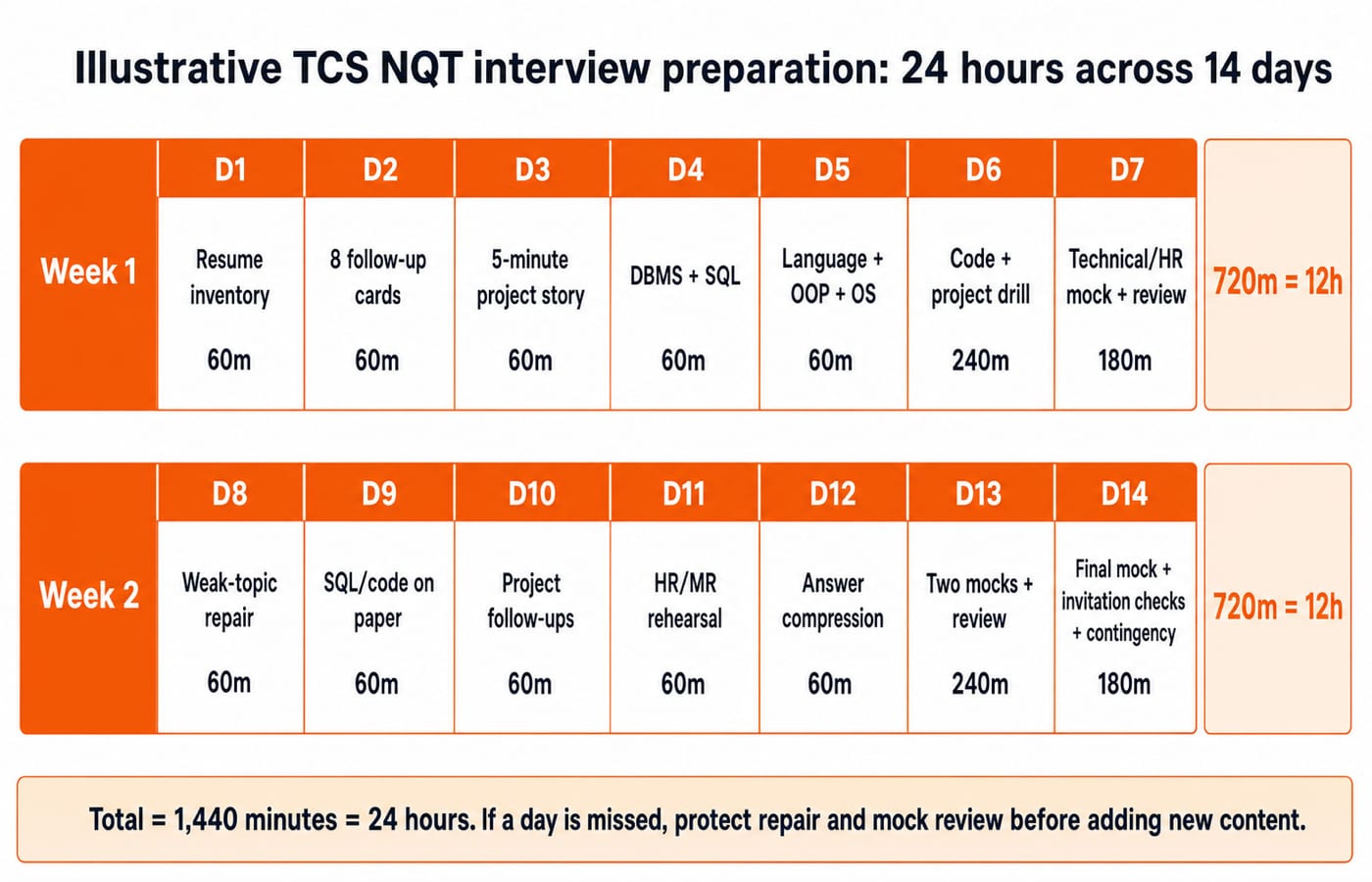
Build two 12-hour weeks. Monday to Friday take 60 minutes each, Saturday 240, and Sunday 180: (5 x 60) + 240 + 180 = 300 + 240 + 180 = 720 minutes = 12 hours. Twice gives 2 x 720 = 1,440 minutes = 24 hours.
Week 1: resume inventory; follow-up cards; project walkthrough; DBMS and SQL; language, OOP and OS; coding plus project drill; technical and HR mock with review. Use
60, 60, 60, 60, 60, 240, 180minutes.Week 2: weak-topic repair; SQL and code; project follow-ups; HR rehearsal; answer compression; two mocks with review; final mock, invitation checks and contingency. Repeat those minutes.
Miss a 60-minute weekday? Recover 30 minutes from Day 14's contingency and defer 30 minutes of new questions, instead of forcing 120 into tomorrow. Miss Saturday? Carry the project drill and mock forward, reduce new coverage, and extend if the interview date allows.
For written-round work, use TCS NQT Preparation: Sections and Study Plan. The TCS NQT live preparation course covers the same ground on a fixed schedule if you would rather not build one yourself.
Mock the uncertainty, then take the next 60-minute action
Run one 25-minute mock: introduction 2, project 6, fundamentals 6, code or SQL 5, HR 4, candidate question 2. Check: 2 + 6 + 6 + 5 + 4 + 2 = 25. Score accuracy, ownership, reasoning, concision and honesty 0 to 4 each, for 5 x 4 = 20.
Mock 1 scores 3 + 2 + 2 + 3 + 4 = 14/20; repair ownership and reasoning. After naming personal work and the duplicate test, Mock 2 scores 3 + 4 + 3 + 3 + 4 = 17/20. The 17 - 14 = 3 gain came from naming your own work precisely, which is the part of an interview you actually control.
Next 60 minutes: 15 repair resume claims, 20 outline the project, 15 answer one SQL and one OOP prompt without notes, 10 record two honest HR constraints. Check: 15 + 20 + 15 + 10 = 60. For structured review and mocks, use the Interview and Resume Preparation Course, or the TCS course above.
Keep learning
Accenture Coding Questions: 4 Patterns with Solved Dry Runs
Stop memorising company-question lists. Learn four reusable coding patterns through precise examples involving strings, arrays, digits, and matrices.
Updated 2 Oct 20265 min readCompany-Specific Prep
Accenture Placement Preparation: 4-Week, 56-Hour Study Plan
Turn four preparation lanes into a practical weekly calendar. Start with a baseline, move hours towards your errors, and recover missed sessions without cramming.
Updated 27 Sep 20265 min readCompany-Specific Prep
Capgemini Interview Questions: Technical and HR Rounds with Model Answers
Practise clear technical and HR answers through Java, SQL, a coding trace and one consistent project story. Each example shows what to say and how to support it.
Updated 25 Sep 20265 min readCompany-Specific Prep
Capgemini Drive Mistakes: Stage-by-Stage Rejection Risks and Fixes
Diagnose the controllable evidence gaps behind common Capgemini drive risks. Repair your CV, timed practice, code traces, project proof and behavioural stories with worked drills.
Updated 24 Sep 20266 min readCompany-Specific Prep