Accenture Interview Process: What Each Stage Tests, from Cognitive Assessment to Final Interview
Build a stage-by-stage preparation map for an Accenture drive, with worked drills for cognitive accuracy, coding, communication, projects and role fit.
KnowledgeGate Team
Exam prep & CS education
Updated 16 Aug 20266 min read52 views
Accenture recruits freshers through a wide funnel: a cognitive assessment, a technical assessment, a coding assessment, a separate communication assessment, and then the interviews. Our Accenture Superset course carries a block for each of them. What each stage tests, though, is a different question from what it is named, and the answer is what should decide your rehearsal. Read your own role notice and candidate portal first: they carry the sequence, timing and rules that actually apply to your drive.
Related reading: Accenture assessment preparation and Accenture drive mistakes.
Start with the drive you actually received, not a universal flowchart
Record five fields before practising, using the invite's exact words.
Field | Example entry |
|---|---|
Exact role | Associate Software Engineer |
Drive name | Campus hiring drive |
Named stages | Online assessment, communication assessment, interview |
Assessment window | 10:00 to 13:00 |
Official channel | Campus placement cell plus candidate portal |
Those values are one candidate's, not a template. If your invite names three stages, follow it even when an article shows four. Marks, cutoffs, question counts, durations and eligibility move between drives and cycles, so take them from the notice you were sent rather than from any article.
Our company-specific placement preparation category groups the practice sets by recruiter, so you can work Accenture's fronts without drifting into another company's pattern.
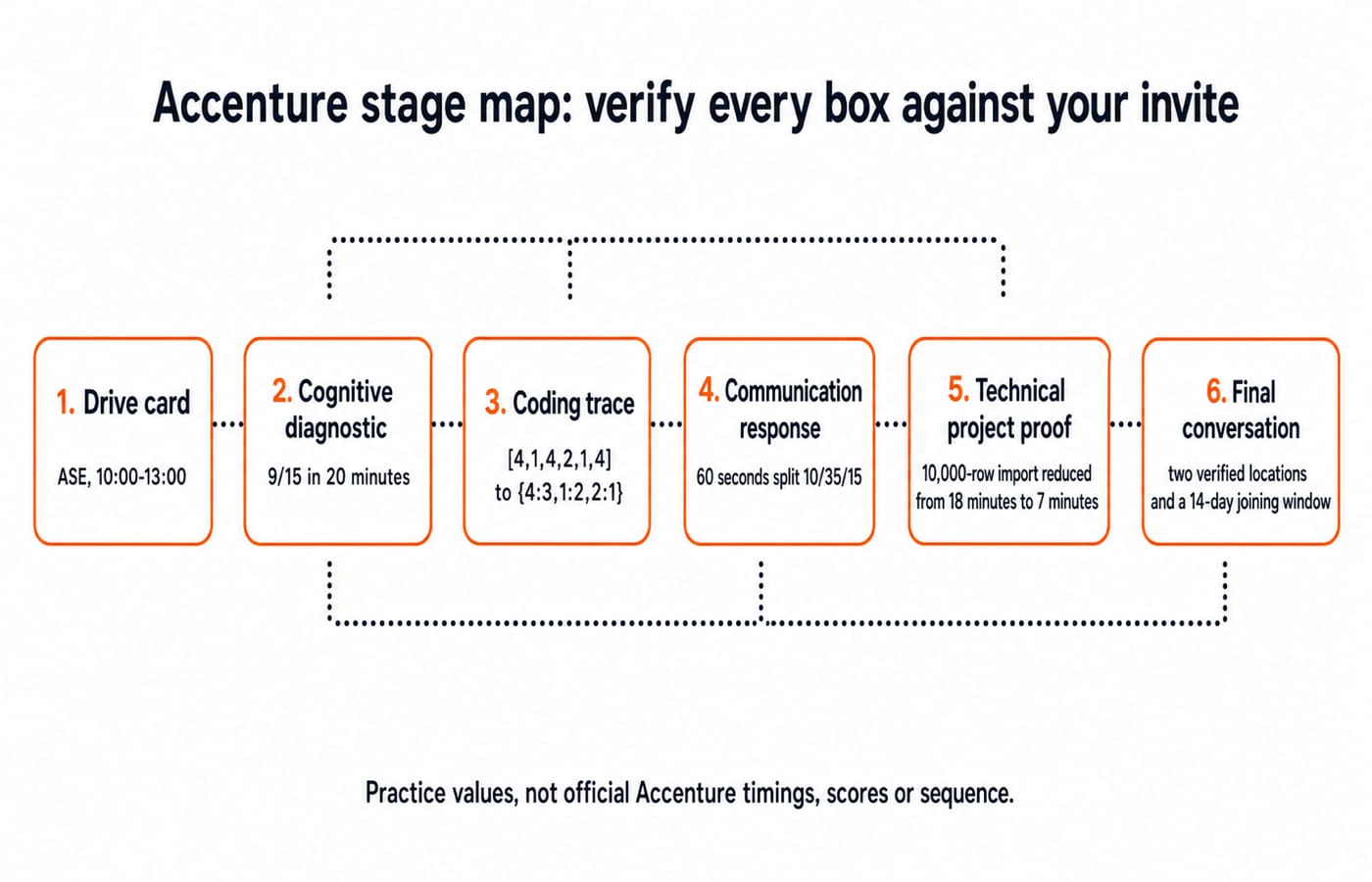
Accenture preparation map: one chain from assessment to interview
The Accenture Superset complete preparation course is built in blocks that mirror those fronts: cognitive, technical, coding and communication, with a separate managerial and HR interview module at the end. That last block is where everything you practised has to be spoken aloud and defended, and it is the one candidates rehearse least.
The evidence chain runs like this:
drive check -> cognitive evidence -> technical and coding evidence -> communication evidence -> technical or final conversation -> official outcome
Notice what changes along that chain. The early stages accept a chosen option as the whole answer. From the coding assessment onward, nothing counts unless you can also run it, say it out loud, and point at where it came from in your own work.
Cognitive assessment: measure accuracy, time and error type together
Accenture's cognitive assessment scores verbal ability, critical reasoning and problem solving, and abstract reasoning as separate fronts, so a diagnostic that reports one combined percentage tells you nothing you can act on. Build a 15-question set, 5 from each family, and time each block separately. Say a candidate scores 4/5, 3/5 and 2/5 in 5, 8 and 7 minutes.
Correct answers:
4 + 3 + 2 = 9, so overall accuracy is9 / 15 x 100 = 60%.Total time:
5 + 8 + 7 = 20 minutes.Average time:
20 x 60 / 15 = 80 seconds per question.Abstract reasoning is weakest at
2 / 5 x 100 = 40%.Critical reasoning also needs a speed review:
8 x 60 / 5 = 96 seconds per question.
A practice percentage is a training signal, not a selection forecast, so spend the reading on the error types rather than the total. Re-solve the six misses untimed, label each one a concept gap, a misreading or a time-pressure slip, then attempt five fresh questions in the weakest family. For the section-by-section breakdown of what each assessment covers and a six-week routine to get through it, our Accenture placement preparation 2026 rounds and study plan is the fuller treatment.
Technical assessment and coding: make every answer traceable
For input [4, 1, 4, 2, 1, 4], build {4: 3, 1: 2, 2: 1}. After each item, the map is:
{4:1} -> {4:1,1:1} -> {4:2,1:1} -> {4:2,1:1,2:1} -> {4:2,1:2,2:1} -> {4:3,1:2,2:1}
One pass costs O(n) time and O(k) space for k distinct values. Sorting the keys adds O(k log k) time. Guaranteed integers from 0 to 100 allow an array of 101 counters.
Choose the structure from the stated constraints, not from a memorised template, and say the reason aloud as you choose. That reasoning is what the technical stages are actually measuring. Accenture also keeps a separate MCQ-based technical assessment, where you read pseudo code and predict its output rather than write anything, so practise tracing on paper as well as coding on a keyboard.
Communication assessment: organise a truthful response under a clock
Accenture runs communication as its own scored stage rather than folding it into an interview, which is why candidates who never rehearse aloud get caught here. Rehearse against a 60-second clock: 10 seconds for the situation, 35 for the action and 15 for the result, so 10 + 35 + 15 = 60 seconds.
Prompt: "Explain how you handled a delayed college project demo." Test data failed 2 days before it. The candidate made 1 clean mock dataset, reran 2 critical tests and sent the guide 1 update. The team demonstrated later without hiding the blocker.
Check three things on playback: the content answers the prompt, the delivery stays short and steady, and the audio is clean. Invent neither metrics nor leadership. An interviewer's follow-up can change how long you speak, never what is true.
Technical interview: turn resume claims into defensible evidence
The technical interview tests whether a resume line survives questioning, so work this pattern on your own project rather than on this one. A 10,000-row CSV import takes 18 minutes. Moving validation outside the insert loop and batching 500 rows brings it to 7.
The reduction is 18 - 7 = 11 minutes, or 11 / 18 x 100 = 61.1%. Larger batches cut database trips but use more memory and enlarge retries.
Expect four follow-ups on a claim like that: how was the time measured, why 500 and not 5,000, what happens if row 6,501's batch fails, and which part did you write yourself. Our technical interview preparation guide for OS, DBMS, CN and OOP covers the ground that conversation moves onto, and the Interview and Resume Preparation Course drills the resume and mock-interview side.
Final interview: make role fit specific without overpromising
Prepare five fields: role reason, collaboration example, locations, joining window and interviewer question. Example: "I can relocate to Bengaluru or Hyderabad and join 14 days after written confirmation." Check both halves of that sentence before you say it. Never offer "anywhere, immediately" unless both are actually true.
In a 4-person capstone, 3 tasks remain with 5 days left. The candidate owns API integration, pairs on testing and holds a 15-minute daily check. All tasks close before the demo. State your contribution and lesson, not the team's entire work.
Accenture's interview end usually carries both a technical conversation and a managerial or HR one, which is why the Superset course keeps a separate module for that second conversation. Some drives still fold everything into a single sitting, so when the invite names only interview, prepare technical depth, project evidence, communication and role fit for the same hour.
Accenture interview process in the short version
Rehearse for 90 minutes: 25 for cognition, 25 for coding, 15 for two recordings and 25 for project and role-fit questions, so 25 + 25 + 15 + 25 = 90 minutes.
Score correctness, time control, explanation, evidence and honesty from 0 to 2 each, so the maximum is 5 x 2 = 10. Repeat the weakest station whenever the total sits below 7, or whenever any single dimension scores 0.
Copy your drive's exact stage names onto the map before you rehearse anything. Work the Accenture Superset course if the assessments are still ahead of you, and the Interview and Resume Preparation course once you have an interview date. Whatever any article says, the role notice and candidate portal you were sent are the versions that count.
Keep learning
Accenture Coding Questions: 4 Patterns with Solved Dry Runs
Stop memorising company-question lists. Learn four reusable coding patterns through precise examples involving strings, arrays, digits, and matrices.
Updated 2 Oct 20265 min readCompany-Specific Prep
Accenture Placement Preparation: 4-Week, 56-Hour Study Plan
Turn four preparation lanes into a practical weekly calendar. Start with a baseline, move hours towards your errors, and recover missed sessions without cramming.
Updated 27 Sep 20265 min readCompany-Specific Prep
Capgemini Interview Questions: Technical and HR Rounds with Model Answers
Practise clear technical and HR answers through Java, SQL, a coding trace and one consistent project story. Each example shows what to say and how to support it.
Updated 25 Sep 20265 min readCompany-Specific Prep
Capgemini Drive Mistakes: Stage-by-Stage Rejection Risks and Fixes
Diagnose the controllable evidence gaps behind common Capgemini drive risks. Repair your CV, timed practice, code traces, project proof and behavioural stories with worked drills.
Updated 24 Sep 20266 min readCompany-Specific Prep