Infosys Interview Process: What to Prepare at Each Stage
Use your current Infosys communication to map the route, then prepare timed practice, defensible project evidence and consistent interview answers.
KnowledgeGate Team
Exam prep & CS education
Updated 5 Aug 20266 min read
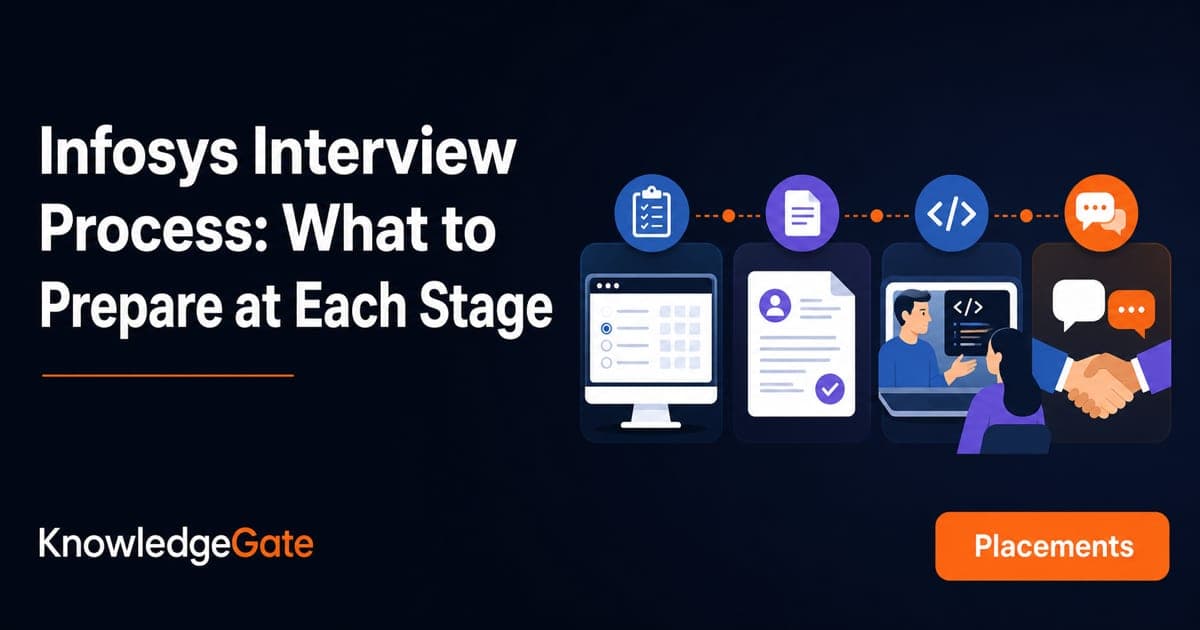
Infosys hires freshers on three tracks: Systems Engineer, Digital Specialist Engineer and Specialist Programmer. The track named in your invitation decides what you practise, and the same message fixes your assessment window, your stated sections and your interview mode. Three capacities carry you through all of it: timed problem solving, project evidence you can defend under questioning, and answers that stay consistent with your resume.
Infosys hiring routes: Systems Engineer, DSE and Specialist Programmer
Systems Engineer is the high-volume fresher role. Digital Specialist Engineer and Specialist Programmer sit above it, are far more programming-heavy, and are reached either on their own application or through an upgrade test taken after an SE offer. An SE candidate who wants that upgrade is therefore preparing two things at once: the aptitude test in front of them, and the coding depth the upgrade test asks for later. Campus hiring runs through the Superset platform, so the role name, the assessment link and the window normally arrive there or by email.
The SE written test spans seven sections: quantitative aptitude, logical reasoning, verbal ability, pseudo code, puzzle solving, English grammar and English writing. Sectional timing applies, so minutes you leave unused in one section cannot rescue another. The Infosys Superset Preparation Course covers all seven, with previous-year sets and full-length mocks in each. Section-wise question counts, marks and cutoffs move from cycle to cycle, so read those off your own invitation and the careers pages on infosys.com, never off a forum thread.
Build the process map from your invitation
Make a one-page source card. Copy these fields from the communication you received:
role or programme name and application ID
assessment platform, scheduled window and stated sections
system-check requirements and permitted materials
interview mode and documents requested
response deadline and official contact channel
If a field is absent, write not stated, and treat that gap as a question for the official contact channel rather than something to fill in from memory. The source card is what you check every later instruction against.
Online assessment: diagnose accuracy section by section
Sit one full-length mock before you revise anything, and read the result as a diagnosis rather than a mark. Pseudo code is the section freshers most often underestimate, because it rewards hand-tracing rather than recall; Infosys pseudocode questions works through that tracing line by line.
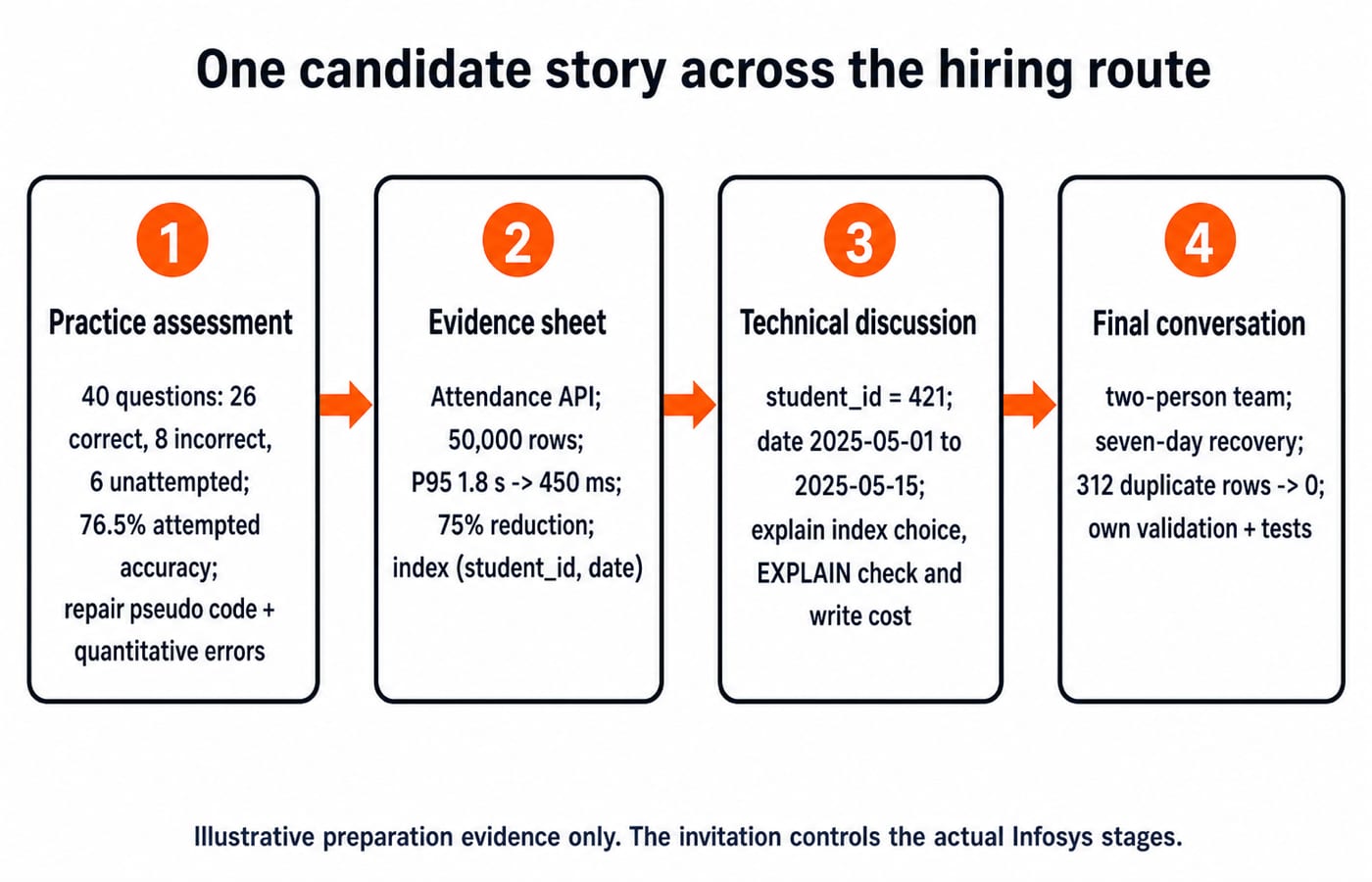
One student's 40-question practice mock, built from the four heaviest sections, came back like this:
Practice lane | Correct | Incorrect | Unattempted |
|---|---|---|---|
Quantitative aptitude | 7 | 3 | 2 |
Logical reasoning | 8 | 1 | 1 |
Verbal ability | 6 | 1 | 1 |
Pseudo code | 5 | 3 | 2 |
Total | 26 | 8 | 6 |
Attempted questions = 26 + 8 = 34. Attempted-question accuracy = 26 ÷ 34 × 100 = 76.5%. Completion = 34 ÷ 40 × 100 = 85%.
Two numbers matter more than the raw score. Accuracy of 76.5% on attempted questions says the errors are concentrated rather than spread, and completion of 85% says the clock is not yet the main problem. Six of the eight wrong answers sit in pseudo code and quantitative, so repair those first: 50 minutes re-solving the eight errors, 25 minutes labelling each miss as concept, misread or slip, and 15 minutes redoing four of them without notes. That is 50 + 25 + 15 = 90 minutes of study.
Convert your resume into an evidence sheet
Use four columns: resume claim, proof, personal contribution, limitation. Give each claim an explainable commit, schema, test or measurement.
Replace this model with your evidence:
Attendance API. A locally generated 50,000-row test dataset showed P95 lookup time falling from 1.8 seconds to 450 milliseconds after adding an index on
(student_id, date). The candidate wrote the query, index migration and tests; a teammate owned the UI.
Convert 450 milliseconds to 0.45 seconds. The reduction is (1.80 - 0.45) ÷ 1.80 × 100 = 1.35 ÷ 1.80 × 100 = 75%. The index improved this read path but adds storage and write cost. It does not speed every query.
Technical discussion: defend a decision
Use context, choice, measurement, trade-off. The query filtered attendance for student_id = 421 from 2025-05-01 through 2025-05-15. The candidate chose (student_id, date) because equality precedes the date range, measured P95, then checked write cost.
Defend the boundary. Why not separate indexes? What access path and examined rows does EXPLAIN report? Synthetic local data cannot prove production performance. Repeat with representative data, identical queries, warm-up runs and several samples. Show ownership, not memorisation.
Final conversation: keep the story consistent
A later conversation usually examines motivation, availability, relocation flexibility, resume consistency and the questions you ask back. Whether it gets its own slot or sits inside one combined interview is set by your invitation, so rehearse the answers and let the format be whatever the invitation says.
A 60 to 90 second project response could sound like this:
Two people had seven days before a demo, and a data check found 312 duplicate attendance rows. I owned input validation, a cleanup script and regression tests; my teammate checked the UI workflow. On the same 50,000-row snapshot, duplicates fell from 312 to 0. We then added a uniqueness constraint after checking that it would not block legitimate records. I would add the constraint before importing data next time.
This shows scope, ownership, measurement, teamwork and reflection. Use the HR interview questions and answers guide for prompts, while keeping facts consistent throughout.
When the sequence changes, preserve the evidence
The usual variation is packaging, not substance: one combined interview instead of two separate conversations, or an extra coding task when a DSE or SP upgrade is in play. Map every activity back to one of the three capacities. A timed task is testing problem solving, a project or code discussion is testing technical evidence, and anything about joining dates, location or gaps is testing consistency and fit.
Save each update with its sender and timestamp. Match the application ID and role, record new deadlines, and do only the stated action. Use the official channel for conflicts. Silence or a portal status proves nothing.
Seven-day, 14-hour preparation handoff
This plan uses two hours per day:
Extract the source card and run the 40-question baseline.
Repair quantitative and reasoning errors.
Repair verbal and pseudo-code errors.
Build three project evidence cards.
Rehearse two technical explanations and trace one coding solution by hand.
Record answers to six final-conversation prompts and check each against the resume.
Run a 90-minute combined simulation, then spend 30 minutes checking documents, device and links.
The total is 7 × 2 = 14 hours. Day 7 is 90 + 30 = 120 minutes. If you miss a day, preserve Days 4, 6 and 7, then reduce other drills instead of cramming.
For resume phrasing and answer drills that sit outside the seven test sections, the Interview and Resume Preparation Course adds structured practice.
Short version and next action
Extract the actual instructions. Measure timed practice. Prove each technical claim. Align the final conversation with the same evidence. SE, DSE and SP differ in how much programming depth they demand, not in the kind of evidence they ask you to show.
Open the Infosys message, complete the source card, then start today on the weakest of your three capacities. The Placement Preparation category holds the aptitude, coding and interview material once you know which section is costing you marks.
Keep learning
Accenture Coding Questions: 4 Patterns with Solved Dry Runs
Stop memorising company-question lists. Learn four reusable coding patterns through precise examples involving strings, arrays, digits, and matrices.
Updated 2 Oct 20265 min readCompany-Specific Prep
Accenture Placement Preparation: 4-Week, 56-Hour Study Plan
Turn four preparation lanes into a practical weekly calendar. Start with a baseline, move hours towards your errors, and recover missed sessions without cramming.
Updated 27 Sep 20265 min readCompany-Specific Prep
Capgemini Interview Questions: Technical and HR Rounds with Model Answers
Practise clear technical and HR answers through Java, SQL, a coding trace and one consistent project story. Each example shows what to say and how to support it.
Updated 25 Sep 20265 min readCompany-Specific Prep
Capgemini Drive Mistakes: Stage-by-Stage Rejection Risks and Fixes
Diagnose the controllable evidence gaps behind common Capgemini drive risks. Repair your CV, timed practice, code traces, project proof and behavioural stories with worked drills.
Updated 24 Sep 20266 min readCompany-Specific Prep