

Time and Work Concepts and Shortcuts: Solved Examples for Competitive Exams
Learn how to model Time and Work questions, select the right shortcut, and solve combined-work, efficiency, worker-hour, and changing-schedule problems accurately.
KnowledgeGate Team
Exam prep & CS education
Updated 7 Nov 20265 min read

Time and Work questions often look unrelated because one asks about two people, another changes the number of workers, and a third makes workers alternate. Underneath, each one uses the same three ideas: total work, rate, and time. The reliable approach is to choose between fractions, LCM units, and ratios, then track exactly who works during each interval.
Build every Time and Work problem from work, rate, and time
Start with one identity:
Work = Rate x Time
If A completes a fixed job in 12 days, A completes 1/12 of the job per day. If B takes 18 days, B's daily rate is 1/18. Rate is also called efficiency. For the same fixed job, a higher efficiency produces a shorter completion time.
This model assumes that the job size is fixed and each stated rate stays constant. Add rates only when the workers or machines are active together. Once somebody leaves, that rate must leave the calculation too.
The fraction method treats the whole job as 1. It is compact for a clean, one-step combination. The LCM-units method chooses a convenient integer as total work. It usually makes joining, leaving, and alternate-day schedules easier to see.
Use LCM units for combined work
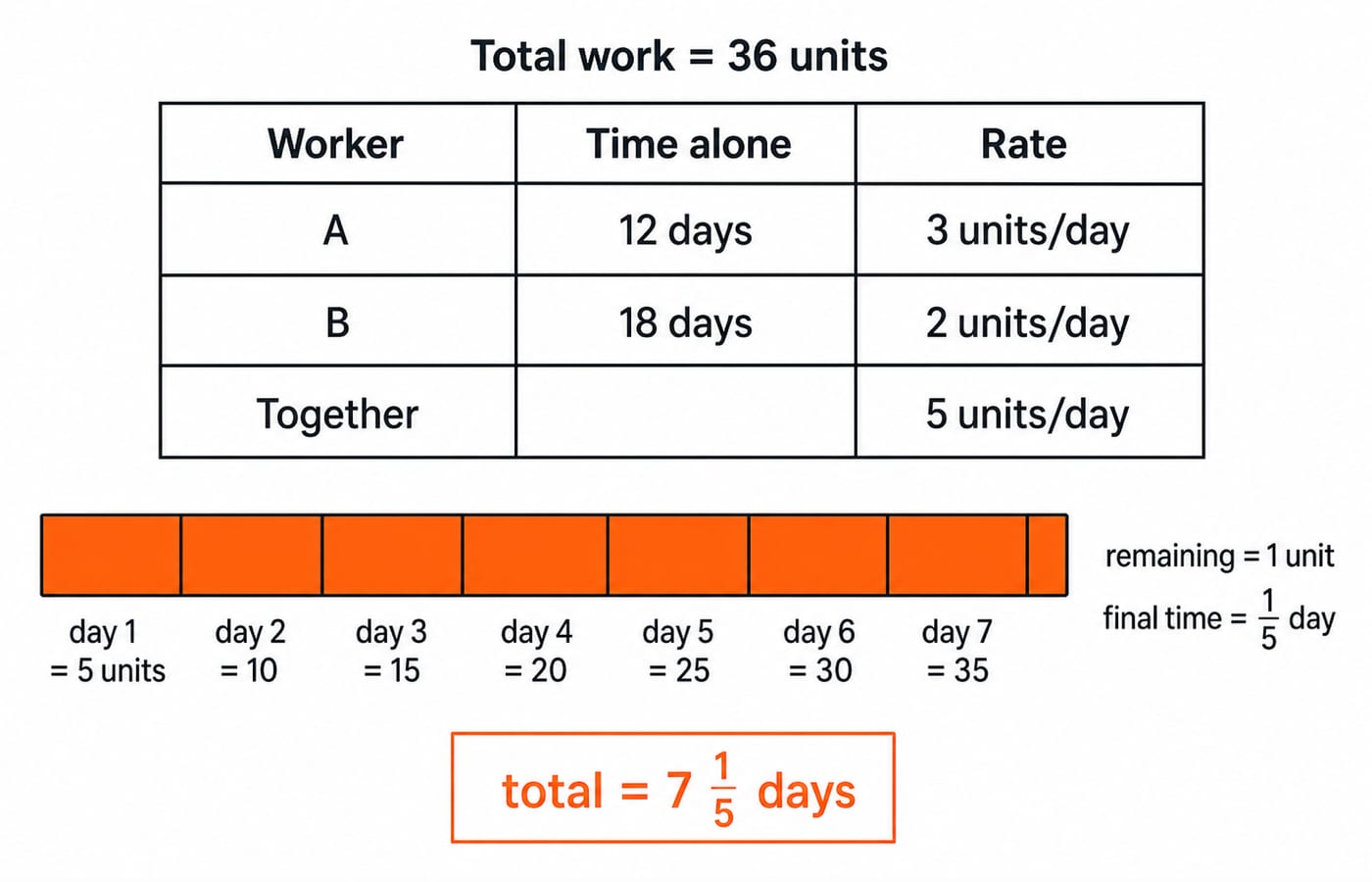
Suppose A takes 12 days and B takes 18 days.
Set total work to
LCM(12, 18) = 36units.A's rate is
36/12 = 3units per day.B's rate is
36/18 = 2units per day.Together, their rate is
3 + 2 = 5units per day.Required time is
36/5 = 7 1/5days.
That means seven complete working days and one-fifth of another working day. The fraction check gives the same answer:
1/12 + 1/18 = 3/36 + 2/36 = 5/36
So the time is 1 / 5/36 = 36/5 days. Never add 12 + 18 to find a combined time. Completion times do not add, rates do.
Turn efficiency ratios into time ratios
For a fixed job, efficiency and time are inversely proportional. If the efficiency ratio A:B is 3:2, the time ratio A:B is 2:3. Copying 3:2 directly as the time ratio reverses the meaning.
Suppose B takes 15 days and the efficiency ratio A:B is 3:2. B's 15 days correspond to three parts in the time ratio 2:3, so A takes:
15 x 2/3 = 10 days
Their rates are 1/10 and 1/15. Together:
1/10 + 1/15 = 3/30 + 2/30 = 1/6
Therefore, they finish together in 6 days.
Percentage statements use the same idea. If A is 25% more efficient than B, their rates are 125:100 = 5:4, so their times are 4:5. If B needs 20 days, A needs 20 x 4/5 = 16 days.
Scale workers, hours, and days without losing the assumptions
For equal workers with constant productivity:
workers x days x hours per day x productivity = fixed work
Suppose 12 workers complete a job in 15 days while working 6 hours per day. The job requires:
12 x 15 x 6 = 1080 worker-hours
Now use 18 equally productive workers for 5 hours per day. Their daily capacity is 18 x 5 = 90 worker-hours, so they need:
1080/90 = 12 days
This shortcut fails if worker productivity differs or the amount of work changes.
Work contribution is also different from clock time. X works for 4 days at 3 units per day, contributing 4 x 3 = 12 units. Y works for 5 days at 2 units per day, contributing 5 x 2 = 10 units. A reward based strictly on contribution is divided in the ratio 12:10 = 6:5, not 4:5 and not 3:2.
Handle joining, leaving, and alternate-day schedules as a timeline
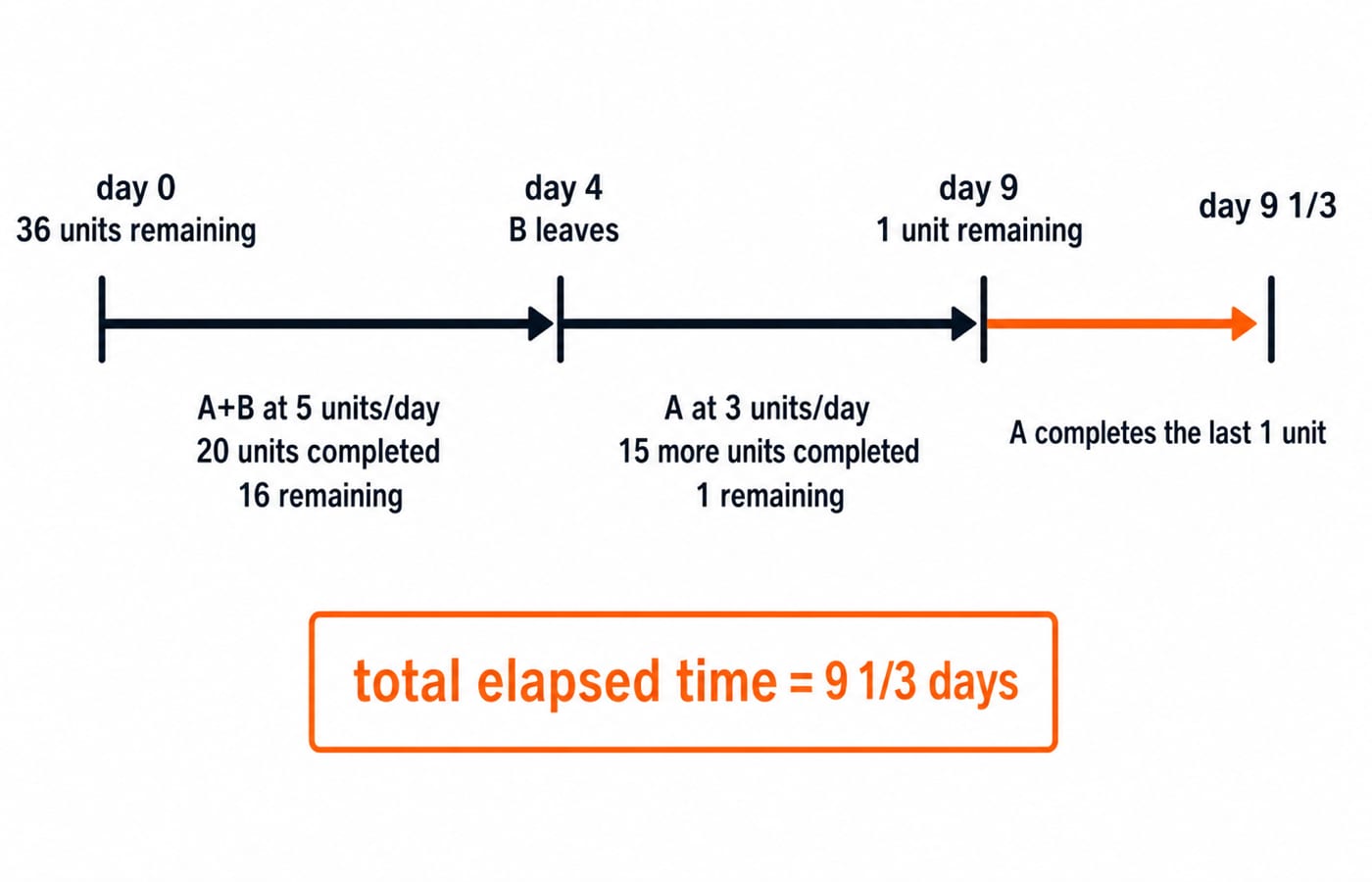
Return to the 36-unit job. A and B work together for 4 days at 5 units per day, so they complete 4 x 5 = 20 units. B then leaves. The remaining work is 36 - 20 = 16 units, which A completes at 3 units per day in 16/3 = 5 1/3 days. Total elapsed time is:
4 + 5 1/3 = 9 1/3 days
For an alternate-day example, let A finish alone in 10 days and B in 15 days. Choose 30 units of total work. A completes 3 units per day and B completes 2.
If A starts, one two-day cycle completes 3 + 2 = 5 units. Five cycles complete 25 units in 10 days. A completes 3 more units on day 11, leaving 2 units. B completes those 2 units on day 12. The answer is 12 days. Always note who starts because reversing the order can change the finishing day.
Choose the fastest safe shortcut under time pressure
Use fractions for one clean rate combination. Use LCM units when the completion times have a manageable LCM or when the schedule changes. Use ratios when the question gives relative efficiency. If the LCM becomes awkward, keep total work as 1 instead of forcing large integers.
Apply three quick checks before accepting an answer:
With positive rates, a combined time must be shorter than the faster individual's time.
A more efficient worker must take less time for the same job.
Completed work across every phase must equal the selected total work.
A compact scratch table with worker, time, rate, and active interval is usually enough. A useful shortcut reduces conversions. It does not skip the model.
Recognise question shapes and avoid common traps
Common forms include individual and combined work, efficiency comparisons, joining or leaving, alternate days, worker-hour scaling, machine productivity, and contribution-based sharing. The Placement Preparation category places these questions within the wider aptitude syllabus.
Most errors come from adding completion times instead of rates, treating efficiency and time as directly proportional, forgetting who starts an alternating schedule, using worker-hours despite unequal productivity, or retaining a worker's rate after departure. Also avoid rounding a fractional day until you have checked whether the question asks for exact time, completed days, or the day on which work finishes.
For a wider topic map and weekly plan, use Aptitude for Placements. Readers preparing specifically for SSC CGL can connect the same rate methods to the broader plan in SSC CGL Quant Strategy. For any specific exam, confirm its current pattern and instructions in the official notification.
The short version: revise, then practise by method
Choose a total amount of work, turn every completion time into a rate, and add rates only during shared intervals. After each phase, subtract completed work from the total. When converting efficiency into time, invert the ratio.
After the examples, practise in a deliberate sequence: solve 5 basic rate questions, 5 combined-work questions, then 5 schedule-change questions. For each miss, record whether the cause was setup, arithmetic, or a misread timeline.
For placement-focused aptitude, continue with Aptitude for Placement. For GATE-focused practice, use Aptitude for GATE. Pick the track that matches your goal, but keep the method constant: model the work first, then calculate.
Keep learning

Data Sufficiency: A 5-Step Method, Shortcuts and Solved Examples
Learn to test each statement independently, prove insufficiency with two valid cases, and stop as soon as the target becomes unique. Three worked problems make the method concrete.
Updated 15 Nov 20266 min readAptitude & Reasoning

Data Arrangement Questions: Concepts, Shortcuts and Solved Examples
Turn names, cities, roles and scores into a clean grid. This guide shows safe shortcuts and solves one complete arrangement from clues to answer.
Updated 11 Nov 20266 min readAptitude & Reasoning

Coding-Decoding Concepts and Shortcuts with Solved Examples
Identify, validate and reverse coding-decoding rules through letter shifts, rearrangements, number codes and sentence substitution.
Updated 9 Nov 20265 min readAptitude & Reasoning

Trigonometry for Competitive Exams: Concepts, Shortcuts and Solved Examples
Build trigonometry from one right triangle, recover standard values safely, and solve identities, equations, and height-and-distance problems step by step.
Updated 8 Nov 20266 min readAptitude & Reasoning