Adders and Subtractors in Digital Logic: Circuits, Worked Examples and Exam Traps
Learn adders and subtractors from one-bit truth tables to four-bit ripple circuits, with verified addition, subtraction, overflow and delay examples.
KnowledgeGate Team
Exam prep & CS education
Updated 26 Aug 20266 min read
A one-bit adder or subtractor is easy to memorise. Multi-bit questions reveal whether you can track carry, borrow and overflow as different signals. Four-bit ripple circuits produce 1011 + 0110 = 10001 and 1001 - 0110 = 0011, while one controlled circuit performs both operations. Start at the LSB, label each signal, and check the assembled bits in decimal.
Related reading: carry lookahead MCQs and Boolean algebra and K-maps.
Adders and subtractors are combinational arithmetic circuits
An adder maps operand bits plus optional Cin to S and Cout. A subtractor maps operand bits plus optional Bin to D and Bout. Current inputs determine outputs, so these are combinational, not storage. CS Fundamentals is the subject route; Combinational Circuits in Digital Electronics guide places the same 1011 + 0110 ripple trace inside a broader design method. Borrow chains, controlled adder-subtraction and signed overflow extend that foundation.
A and B are operand bits. Cin and Cout denote carry; Bin and Bout denote borrow. Bit 0 is the LSB. A one-bit stage obeys:
A + B + Cin = S + 2CoutA - B - Bin = D - 2Bout
These are arithmetic identities. In gate equations, + means Boolean OR.
Half adder and full adder: tables, equations and construction
Half adder:
A | B | S | C |
|---|---|---|---|
0 | 0 | 0 | 0 |
0 | 1 | 1 | 0 |
1 | 0 | 1 | 0 |
1 | 1 | 0 | 1 |
Thus S = A XOR B and C = AB. Without Cin, it cannot serve as a non-LSB stage.
Full adder:
A | B | Cin | S | Cout |
|---|---|---|---|---|
0 | 0 | 0 | 0 | 0 |
0 | 0 | 1 | 1 | 0 |
0 | 1 | 0 | 1 | 0 |
0 | 1 | 1 | 0 | 1 |
1 | 0 | 0 | 1 | 0 |
1 | 0 | 1 | 0 | 1 |
1 | 1 | 0 | 0 | 1 |
1 | 1 | 1 | 1 | 1 |
Equations are S = A XOR B XOR Cin and Cout = AB + Cin(A XOR B). The majority form is Cout = AB + ACin + BCin.
Construction uses two half adders and OR: HA1 gives P = A XOR B, C1 = AB; HA2 gives S = P XOR Cin, C2 = P Cin; then Cout = C1 + C2.
Four-bit ripple-carry addition worked bit by bit
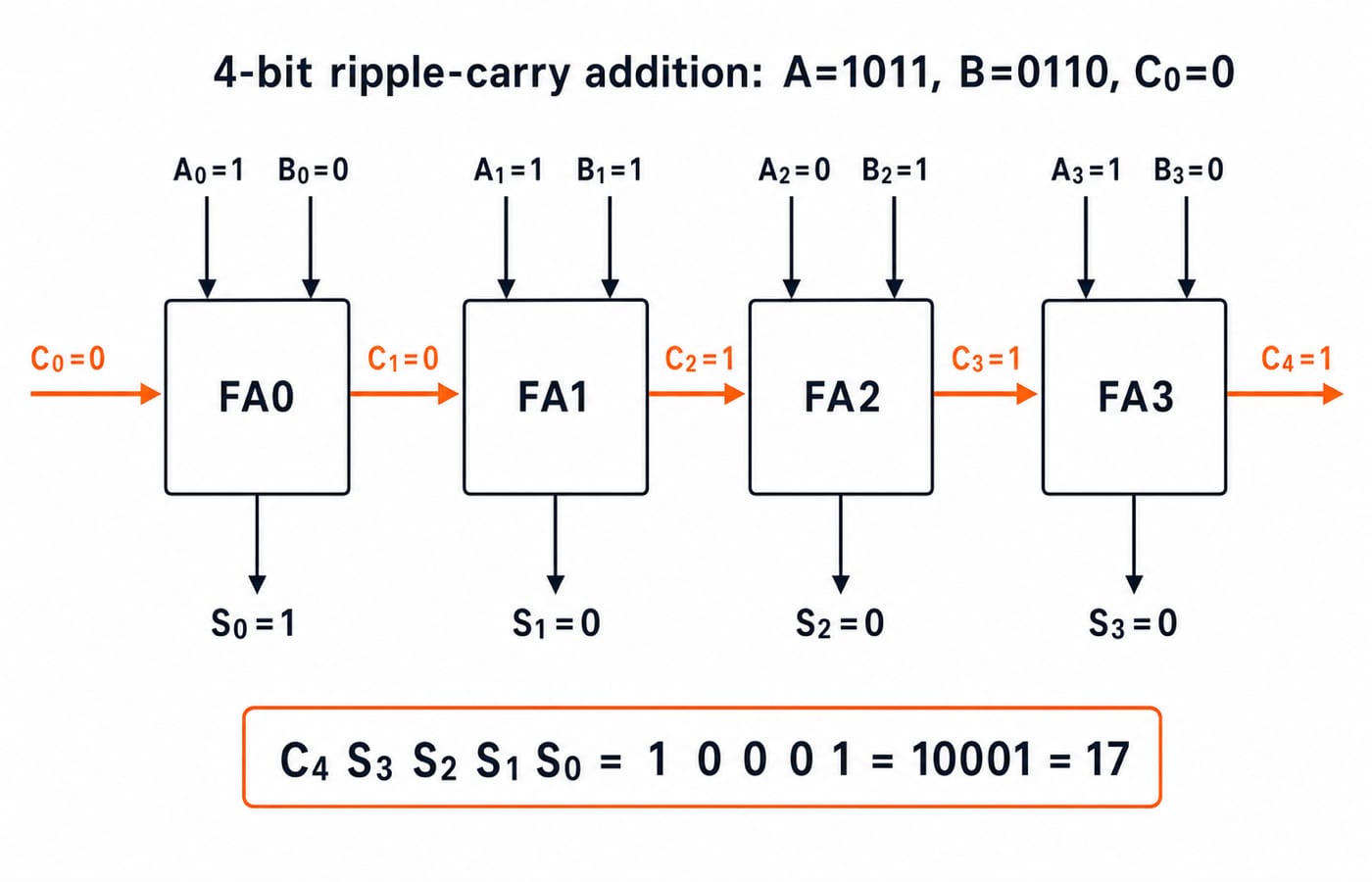
Take A = 1011 (11), B = 0110 (6), C0 = 0. Start at bit 0.
Bit | Calculation | Result |
|---|---|---|
0 |
|
|
1 |
|
|
2 |
|
|
3 |
|
|
Thus C4 S3 S2 S1 S0 = 10001; 11 + 6 = 17. Stored sum is 0001, with separate unsigned Cout = 1. Dropping it changes the value.
Carries are C1 = 0, C2 = 1, C3 = 1, C4 = 1. Each stage awaits the previous carry, so worst-case delay grows with stage count.
Half subtractor, full subtractor and a borrow chain
Half subtractor:
A | B | D | Borrow |
|---|---|---|---|
0 | 0 | 0 | 0 |
0 | 1 | 1 | 1 |
1 | 0 | 1 | 0 |
1 | 1 | 0 | 0 |
Thus D = A XOR B, Borrow = NOT(A)B. Borrow occurs only for A = 0, B = 1.
A | B | Bin | D | Bout |
|---|---|---|---|---|
0 | 0 | 0 | 0 | 0 |
0 | 0 | 1 | 1 | 1 |
0 | 1 | 0 | 1 | 1 |
0 | 1 | 1 | 0 | 1 |
1 | 0 | 0 | 1 | 0 |
1 | 0 | 1 | 0 | 0 |
1 | 1 | 0 | 0 | 0 |
1 | 1 | 1 | 1 | 1 |
For a full subtractor, D = A XOR B XOR Bin and Bout = NOT(A)B + NOT(A)Bin + B Bin. Equivalently, Bout = NOT(A)B + Bin NOT(A XOR B).
Calculate 1001 (9) minus 0110 (6), with b0 = 0; bi is the borrow entering bit i.
Bit
0:1 - 0 - 0givesD0 = 1,b1 = 0.Bit
1:0 - 1 - 0givesD1 = 1,b2 = 1.Bit
2:0 - 1 - 1 = -2givesD2 = 0,b3 = 1.Bit
3:1 - 0 - 1givesD3 = 0,b4 = 0.
So D3D2D1D0 = 0011, matching 9 - 6 = 3. Carry and borrow move towards the MSB but remain distinct.
One adder-subtractor circuit performs both operations
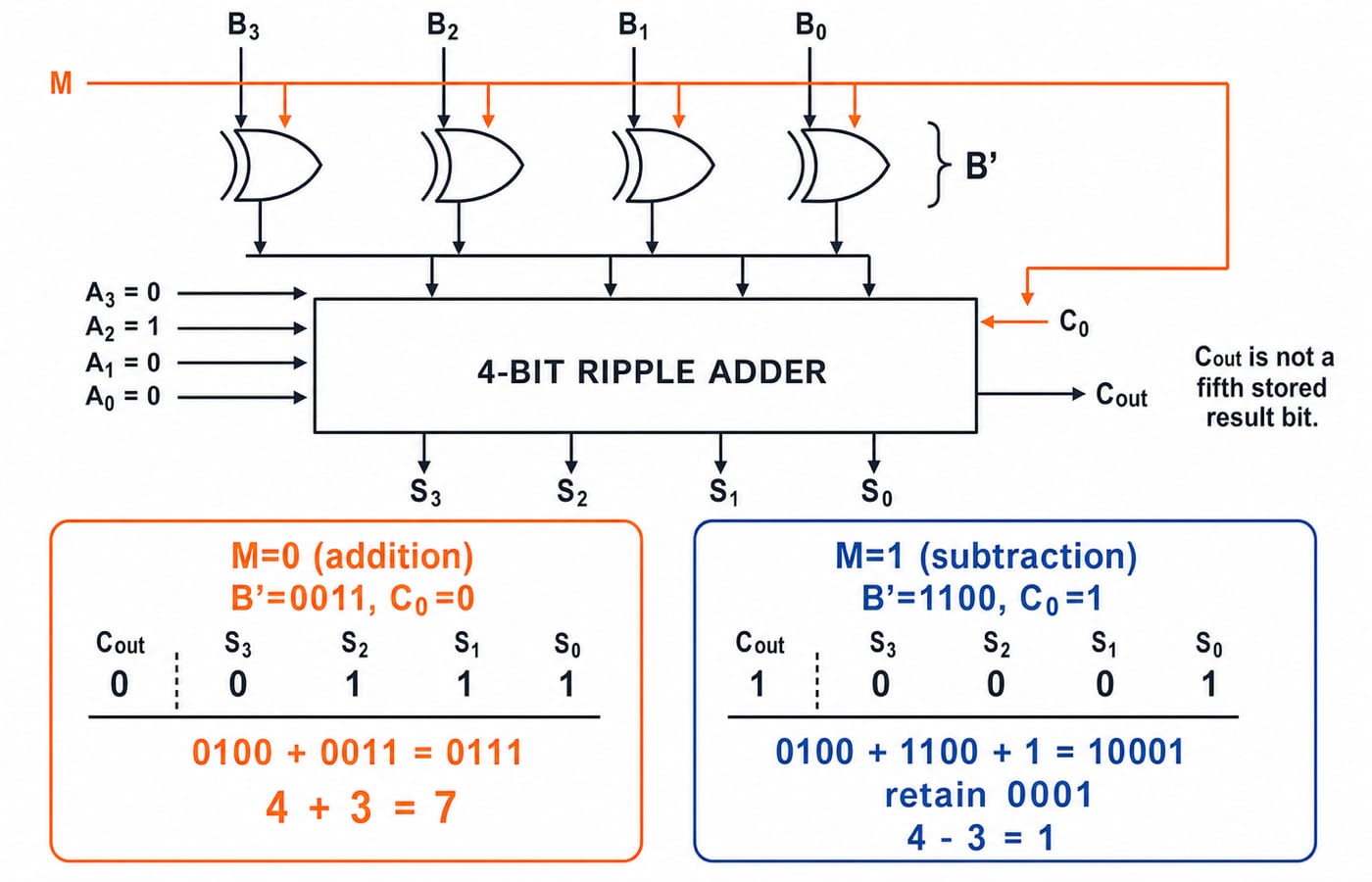
For mode M, feed B'i = Bi XOR M and set C0 = M. Then M = 0 gives A + B; M = 1 gives A + NOT(B) + 1 = A - B in two's complement.
For A = 0100 (4) and B = 0011 (3):
M = 0:B' = 0011,C0 = 0, so0100 + 0011 = 0111(7), withCout = 0.M = 1:B' = 1100,C0 = 1, so0100 + 1100 + 1 = 10001. Retain0001(1); leading1isCout. Thus4 - 3 = 1.
Mode complements B through XOR gates and supplies the added 1. In fixed-width signed arithmetic, discarded Cout alone does not indicate overflow.
Carry, borrow, overflow and propagation delay differ
Cout reports carry beyond unsigned width. Final Bout = 1 reports unsigned underflow in a direct subtractor. Signed two's-complement overflow means an out-of-range signed result. A ripple adder uses carry into sign bit XOR carry out.
Four-bit signed 0111 (+7) plus 0011 (+3) leaves 1010. Here C3 = 1, C4 = 0, so V = C3 XOR C4 = 1; two positives appearing negative confirms overflow. The ripple addition's C4 = 1 matters for unsigned 11 + 6 = 17, but not alone for signed overflow.
Use the supplied model. At 2 ns per carry stage, four stages take 4 x 2 ns = 8 ns. With 1 ns final carry-to-sum delay, the MSB sum takes 3 x 2 + 1 = 7 ns. These are not hardware constants.
Exam traps and a repeatable solving routine
Trap | What goes wrong | Correction |
|---|---|---|
Start at MSB | Signal direction is wrong | Start at bit |
Give half adder | That input is absent | Use a full adder |
Use | Borrow direction reverses | Use |
Equate | Unsigned and signed status mix | Test sign-bit carries |
Complement | Subtraction is incomplete | Set |
Read subtraction | A false fifth bit appears | Retain fixed-width bits |
Questions may ask for a table row, equation, full stage from half stages, ripple trace, mode switch, status distinction or supplied delay.
Routine: identify width and representation, write the LSB input, trace every signal, assemble MSB to LSB, then check in decimal. KnowledgeGate offers over 40 practice questions on Adders & Subtractors. Use Combinational Circuits MCQs for practice and GATE Guidance by Sanchit Sir for structured preparation.
Adders and subtractors: the short version and next step
Remember: XOR gives sum or difference, AND gives half-adder carry, and NOT(A)B gives half-subtractor borrow. Full stages accept incoming signals; chaining creates word-level circuits.
Keep three anchors: 1011 + 0110 = 10001; 1001 - 0110 = 0011; controlled 0100 + 0011 = 0111 at M = 0, but 0100 - 0011 = 0001 at M = 1. Retrace signals, redraw the controlled circuit, and explain why M reaches the XOR bank and C0. Continue with Zero to Hero for a broader core-CS path.
Keep learning
NOT, OR and AND Gates: Evolution, Truth Tables and a Worked Circuit
Learn how NOT, OR and AND gates developed from switching ideas, then trace F=(A+B')C node by node and confirm it with a complete truth table.
Updated 23 Oct 20265 min readDigital Logic
Binary Arithmetic Operations Explained: Rules and Worked Examples
Learn binary addition, subtraction, multiplication and division with aligned worked examples, then separate carry, borrow and two's-complement overflow.
Updated 19 Oct 20266 min readDigital Logic

1's Complement Explained: Binary Conversion, Addition and Worked Examples
Learn how fixed-width 1's complement numbers represent negatives, why zero has two encodings, and how end-around carry works through exact examples.
Updated 15 Oct 20266 min readDigital Logic
Decimal Conversion Explained: Binary, Octal and Hexadecimal Worked Examples
Learn one dependable method for converting values between decimal, binary, octal and hexadecimal, including fractions, shortcuts and checks.
Updated 11 Oct 20265 min readDigital Logic