Encoding and Modulation MCQs: 11 Solved Questions with Explanations
Work through 11 solved MCQs on modems, QAM, line coding, PCM, Base64 and mixed signal facts. Each answer names the deciding idea and shows the numbers.
KnowledgeGate Team
Exam prep & CS education
Updated 20 Aug 20268 min read
Encoding, modulation and compression get taught in the same week and then blur together in the exam hall. Memorising labels is not enough if you still confuse NRZ with Manchester, PCM with modulation, or Base64 with compression. Attempt every question before reading its explanation, and open the linked solved page when you want the full working. Then use GATE CS Exam Preparation to place weak areas inside the wider subject.
Encoding and modulation: the three buckets
Bucket one is line coding: digital data in, a digital signal out, with NRZ-L, NRZ-I and Manchester as the working examples. Bucket two crosses the analog boundary. Modulation shapes an analog carrier so digital bits can travel over it, which is what a modem does at the sending end, and pulse code modulation runs the other way, turning sampled analog values into digital codewords. Bucket three changes representation only: Base64 rewrites bytes into printable characters, LZW into dictionary indices, and neither touches a physical carrier. Name the input type and the output type before choosing any option, because the tempting wrong answers are usually correct statements about the wrong bucket.
Digital and analog signals, modems, and QAM
Q1. While transmitting data from a sender to a receiver using a modem on the Internet, the data is first converted from ______ to ______. (RSSB Informatic Assistant 2023, see the solved page)
(a) Analog, Analog
(b) Analog, Digital
(c) Digital, Analog
(d) Digital, Digital
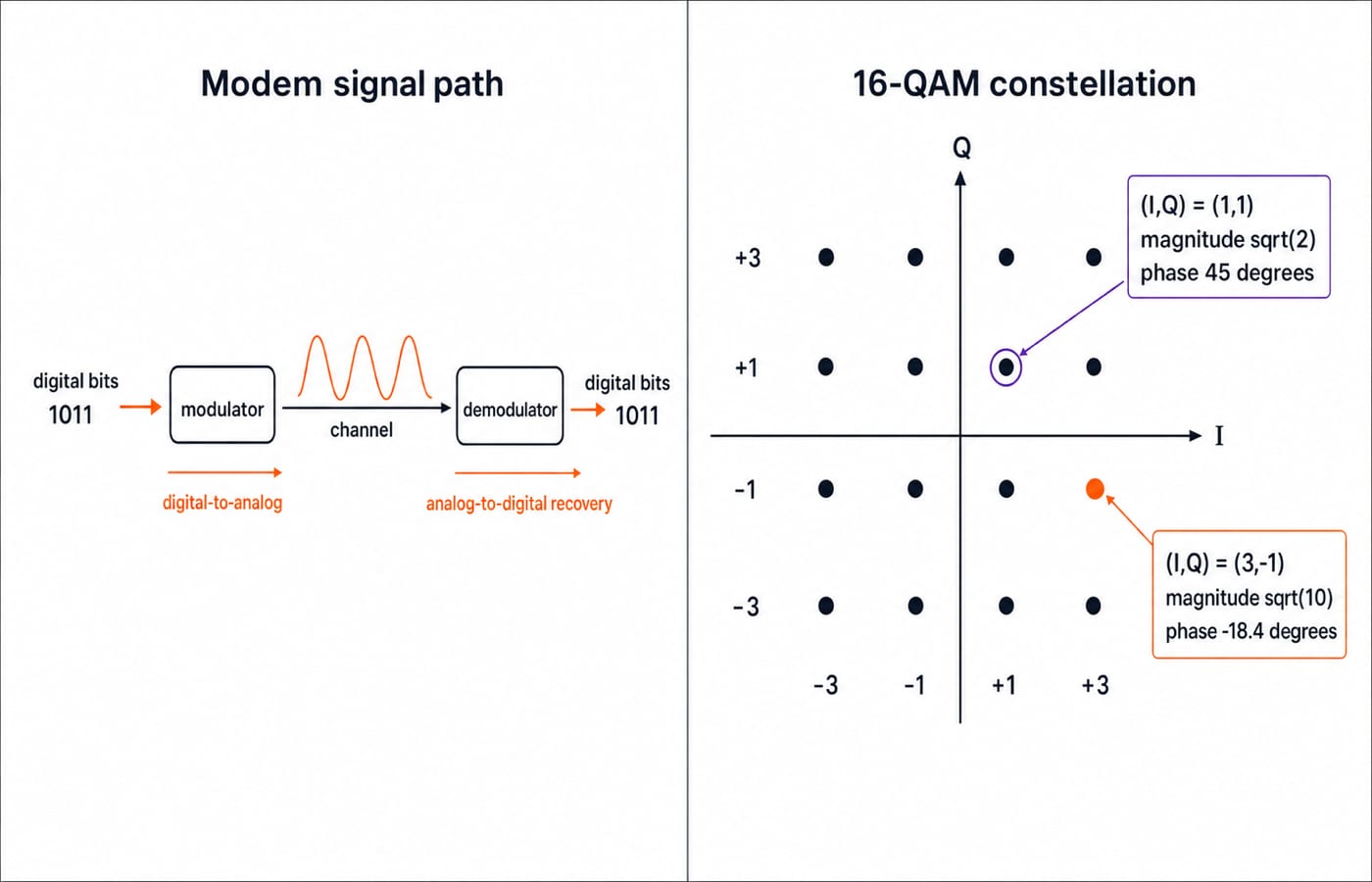
Answer: (c) Digital, Analog. In the stated path, digital bits modulate an analog carrier; the receiver demodulates them. This does not describe every Internet link.
Q2. Quadrature Amplitude Modulation means changing both: (UGC NET November 2017, see the solved page)
(a) Frequency and phase of the carrier.
(b) Frequency and Amplitude of the carrier.
(c) Amplitude and phase of the carrier.
(d) Amplitude and Wavelength of the carrier.
Answer: (c) Amplitude and phase of the carrier. QAM combines orthogonal I and Q. For I = 3, Q = -1, magnitude = sqrt(3^2 + (-1)^2) = sqrt(10); phase = atan2(-1, 3), about -18.4 degrees. Thus the pair changes amplitude and phase, not frequency.
Q3. ________ signals are discrete and generated by digital modulations. (RSSB Informatic Assistant 2023, see the solved page)
(a) Analog
(b) Digital
(c) Noise
(d) Bandwidth
Answer: (b) Digital. “Discrete” points to finite signal values, commonly two for binary data; noise and bandwidth are channel properties. A digitally modulated carrier need not be a baseband binary waveform.
Line coding, clock demand, and synchronisation
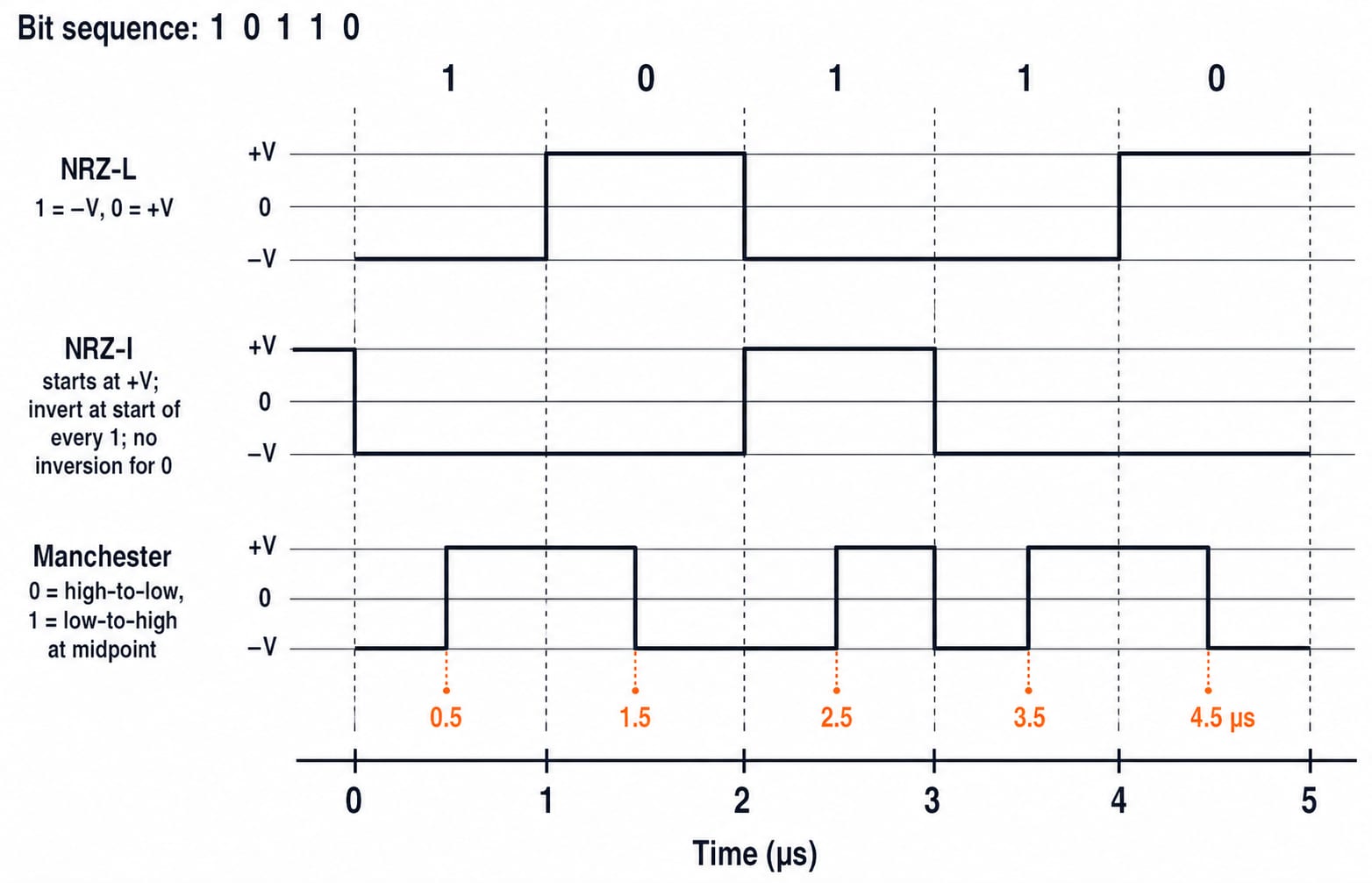
NRZ holds one level for a whole bit; Manchester forces a transition at the middle of every bit, so it needs two half-intervals where NRZ needs one. The comparison below is about signalling intervals for the same bit sequence, not about the bandwidth either scheme occupies.
Q4. To send the same bit sequence, NRZ encoding requires (ISRO Computer Science 2020, see the solved page)
(a) Same clock frequency as Manchester encoding
(b) Half the clock frequency as Manchester encoding
(c) Twice the clock frequency as Manchester encoding
(d) A clock frequency which depends on the number of zeros and ones in the bit sequence
Answer: (b) Half the clock frequency as Manchester encoding. NRZ uses one interval per bit; Manchester uses two around its middle transition. For a 1 microsecond bit, these are 1 microsecond and two 0.5 microsecond halves.
Q5. Which statements are true for digital-to-digital encoding schemes?
A. Unipolar encoding uses one level of value.
B. A unipolar encoded signal contains a direct current component (a component with zero frequency).
C. In NRZ-L, the level of the signal depends on the state of the bit.
D. In NRZ-I, the signal is not inverted if a 1 is encountered.
E. The RZ encoding scheme removes both DC components and the problem of synchronization.
Choose the correct answer from the options given below: (UGC NET Paper 2 December 2025, see the solved page)
(a) A, B, C and E only
(b) A, C, D and E only
(c) B, C, D and E only
(d) A, B, D and E only
Answer: (a) A, B, C and E only. Unipolar signalling uses a single non-zero level, so A holds, and because that level never balances against a negative one the average is non-zero, which is the direct current component in B. C is the definition of NRZ-L: the level itself carries the bit value. D is false, because NRZ-I inverts precisely when it meets a 1 and holds its level on a 0. E is true on the definition used here, since returning to zero inside every bit gives the receiver a transition per bit and cancels the average. Unipolar RZ is the exception that keeps an offset.
Q6. Match the following.
(a) Line Coding
(b) Block Coding
(c) Scrambling
(d) Pulse Code Modulation
(i) A technique to change an analog signal to digital data
(ii) Provides synchronization without increasing the number of bits
(iii) The process of converting digital data to a digital signal
(iv) Provides redundancy to ensure synchronization and inherits error detection
Codes: (UGC NET June 2016, see the solved page)
(a) (a)-(iv), (b)-(iii), (c)-(ii), (d)-(i)
(b) (a)-(iii), (b)-(iv), (c)-(ii), (d)-(i)
(c) (a)-(i), (b)-(iii), (c)-(ii), (d)-(iv)
(d) (a)-(ii), (b)-(i), (c)-(iv), (d)-(iii)
Answer: (b). Line coding maps data to signal, block coding adds redundancy, scrambling replaces patterns without extra bits, and PCM digitises analog input. Thus (a)-(iii), (b)-(iv), (c)-(ii), (d)-(i).
Sampling and the PCM pipeline
PCM orders anti-alias filtering, sampling, quantisation, then binary encoding. In this teaching example an input band-limited below 4 kHz is sampled at 8 kHz, the Nyquist minimum of twice the highest frequency present. The samples {0.2, 2.2, 3.1, 2.2, 0.2} V meet eight allowed levels {-3.5, -2.5, -1.5, -0.5, +0.5, +1.5, +2.5, +3.5} V, coded 000 to 111 in that order. Each sample snaps to its nearest level, giving {+0.5, +2.5, +3.5, +2.5, +0.5} V and the codewords {100, 110, 111, 110, 100}. The 3.1 V sample shows the price: it is stored as +3.5 V, a quantisation error of 0.4 V that no later stage recovers.
Q7. The process of taking a snapshot of the waveform at regular intervals and representing it as a binary number is known as (KVS Computer Science 2013, see the solved page)
(a) Sampling
(b) Standard Assessment
(c) Sequential Formatting
(d) Sound Structure
Answer: (a) Sampling. Sampling takes regular-in-time snapshots. Quantisation selects levels and encoding assigns bits, so these later PCM stages remain distinct.
Q8. Arrange the following steps for Pulse Code Modulation (PCM).
A. Sampling
B. Low-Pass filter
C. Encoding
D. Quantization
Choose the correct answer from the options given below: (UGC NET Paper 2 December 2025, see the solved page)
(a) A, B, C, D
(b) B, C, D, A
(c) B, A, D, C
(d) D, C, B, A
Answer: (c) B, A, D, C. Filter first so nothing above half the sampling rate can alias, then sample, then quantise each sample to an allowed level, then encode that level as its binary word. The walkthrough above runs in this order.
Base64 and variable-length encoding questions
Base64 rewrites bytes into printable characters so they survive text-only transport, which is a change of representation and not of carrier. Huffman, Shannon-Fano, adaptive Huffman and LZW instead shorten the data itself by exploiting how often symbols repeat.
Q9. In the __________ encoding scheme, each 24 bits become four 6-bit chunks, and eventually are sent as 32 bits. (RSSB BCI-Paper2 2022, see the solved page)
(a) 8 bit
(b) binary
(c) base 64
(d) quoted-printable
Answer: (c) base 64. Split 24 bits = 3 bytes as 4 x 6-bit values. ASCII Man: bytes 01001101 01100001 01101110, chunks 010011 010110 000101 101110, indices 19, 22, 5, 46, Base64 TWFu. Four 8-bit characters occupy 4 x 8 = 32 bits, so 3 bytes expand to 4; this is not compression.
Q10. Which of the following is not a variable length encoding? (UPPSC Polytechnic Lecturer 2022, see the solved page)
(a) LZW encoding
(b) Huffman encoding
(c) Shannon Fano encoding
(d) Adaptive Huffman encoding
Answer: (a) LZW encoding. Huffman, Shannon-Fano and adaptive Huffman all give frequent symbols shorter codewords, so output length varies from symbol to symbol. Textbook LZW instead emits fixed-width dictionary indices, which is why it sits outside that family. Working implementations do widen the index as the dictionary fills, from 9 bits upward, so the fixed-width description is the classroom form.
Mixed signal facts: phase, frequency, bipolar encoding, and infrared
Test the four claims separately and require one reason each.
Q11. State TRUE or FALSE for the following.
(i) A sine wave with a phase of 180° starts at time 0 with a zero amplitude. The amplitude is decreasing.
(ii) If a signal changes instantaneously, its frequency is zero.
(iii) In bipolar encoding, we use three voltage levels: positive, negative and zero.
(iv) Infrared signals can be used for short-range communication in a closed area using ground propagation. (Coal India Computer Science 2017, see the solved page)
(a) (i) TRUE, (ii) FALSE, (iii) TRUE, (iv) FALSE
(b) (i) TRUE, (ii) TRUE, (iii) TRUE, (iv) FALSE
(c) (i) FALSE, (ii) TRUE, (iii) FALSE, (iv) FALSE
(d) (i) TRUE, (ii) TRUE, (iii) FALSE, (iv) FALSE
Answer: (a). For (i), sin(2*pi*f*t + pi) = 0 at t=0; derivative 2*pi*f*cos(pi) = -2*pi*f, so it decreases. Claim (ii) is false: an ideal edge needs unbounded frequencies. Claim (iii) is true for +V, 0, -V. Claim (iv) is false: indoor infrared uses line of sight or reflection, not ground propagation.
Encoding and modulation answer diagnosis
If you missed | Likely confusion | Redo |
|---|---|---|
Q1-Q3 | Conversion direction versus carrier property | Label input, output, I, and Q |
Q4-Q6 | Line coding, transitions, and synchronisation | Draw both line-code traces |
Q7-Q8 | PCM stage order | Rebuild the five-sample example |
Q9-Q11 | Physical signalling, representation, and mixed signal facts | Rework Base64, then test each claim separately |
Score yourself out of 11. At 9 to 11, revisit only the misses. At 6 to 8, redraw both figures from memory and redo Q4 to Q10 after a day. At 0 to 5, rebuild the three-bucket map first, because the gap is conceptual rather than careless.
For adjacent practice, use Subnetting MCQs: 12 Solved IP Addressing Questions for IP calculations, TCP and UDP MCQs: 12 Solved Transport Layer Questions for transport comparisons, or Application Layer MCQs: 12 Solved DNS, HTTP, Email for DNS, HTTP, and email. Each sits on a different layer of the same networks syllabus.
The next practice step
Three habits solve most of this set. Name the input and output signal types before choosing a conversion. Draw actual transitions instead of memorising line-code slogans. In PCM, keep sampling, quantisation, and encoding separate. For structured subject coverage, GATE Guidance by Sanchit Sir provides the sequence; for timed practice, use the GATE Test Series. Return to these questions after a day without looking at the answers. A second clean attempt shows whether each distinction is usable rather than merely familiar.
Keep learning

Mobile Computing MCQs: Solved Questions on Concepts, Features and Applications
Work through 10 solved questions covering portability, cellular standards, Bluetooth, CDMA, Android, mobile cloud, and device constraints. Each answer has a concise explanation.
7 Oct 20267 min readComputer Networks MCQs
Computer Networks Basics & Criteria MCQs: 12 Solved Questions with Explanations
Solve 12 Computer Networks questions, then use clear explanations and worked criteria checks to separate similar terms confidently.
3 Oct 20268 min readComputer Networks MCQs
TCP Timers, RTT Estimation & SWS: 10 Solved MCQs and NATs
Solve 10 TCP exam questions covering timer roles, Silly Window Syndrome, recursive RTT estimates, Jacobson/Karels RTO and Karn's rule.
Updated 28 Sep 20267 min readComputer Networks MCQs
RSA Algorithm MCQs: 12 Solved Questions with Step-by-Step Explanations
Practise RSA key generation, modular inverses, encryption, signatures and defining equations, with concise working for conceptual and numerical answers.
25 Sep 20268 min readComputer Networks MCQs