Selective Repeat ARQ MCQs: 12 Solved Questions on Window Size and Link Utilisation
Work through 12 Selective Repeat ARQ questions, from out-of-order buffering and sequence-space limits to sliding-window utilisation and bit-field numericals.
KnowledgeGate Team
Exam prep & CS education
Updated 23 Aug 20268 min read

Selective Repeat ARQ errors often happen before formula substitution. Students mix sender and receiver windows, use the full sequence space instead of its safe half, or confuse one-way delay with round-trip delay. The twelve questions below land on those three fault lines in turn, and every answer is carried down to the last substitution. Attempt each one before reading its explanation.
Selective Repeat ARQ basics: what the receiver accepts and retransmits
Selective Repeat buffers valid out-of-order arrivals and retransmits only missing or damaged frames. Go-Back-N discards ahead-of-sequence frames and may retransmit the missing frame plus every later one. Q1, Q2, Q5, Q9 and Q10 have no separate worked page on the site, so their full working is given here; for the theory underneath all twelve, the Selective Repeat ARQ module teaches the same rules from scratch.
Q1
What is Selective Repeat ARQ, and how does it improve network efficiency compared to Go-Back-N?
Answer and explanation: Selective Repeat individually tracks frames, buffers valid out-of-order arrivals, and retransmits only lost or damaged frames. If frame 1 is lost from 0, 1, 2, 3, the receiver keeps 2 and 3 while the sender repeats 1. Go-Back-N discards 2 and 3 and repeats from 1, trading simpler receiver logic for extra retransmissions.
Q2
Which protocol can accept out of order delivery?
(a) Stop-and-Wait ARQ
(b) Go-Back-N ARQ
(c) Both Stop-and-Wait ARQ and Go-Back-N ARQ
(d) Neither Stop-and-Wait ARQ nor Go-Back-N ARQ
Answer: (d) Neither Stop-and-Wait ARQ nor Go-Back-N ARQ. Stop-and-Wait has no later frame to buffer, and Go-Back-N discards frames beyond the next expected number. Selective Repeat accepts them, but it is not listed.
Selective Repeat ARQ window size and sequence-space MCQs
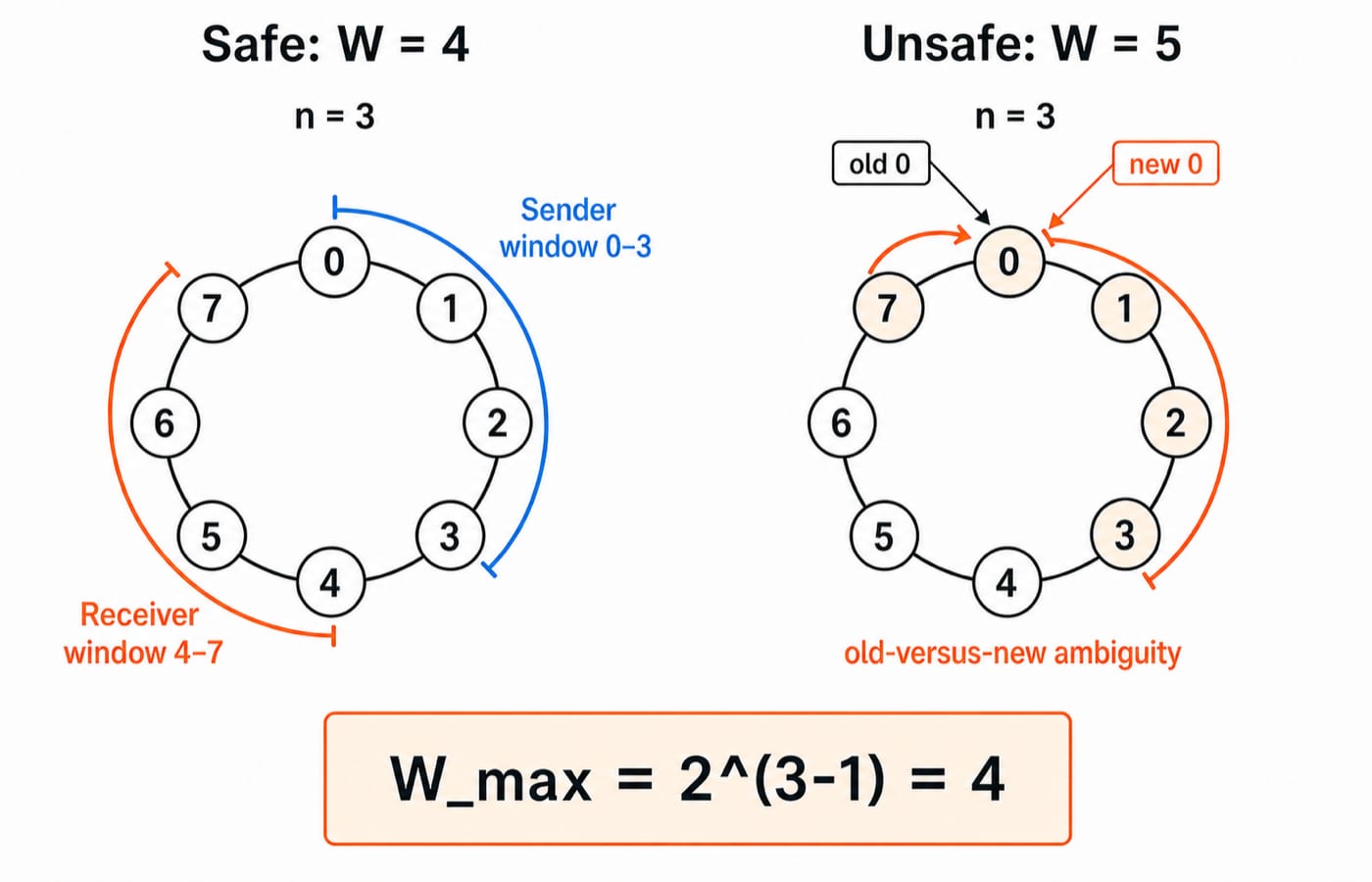
Let sender window be SWS, receiver window be RWS, and sequence space be S. Selective Repeat requires S >= SWS + RWS. If both windows equal W, then S >= 2W. Since an n-bit field gives S = 2^n, W_max = 2^(n-1).
Q3
In a sliding window ARQ scheme, the transmitter's window size is N and the receiver's window size is M. The minimum number of distinct sequence numbers required to ensure correct operation of the ARQ scheme is (GATE 2004)
(a) min (M, N)
(b) max (M, N)
(c) M + N
(d) MN
Answer: (c) M + N. The sequence space must distinguish N outstanding sender frames from the M numbers the receiver can accept. It therefore covers both live ranges.
Q4
The maximum window size for data transmission using the selective reject protocol with n-bit frame sequence numbers is: (GATE 2005)
(a) 2^n
(b) 2^(n-1)
(c) 2^n - 1
(d) 2^(n-2)
Answer: (b) 2^(n-1). An n-bit field supplies 2^n values, but the symmetric window may use at most half. Otherwise, after wraparound, a delayed old frame can look new.
Q5
Suppose that we run the sliding window algorithm with SWS = 5 and RWS = 3 and no out of order arrivals. Find the smallest value for Maximum Sequence numbers.
Answer: 8. Apply S >= SWS + RWS = 5 + 3 = 8. The arrival order does not shrink the two live ranges.
Sliding-window link utilisation and optimal window numericals
Use T_f = L/R, T_ack = L_ack/R_ack when supplied, and one-way propagation T_p. With negligible ACK transmission, the cycle is T_f + 2T_p, so U = W T_f/(T_f + 2T_p) before saturation. Full utilisation needs W >= ceil(1 + 2T_p/T_f).
Q6
Consider the implementation of sliding window protocol over a lossless link, with a window size of W frames, where each frame is of size 1000 bits (including header). The bandwidth of the link is 100 kbps (1k = 10^3) and the one-way propagation delay is 100 milliseconds. Assume that processing times at the sender and receiver are zero and the transmission time of acknowledgements is also zero. Which one of the following options gives the minimum size of W (in number of frames) required to achieve 100% link utilization? (GATE 2026)
(a) 10
(b) 21
(c) 20
(d) 11
Answer: (b) 21. T_f = 1000/100,000 = 0.01 s = 10 ms, so a = T_p/T_f = 100/10 = 10 and W >= 1 + 2a = 21. With 20 frames, the sender becomes idle before the first ACK.
Q7
Consider the sliding window flow-control protocol operating between a sender and a receiver over a full-duplex error-free link. Assume the following: (GATE 2021, NAT)
The time taken for processing the data frame by the receiver is negligible.
The time taken for processing the acknowledgement frame by the sender is negligible.
The sender has infinite number of frames available for transmission.
The size of the data frame is 2,000 bits and the size of the acknowledgement frame is 10 bits.
The link data rate in each direction is 1 Mbps (= 10^6 bits per second).
One way propagation delay of the link is 100 milliseconds.
The minimum value of the sender's window size in terms of the number of frames, (rounded to the nearest integer) needed to achieve a link utilization of 50% is_____________.
Answer: 51 frames. T_f = 2000/10^6 = 2 ms and T_ack = 10/10^6 = 0.01 ms. The cycle is 2 + 100 + 0.01 + 100 = 202.01 ms. From W(2)/202.01 >= 0.50, W >= 50.5025, so the minimum integer is 51.
Q8
Station A uses 32 byte packets to transmit messages to Station B using a sliding window protocol. The round trip delay between A and B is 80 milliseconds and the bottleneck bandwidth on the path between A and B is 128 kbps. What is the optimal window size that A should use? (GATE 2006)
(a) 20
(b) 40
(c) 160
(d) 320
Answer: (b) 40. The bandwidth-delay product is 128,000 x 0.08 = 10,240 bits, and each packet is 32 x 8 = 256 bits. Therefore 10,240/256 = 40 packets. The given 80 ms is already round trip.
Q9
Consider a situation where a host sends data to another host using a full duplex link. The receiver window size is 4 packets. The size of each packet is 1400B long. The time taken to put the data packet on to the transmission link is 60 micro sec. The propagation delay is 150 micro sec in this link. What is the throughput in MBps possible during this communication, if the ACK packets are very small and the transmission time of the ACK is very less and it follows selective repeat protocol for flow control? (upto two decimal place)
Answer: 15.56 MBps. The cycle is 60 + 2(150) = 360 microseconds, and the window carries 4 x 1400 = 5600 bytes. Thus 5600/0.00036 = 15,555,555.56 bytes/s = 15.56 MBps, below the raw rate 1400/0.00006 = 23.33 MBps.
Selective Repeat ARQ sequence-number bits from utilisation targets
First find window W from timing and utilisation. Then choose the least m satisfying W <= 2^(m-1); half the sequence space is reserved for wraparound safety.
Q10
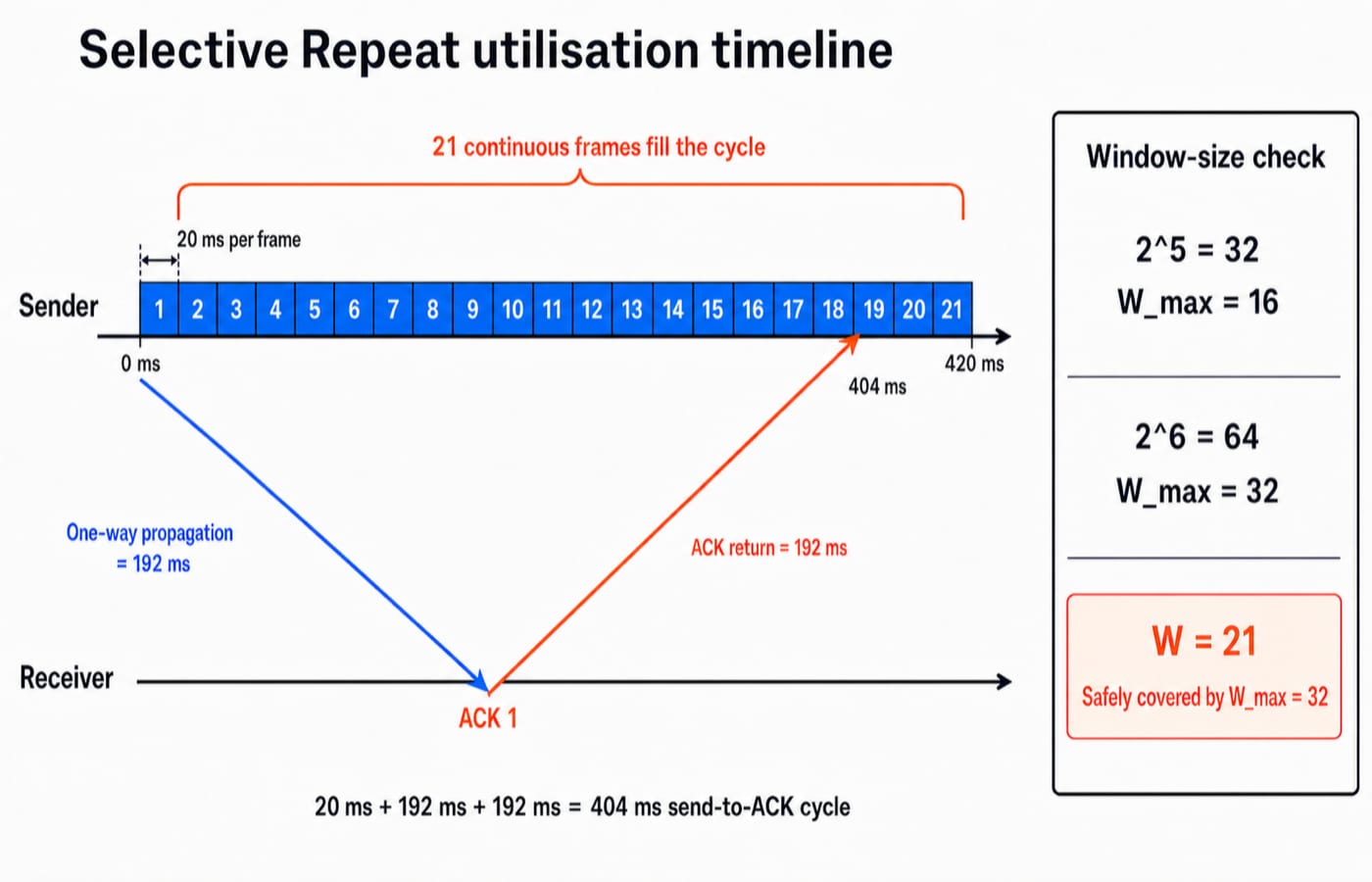
Consider a 392 Kbits/sec satellite communication link with one way propagation delay of 192 msec. Selective Retransmission (repeat) protocol is used on this link to send data with a frame size of 980 Bytes. Neglect the transmission time of acknowledgement. The minimum number of bits required for the sequence number field to achieve 100% utilization is ________
Answer: 6 bits. T_f = (980 x 8)/392,000 = 0.020 s = 20 ms, so a = 192/20 = 9.6 and W >= ceil(1 + 2a) = ceil(20.2) = 21. Since 2^m >= 2W = 42, m = 6; five bits safely cover only 16 frames.
Q11
Consider a selective repeat sliding window protocol that uses a frame size of 1 KB to send data on a 1.5 Mbps link with a one-way latency of 50 msec. To achieve a link utilization of 60%, the minimum number of bits required to represent the sequence number field is ________. (GATE 2014, NAT)
Answer: 5 bits. With 1 KB = 1000 bytes, T_f = 8000/1,500,000 = 5.333... ms and 1 + 2a = 1 + 2(50/5.333...) = 19.75. Therefore W >= ceil(0.60 x 19.75) = ceil(11.85) = 12, and 2^(m-1) >= 12 first holds at m = 5. Using 1024 bytes gives the same answer.
Q12
Consider a 128×10^3 bits/second satellite communication link with one way propagation delay of 150 milliseconds. Selective retransmission (repeat) protocol is used on this link to send data with a frame size of 1 kilobyte. Neglect the transmission time of acknowledgement. The minimum number of bits required for the sequence number field to achieve 100% utilization is _____________ . (GATE 2016, NAT)
Answer: 4 bits. With 1 kilobyte = 1024 bytes, T_f = 8192/128,000 = 0.064 s = 64 ms, so W >= ceil(1 + 2(150/64)) = ceil(5.6875) = 6. Three bits safely allow four frames; four bits allow eight. A decimal kilobyte also gives W = 6.
Common Selective Repeat ARQ traps
Five mistakes cost most of the marks lost on this topic, and each one is caught by a question above.
Treating the whole sequence space as the window. An n-bit field holds 2^n numbers, but Selective Repeat may leave only 2^(n-1) frames outstanding, so the sender and receiver ranges never overlap after a wraparound. The ring diagram shows the collision at W = 5 with n = 3.
Assuming the two windows are equal. The general rule is S >= SWS + RWS, which is why Q3 answers M + N and Q5 answers 8. S >= 2W is only the symmetric special case.
Doubling a delay that is already round trip. Q8 gives 80 ms as the round-trip delay, so its bandwidth-delay product uses 0.08 s, while Q6, Q10 and Q12 quote one-way delays that do need doubling.
Leaving the frame size in bytes. A 980-byte frame is 7,840 bits and a 1 KB frame is 8,000 or 8,192 bits by convention, and only bits divide cleanly by a bit rate.
Reaching for the bit count before the window. Fix W from the timing and the utilisation target first, then take the least m with 2^(m-1) >= W. In Q11 it is the 60% target that turns 19.75 into 12.
For broader practice, use Computer Networks MCQs, then try TCP and UDP MCQs: 12 Solved Transport Layer Questions. If the numericals caused trouble, redo Q6 to Q12 without notes.
Selective Repeat ARQ MCQs: the short version and next step
Remember three rules: buffer valid out-of-order frames, keep a symmetric window within half the sequence space, and build utilisation from the correct ACK cycle. Recompute missed numericals without looking at the answers. For a structured path, continue with GATE Guidance by Sanchit Sir; for timed practice, use the GATE Test Series.
Keep learning

Repeater, Hub, Bridge & Switch MCQs: 12 Solved Questions with Explanations
Solve 12 exam questions on device layers, MAC forwarding, VLANs, collision and broadcast domains, port mirroring, bridges and crosspoint counting.
Updated 20 Oct 20267 min readComputer Networks MCQs
Ethernet IEEE 802.3 MCQs: 12 Solved Questions with Explanations
Solve 12 Ethernet questions on IEEE 802.3, speed generations, hubs, MAC addresses, multicast, CSMA/CD and the first binary backoff race.
Updated 16 Oct 20267 min readComputer Networks MCQs

OSI Model & Layers MCQs: 12 Solved Questions on PDUs and Encapsulation
Test OSI layers, PDUs, encapsulation and router traversal through solved MCQs, with explanations, a byte-by-byte frame trace and a layer-visit method.
12 Oct 20267 min readComputer Networks MCQs

Mobile Computing MCQs: Solved Questions on Concepts, Features and Applications
Work through 10 solved questions covering portability, cellular standards, Bluetooth, CDMA, Android, mobile cloud, and device constraints. Each answer has a concise explanation.
7 Oct 20267 min readComputer Networks MCQs