CAT Preparation Strategy for Working Aspirants: A Six-Month Plan
A job-compatible CAT plan built around a 12-hour normal week, a 6.5-hour fallback, diagnostic evidence, timed practice, mock analysis and a deliberate taper.
KnowledgeGate Team
Exam prep & CS education
Updated 2 Aug 20266 min read

A CAT plan must survive meetings, commutes, travel and missed weeks. This one runs on 12 hours in a normal week, drops to 6.5 hours when work explodes, and gates each phase on evidence rather than on the calendar, so one bad Tuesday does not cost you the month. Week 1 measures all three sections; every hour after that is allocated from those numbers.
Start with a 12-hour week that a job can survive
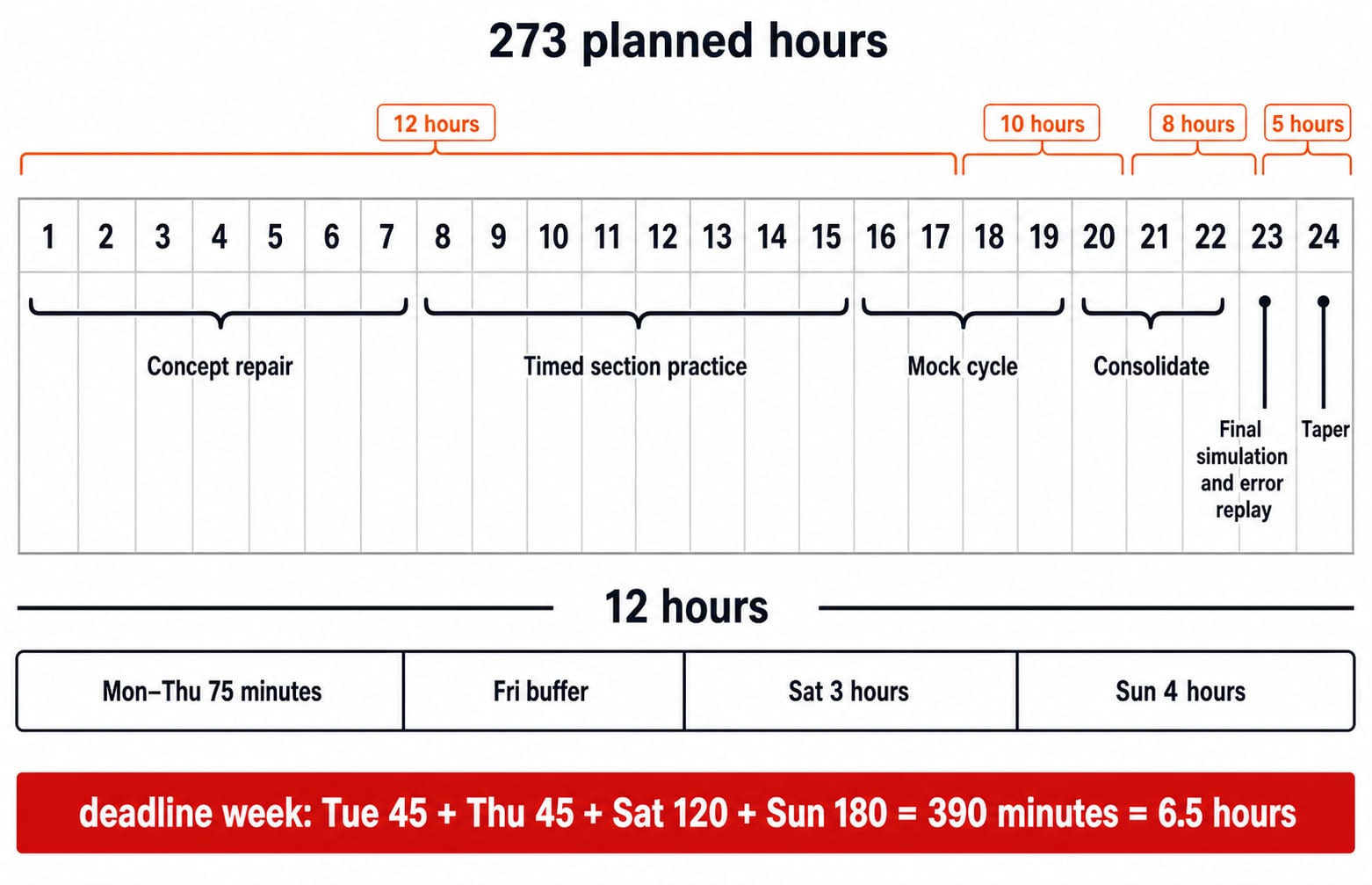
Study 75 minutes Monday to Thursday: 4 × 75 = 300 minutes, or 5 hours. Keep Friday free; study 3 hours Saturday and 4 Sunday. Total: 5 + 3 + 4 = 12 hours, with Friday held back as the buffer that absorbs one late office day. Protect sleep; hours borrowed from it give nothing back.
Weekdays use 45 minutes solving and 30 reviewing; Saturday, 90 mixed and 90 analysis; Sunday, 90 section work, 90 repair and 60 planning. Work from one source per section rather than three.
Weeks 1-20 give 20 × 12 = 240 hours. Weeks 21-22 add 20; weeks 23 and 24 add 8 and 5. Total: 240 + 20 + 8 + 5 = 273 hours.
Use week 1 to measure the gap
Run three 30-minute samples of 12 questions, then review for 90 minutes. A worked record has QA: 7 correct, 3 wrong and 2 skipped, so 7 ÷ 10 = 70% accuracy; VARC at 8, 2 and 2, so 8 ÷ 10 = 80%; and DILR at 3, 3 and 6, so 3 ÷ 6 = 50%. Read those figures as a ranking for your hours, not a forecast: DILR is the lowest accuracy and the thinnest evidence, only 6 of its 12 questions attempted.
For two weeks, allocate 4.5 hours to DILR, 3.5 to QA, 2 to VARC and 2 to cross-section review. Total: 12 hours. Three equal four-hour blocks also total 12 and would leave DILR where it is, which is why the weakest section takes the largest share. Re-test at week 4 and change the split only when the accuracy figures move. Log every block in one ledger: task and date, outcome, reason, next action.
Task and date | Outcome | Reason | Next action |
|---|---|---|---|
DILR set 2 | 2 of 4 correct in 21 min | constraint copied incorrectly | redraw the table and redo after 48 hours |
QA arithmetic drill | 6 of 8 correct in 19 min | ratio set up in the wrong order | redo both misses from blank on Thursday |
VARC passage 3 | 1 of 4 correct in 14 min | skimmed for gist, missed the tone shift | reread untimed, then redo the questions |
Question counts, sectional timing and marking rules have shifted between cycles, so take them from the official CAT website rather than from a two-year-old paper, and set every simulation to the current numbers before you read a score.
Months 1 and 2: close every concept loop
Do four 90-minute concept loops, four 45-minute drills, a 90-minute retrieval block and a 90-minute error replay: 6 + 3 + 1.5 + 1.5 = 12 hours. A loop is 40 minutes learning, 20 following examples, 20 solving 8 questions without notes and 10 logging errors.
Suppose Tuesday's eight-question arithmetic drill gives 6 correct, one ratio error and one arithmetic slip. Redo both from blank on Thursday. Require 2/2 correct with one-sentence explanations for each, or add a fresh four-question drill instead of video.
At week 8, move on if you can explain methods, complete at least 80% of drills and have replayed every high-value error. Otherwise carry two repair blocks into month 3. Order the QA loops so arithmetic and algebra land before the advanced topics built on them, as CAT Quant Preparation: Arithmetic and Algebra First sets out.
Months 3 and 4: practise timed section decisions
Monday is two VARC passages in 35 minutes, 25 of analysis and a 15-minute inference log. Tuesday is two DILR sets in 45 plus 30 of review; Wednesday, 10 QA questions in 35 plus 40 of correction; Thursday, 45 on the weakest section plus 30 of review. Add Saturday's 3 hours and Sunday's 4 for a section test, repair and planning: 5 + 3 + 4 = 12 hours.
Suppose DILR set A is 4/4 in 24 minutes and B is 2/4 in 21 after a misread constraint. Review, then redo B after two days at 4/4 in 14 minutes. Record the accuracy gain and the 7-minute reduction. Label every set solve now, return later or leave before you commit, using the filter in CAT DILR Set Selection: The Four-Step Filter, and keep selection errors separate from concept errors: B was a misread at selection, not a hole in the method.
Month 5: connect each mock to a repair plan
Reserve 3 hours on Saturday for one current-format simulation, 4 hours on Sunday for analysis, and four 75-minute weekday repairs. That is 3 + 4 + 5 = 12 hours.
In an illustrative 60-question mock, 42 are attempted: 29 correct and 13 wrong; 18 are skipped. Accuracy is 29 ÷ 42 = 69% rounded. Split wrong answers into 4 concept, 3 method, 4 selection and 2 haste errors. Split skips into 6 solvable and 12 sensible leaves; flag 4 correct answers as lucky.
Use two 75-minute concept blocks and two 75-minute selection drills. Put a 75-minute elimination drill for method, haste and lucky answers inside Sunday's analysis, preserving 12 hours. Compare accuracy, avoidable errors and sound leaves, not only score.
Month 6: consolidate, simulate, then taper
Freeze resources at week 21: nothing new joins the list unless a foundational gap keeps recurring. In weeks 21 and 22, use 10 hours for one simulation, full analysis, two error replays and one light section block.
Cap week 23 at 8 hours. Simulate early, re-solve 6 high-value errors without notes, revisit 3 solvable skips and write one page of reminders.
The final week is 60 minutes of method recall, 60 of error replay, 45 of familiar DILR, 45 of calm RC and 90 of light mixed review: 60 + 60 + 45 + 45 + 90 = 300 minutes, or 5 hours. Keep the final 24 hours for rest and official logistics, without full mocks or new topics.
When work explodes, switch capacity states
Choose each Sunday: green is 12 hours, amber is 8 after two late office days, and red is 6.5 for deadlines or travel. Amber keeps two weekday blocks and the weekend: Tuesday 45 minutes, Thursday 45, Saturday 180 and Sunday 210. Thus 45 + 45 + 180 + 210 = 480 minutes = 8 hours. Red is Tuesday VARC 45 minutes, Thursday QA 45, Saturday DILR plus review 120, and Sunday mixed practice plus planning 180. Thus 45 + 45 + 120 + 180 = 390 minutes = 6.5 hours.
Carry at most two high-value tasks, using Friday first. Drop low-value volume rather than stacking blocks. After two red weeks, rebuild the phase objective at 8 hours; never compress 24 missed hours into one weekend. The same capacity-first arithmetic transfers to other long syllabi: UGC NET Prep for Working Professionals runs a weekly plan on it.
The short version and your next seven days
Diagnose during week 1 of concept repair.
Complete concept repair in weeks 1-8.
Practise timed sections for 8 weeks.
Run weekly mock-analysis-repair cycles for 4 weeks.
Consolidate for 3 weeks.
Taper for 1 week.
Twelve hours is normal, 6.5 is a valid survival plan, and missed work is reprioritised. This week, block Monday to Thursday for 75 minutes, Friday as buffer, Saturday for 3 hours and Sunday for 4. Run samples, create the ledger, allocate week 2 from accuracy, and settle on one source per section.
The CAT and MBA Entrance Preparation category lists what we run for this exam. If you would rather not assemble the concept loops, drills and mock cycles yourself, the CAT Preparation Course carries concepts, practice and exam strategy in one route.
Keep learning

CAT Mock Analysis: Diagnose Time, Accuracy and Question Choice
Turn one mock into a practical review sheet. Separate execution, selection and reach problems, then test one measurable rule per section.
Updated 22 Aug 20265 min readMBA Entrance (CAT)

CAT for Non-Engineers: Build a Quant Foundation Before Chasing Shortcuts
Use this 12-week quant plan to find your real gaps, rebuild core relationships, revisit errors and add timed mixed practice only when the foundation is ready.
Updated 20 Aug 20266 min readMBA Entrance (CAT)

CAT Preparation for Working Professionals: A Sustainable 10-Hour Week
Build a repeatable CAT week around a full-time job, then use completed work and error patterns to decide what the next 600 minutes should contain.
Updated 18 Aug 20266 min readMBA Entrance (CAT)

CAT Quant for Non-Engineers: A 16-Week Foundation Plan Without Shortcuts
Rebuild CAT quant in dependency order: a 24-question diagnostic, a 16-week 160-hour map, an exact 10-hour week, an accuracy gate and a missed-day rule.
Updated 16 Aug 20265 min readMBA Entrance (CAT)