CAT VARC Reading Accuracy: A 6-Week Plan Before You Chase Attempt Speed
Stop measuring progress only by attempts. This six-week home-practice system builds defensible answers, stable accuracy and then controlled speed.
KnowledgeGate Team
Exam prep & CS education
Updated 31 Jul 20266 min read

You keep attempting more passages or questions, yet close options still defeat you. After checking the key, you know what was wrong but cannot explain why you chose it. This six-week system stabilises reading, evidence selection and option elimination before pace rises. The times, set sizes and accuracy thresholds are home-practice numbers; the official section structure, timing and scoring come from the IIMs' CAT notification at iimcat.ac.in.
CAT VARC accuracy needs a baseline before a speed target
Take three comparable practice passages without changing your usual method. Use exactly four questions per passage, giving you 12 decisions. Record reading time, question time, answer, evidence sentence and error type.
Passage A gives 3 correct out of 4, Passage B gives 2 out of 4 and Passage C gives 2 out of 4. Total correct is 3 + 2 + 2 = 7, so accuracy is (3 + 2 + 2) / 12 x 100 = 58.3%. The five errors are two unsupported inferences, two extreme-word traps and one missed contrast. The first problem is evidence control, not a shortage of attempts.
CAT & MBA Entrance Preparation gathers the CAT material in one place, so you are not hunting for comparable passages every week. Comparability is the point: without it the accuracy figure means nothing.
Close reading means mapping the argument, not underlining everything
Label each paragraph claim, reason, contrast or implication. For a 600 to 700-word home-practice passage, write a five-to-eight-word role beside every paragraph in an untimed round.
Mini-passage:
City authorities often treat cycle lanes as a traffic-engineering problem. Yet adoption also depends on safe junctions and predictable enforcement. A painted lane that ends before a busy crossing can raise the measured coverage without making a commuter's complete trip safer.
Its map is claim, then contrast, then implication. Which option best captures the author's point?
A. Every painted lane makes commuting safer.
B. Lane coverage alone can overstate practical safety.
C. Enforcement is always more important than design.
D. Commuters generally reject cycling infrastructure.
B is correct: all three sentences expose the coverage-safety gap. A, C and D exceed the text. Cite the decisive phrase before checking.
CAT VARC option elimination must name the exact defect
Replace “silly mistake” with a diagnosis: outside scope, reverses the claim, partly true but incomplete, too absolute or unsupported comparison. Give every rejected option a cause and an evidence pointer.
In the cycle-lane question, A fails because “every” is too absolute: painted coverage does not ensure safety. C turns “also depends” into a ranking, an unsupported comparison. D invents a general rejection of cycling infrastructure. B preserves both ideas: coverage may rise while practical safety remains limited.
An error-log entry should be specific:
Set 1, Q3 | chose C | trap: unsupported comparison | evidence: "also depends" does not mean "more important" | retest: Day 3
On Day 3, mark it repaired only if you reject C before seeing the key.
The 6-week CAT VARC accuracy plan uses eight honest hours a week
Weeks 1 and 2 run like this. Monday, Wednesday and Friday are 60-minute close-reading sessions, so 3 x 60 = 180 minutes. Tuesday and Thursday are 60-minute option-analysis sessions, so 2 x 60 = 120 minutes. Saturday brings 120 minutes of controlled timed sets, and Sunday is a 60-minute error audit. Total: 180 + 120 + 120 + 60 = 480 minutes = 8 hours. Later weeks keep the same 480 minutes and shift them toward timed work.
Phase | Passage mapping | Timed sets | Option analysis or review | Weekly total |
|---|---|---|---|---|
Weeks 1 and 2 | 180 min untimed | 120 min timed check | 180 min analysis and audit | 480 min |
Weeks 3 and 4 | 180 min | 180 min controlled | 120 min review | 480 min |
Weeks 5 and 6 | 120 min | 240 min mixed | 120 min review | 480 min |
For a nearby example of holding a daily habit across a fixed run of days, see Aptitude for Placements: A 30-Day Practice Routine. The scheduling discipline transfers directly, even though its question types are far shorter.
Raise CAT VARC attempts only after the accuracy gate holds
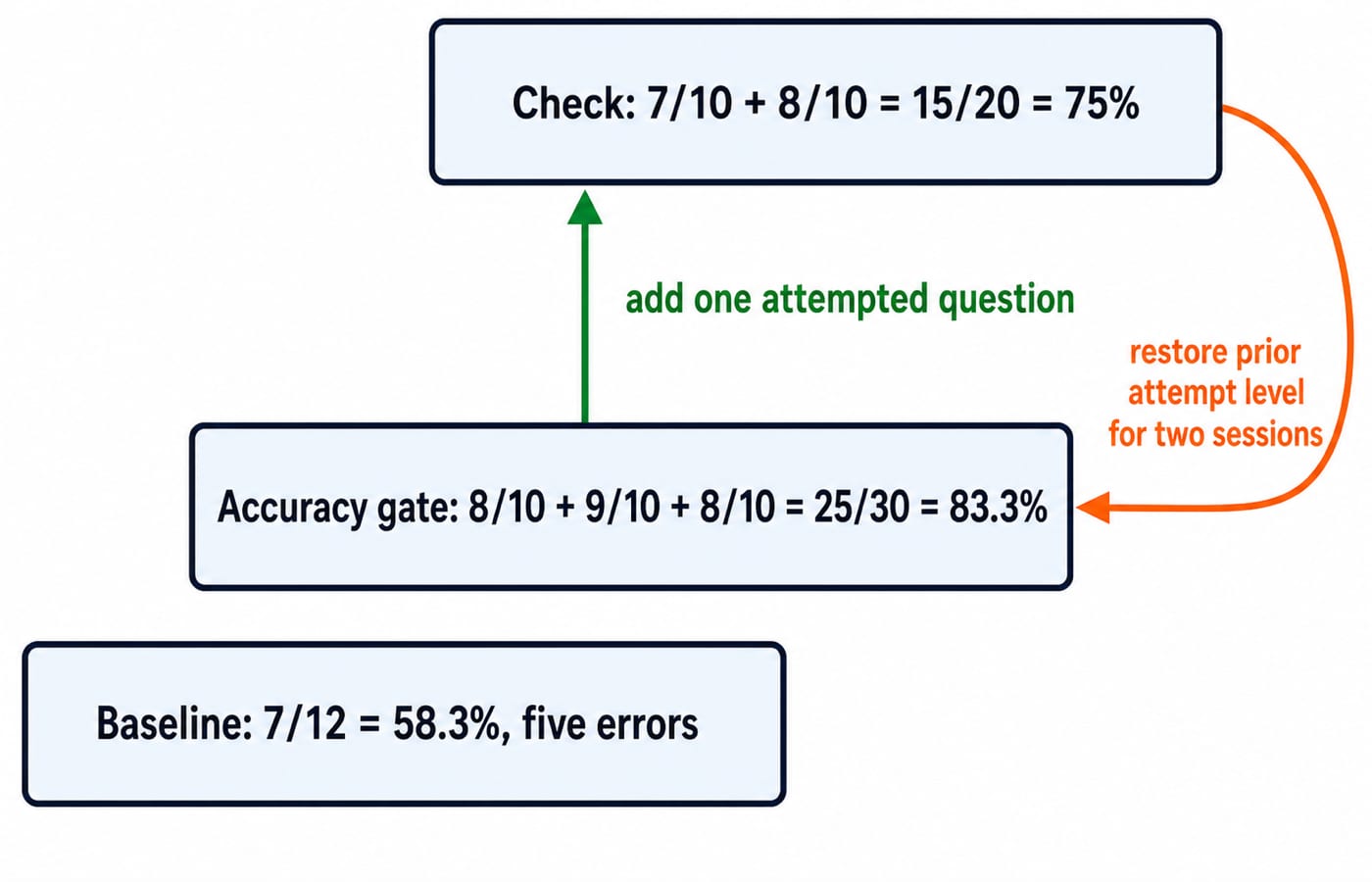
Complete three comparable 10-question home drills and require at least 80% combined accuracy before adding one attempted question or trimming time. Eighty per cent is high enough that one lucky guess cannot carry a drill. Keep passage length, difficulty and question mix similar across the drills, and record the same evidence fields used at baseline. Scores of 8/10, 9/10 and 8/10 produce 8 + 9 + 8 = 25 correct, then 25 / 30 x 100 = 83.3%. The gate holds, so speed may rise by one small step.
If the next two drills produce 7/10 and 8/10, the result is 7 + 8 = 15, then 15 / 20 x 100 = 75%. Restore the earlier attempt level for two sessions and repair the new error cluster. Do not respond by rushing harder.
Build CAT VARC speed by compressing one stage at a time
Compare like with like: the same 650-word home-practice passage length and a five-question set. In Session 1, reading takes 11:00 and answering 9:00, a 20:00 total, with 4/5 correct. By Session 5 only reading has been trimmed, to 10:00, so the total is 19:00, still 4/5. By Session 9 only answering has moved, to 8:00, an 18:00 total, and accuracy holds at 4/5.
Change only one stage in a step. Reduce reading time or answer time, never both together. If accuracy falls to 3/5, restore the previous time for the next two comparable passages. Then inspect whether the loss came from the paragraph map, evidence search or elimination.
The verbal section in Aptitude for Placements: Section Topics and Weekly Plan drills the same named-defect elimination on shorter passages, useful on a day when a full 650-word passage will not fit.
Passage selection, the error audit and missed days keep the plan honest
Spend 90 seconds choosing the passage before a drill. Weigh three cards. Card A is a 620-word psychology passage with clear cause and effect. Card B is a 550-word aesthetics passage with two nested arguments. Card C is a 680-word environmental-policy passage organised as claim and counterclaim. Rank A first, C second and B third, because structure decides difficulty rather than word count: B is the shortest card and still the hardest to map.
Use Sunday to measure repair. The learner began at 7/12, which is 7 / 12 x 100 = 58.3%. On a comparable 12-question retest, 9/12 gives 9 / 12 x 100 = 75%. If two of the three remaining errors are extreme-word traps, put the next week's extra 60 minutes into option elimination, not another random passage.
Never double the next day after a miss. If Wednesday's 60 minutes are lost, keep Thursday's planned session, move one 30-minute mapping block to Saturday and drop the other 30 minutes. Preserve the Sunday audit because feedback is what makes the plan adapt.
The short version: defend answers first, then earn speed
Follow the sequence: map the passage, identify evidence, eliminate by named defect, audit errors, pass the accuracy gate and then increase pace by one small step. Eight review-led hours beat a larger attempt count that hides the same reasoning errors.
If you want the broader preparation plan organised in one place, the CAT Preparation Course is the structured next step. Keep your immediate goal simple: make each answer defensible before asking yourself to produce more of them.
Keep learning

CAT Mock Analysis: Diagnose Time, Accuracy and Question Choice
Turn one mock into a practical review sheet. Separate execution, selection and reach problems, then test one measurable rule per section.
Updated 22 Aug 20265 min readMBA Entrance (CAT)

CAT for Non-Engineers: Build a Quant Foundation Before Chasing Shortcuts
Use this 12-week quant plan to find your real gaps, rebuild core relationships, revisit errors and add timed mixed practice only when the foundation is ready.
Updated 20 Aug 20266 min readMBA Entrance (CAT)

CAT Preparation for Working Professionals: A Sustainable 10-Hour Week
Build a repeatable CAT week around a full-time job, then use completed work and error patterns to decide what the next 600 minutes should contain.
Updated 18 Aug 20266 min readMBA Entrance (CAT)

CAT Quant for Non-Engineers: A 16-Week Foundation Plan Without Shortcuts
Rebuild CAT quant in dependency order: a 24-question diagnostic, a 16-week 160-hour map, an exact 10-hour week, an accuracy gate and a missed-day rule.
Updated 16 Aug 20265 min readMBA Entrance (CAT)