CAT DILR Set Selection: Choose the Right Set With a Four-Step Filter
Stop choosing DILR sets by familiarity alone. Score each candidate on four visible features, rank the options, and test the method on a fully solved sales set.
KnowledgeGate Team
Exam prep & CS education
Updated 23 Jul 20266 min read

You may solve a DILR set in practice and still lose by choosing badly. An intimidating set can waste time, while a familiar one can hide cases. Set selection is therefore a separate skill from set solving. The filter below scores every candidate on four visible features: representation cost, anchors, branching, and question payoff. It is a trained habit rather than an official rule, and it belongs in every mock you sit during your CAT and MBA entrance preparation.
1. The four-step filter in one scan
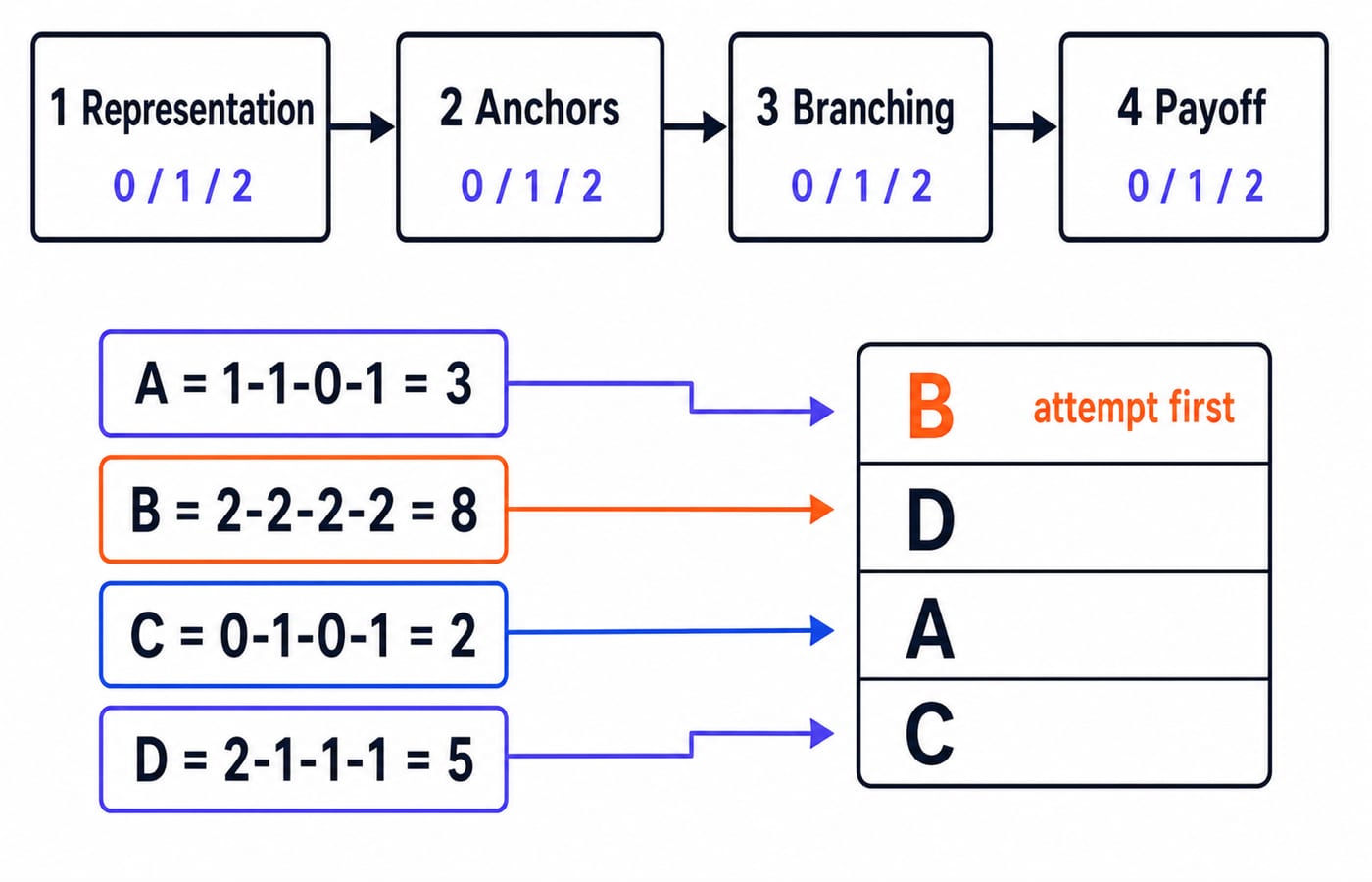
Use this exact sequence: (1) representation cost, (2) anchor density, (3) branching burden, and (4) question payoff. Score each feature from 0 to 2.
The maximum is 8. Higher means “attempt earlier”, not “guaranteed easy”. Use it to compare sets, then adjust cut-offs after mock reviews.
In practice, scan each candidate for at most 90 seconds and write a score such as 2-2-2-2. Four scans take at most 4 x 90 = 360 seconds, or 6 minutes. Reserve up to 2 more minutes to compare the top two. These are training limits, not official timings.
2. Step 1: Price the representation before doing algebra
Ask whether the information has an obvious home. Score 2 for one compact view with no more than two changing attributes, 1 for two linked views, and 0 when the representation remains unclear.
Stores A to D with two sales days fit one Store x Day table, so score 2. An eight-person circle with four colours needs a circle and an attribute table. It starts at 1, or 0 if clues do not connect the views.
“It is a circular arrangement” names the genre. It does not prove that the circle will fill quickly.
3. Step 2: Count hard anchors, not clues
A hard anchor can be entered immediately: B = Tuesday, A is opposite E, or Store C total = 120. H is not red and P is before R restrict but usually place nothing.
Score 2 when anchors start several positions and force a chain, 1 when one or two starts leave gaps, and 0 when nearly every clue needs another. Underline anchors while scanning.
Six clues can beat ten. Direct totals plus row equations may open a table, while ten negative clues leave many arrangements alive.
4. Step 3: Estimate the branching burden
Score 2 for no split or one that collapses immediately, 1 for two genuine cases, and 0 for four or more live cases or a nested split.
A is Monday or Thursday creates 2 cases. Add independent red or blue for C: 2 x 2 = 4. Add independent morning or evening: 2 x 2 x 2 = 8. Eight branches may be solvable, but they are a poor first choice when another set has none.
Dependent choices may collapse after an anchor, so count live cases instead of multiplying mechanically.
5. Step 4: Inspect what the questions return
Score 2 when at least 3 of 4 questions become look-ups or one-line calculations after the base diagram, 1 when only 2 do, and 0 when each creates fresh cases.
“What is Tuesday sales for Store C?” is a direct look-up. “Which option could be the complete order?” may require testing four options after partial deductions.
Prefer a longer base table that settles four local questions over an elegant puzzle demanding a new branch per question. You are buying expected return here: a high payoff score still assumes your base diagram actually closes.
6. Worked example: rank four sets, then cash the best one
The four sets below are teaching examples, not CAT previous-year sets.
Set A: Talks A to G run Monday to Sunday, with two fixed placements and three independent either-or clues.
Set B: Two-day sales totals come with one equation for each of four stores.
Set C: Seat A to H in a circle with four colours repeated twice. Only
A opposite EandB immediately clockwise of Fare direct anchors; six other clues are relative or negative.Set D: Analyse a five-team round robin with 3 points for a win, 1 for a draw, and 0 for a loss. The totals are P=9, Q=7, R=5, S=4, and T=2, with several results unknown.
The scores are A=1 + 1 + 0 + 1 = 3, B=2 + 2 + 2 + 2 = 8, C=0 + 1 + 0 + 1 = 2, and D=2 + 1 + 1 + 1 = 5. Rank them B, D, A, C. Choose B for its visible structure, not its topic label.
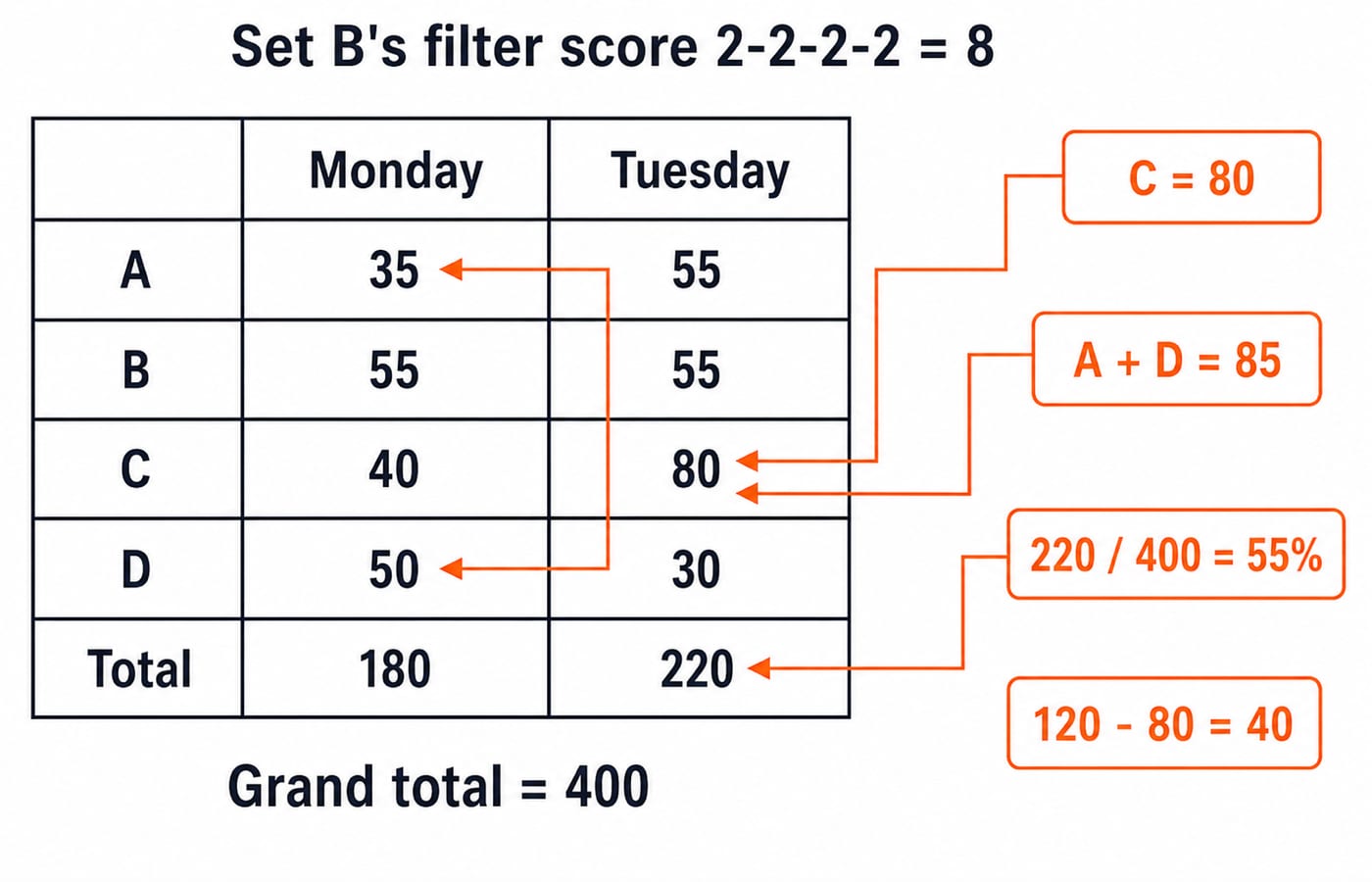
Set B is four stores and their two-day totals: Store A 90, Store B 110, Store C 120, and Store D 80. One equation per store fixes the Monday and Tuesday split.
Store A:
M + T = 90,T = M + 20. Thus2M + 20 = 90,2M = 70,M = 35, andT = 55.Store B: Monday equals Tuesday, so
2M = 110, givingM = 55andT = 55.Store C:
T = 2M, soM + 2M = 120,3M = 120,M = 40, andT = 80.Store D:
M = T + 20, so(T + 20) + T = 80,2T = 60,T = 30, andM = 50.
Monday is 35 + 55 + 40 + 50 = 180. Tuesday is 55 + 55 + 80 + 30 = 220. The grand total, 180 + 220 = 400, matches 90 + 110 + 120 + 80 = 400. Every line is a single linear equation, so if this arithmetic is what costs you seconds in the exam hall, the repair belongs in your aptitude for placements groundwork, not in the selection filter.
The base table answers four questions:
Highest Tuesday sales: Store C with 80.
Combined Tuesday sales for Store A and Store D:
55 + 30 = 85.Tuesday's share of the grand total:
220 / 400 = 0.55 = 55%.Difference between Store C's and Store D's two-day totals:
120 - 80 = 40.
7. Traps, overrides, and how CAT frames DILR
Familiarity bias: Recognition causes premature commitment and hidden casework. Score before choosing.
Sunk-cost bias: Four or five fruitless minutes feel too costly to abandon. Pre-set an exit trigger: “no new forced entry after two passes through the clues”.
False-easy bias: A neat diagram can hide option testing. Inspect questions before selecting.
If you spot a forced deduction missed during the scan, promote the set. Record why in your mock log instead of changing the score after seeing the result.
CAT sets Data Interpretation & Logical Reasoning as its own section, so the order you attempt sets in is entirely your call. The official CAT site at iimcat.ac.in carries the notification for each cycle, which is where the number of sets, the question count, the sectional timing and the marking rules are stated. Take those numbers from there and set your scan budget accordingly; the filter only decides the order in which you spend it.
8. Short version and the next practice drill
Remember: represent, anchor, branch, cash. Scan, score, rank, attempt the top set, and leave at your exit trigger. Log mock, set, R-A-B-Q score, attempt order, minutes spent, questions correct, and selection error.
For the next three sessions, scan four sets under the 90-second training cap. Solve the top-ranked set first, then compare ranking with actual time and accuracy. Twelve scored decisions are enough to locate your own cut-off, and to settle whether a 5 built on clean anchors serves you better than a 6 whose points came mostly from payoff.
To make the scan a daily reflex rather than a mock-day experiment, work it into a 30-day aptitude practice routine. For a structured CAT study path around it, continue with the CAT Preparation Course.
Keep learning

CAT Mock Analysis: Diagnose Time, Accuracy and Question Choice
Turn one mock into a practical review sheet. Separate execution, selection and reach problems, then test one measurable rule per section.
Updated 22 Aug 20265 min readMBA Entrance (CAT)

CAT for Non-Engineers: Build a Quant Foundation Before Chasing Shortcuts
Use this 12-week quant plan to find your real gaps, rebuild core relationships, revisit errors and add timed mixed practice only when the foundation is ready.
Updated 20 Aug 20266 min readMBA Entrance (CAT)

CAT Preparation for Working Professionals: A Sustainable 10-Hour Week
Build a repeatable CAT week around a full-time job, then use completed work and error patterns to decide what the next 600 minutes should contain.
Updated 18 Aug 20266 min readMBA Entrance (CAT)

CAT Quant for Non-Engineers: A 16-Week Foundation Plan Without Shortcuts
Rebuild CAT quant in dependency order: a 24-question diagnostic, a 16-week 160-hour map, an exact 10-hour week, an accuracy gate and a missed-day rule.
Updated 16 Aug 20265 min readMBA Entrance (CAT)