

Capability Maturity Model (CMM/CMMI) MCQs: 12 Solved Questions on Process Improvement Levels
Learn the historical CMM and current CMMI level names, then solve 12 exam MCQs on ordering, characteristics, KPAs, process areas, and assessment.
KnowledgeGate Team
Exam prep & CS education
Updated 14 Nov 20267 min read

CMM questions look like memory checks, but papers mix historical CMM wording, current CMMI wording, level order, characterisations, and Key Process Areas. A label can point to the wrong level. Learn the distinction between the two terminologies first, then solve 12 questions with short explanations.
CMM and CMMI: lock the two level-name schemes first
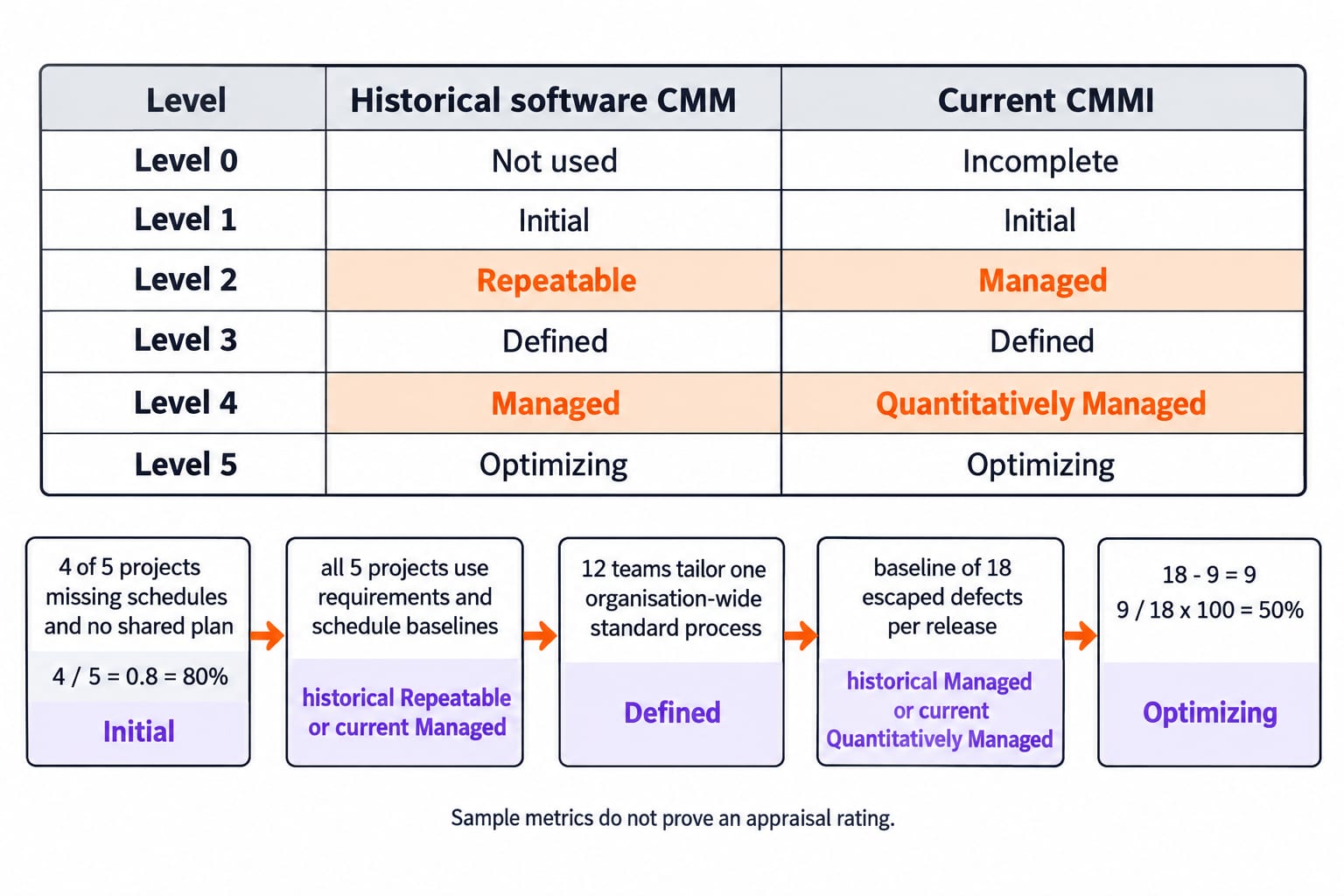
In Software Engineering for CS Teaching Exams, version matters. Most questions follow historical wording from the 1993 SEI CMM v1.1 report. The CMMI Institute supplies current wording.
Level | Historical software CMM | Current CMMI |
|---|---|---|
0 | Not used | Incomplete |
1 | Initial | Initial |
2 | Repeatable | Managed |
3 | Defined | Defined |
4 | Managed | Quantitatively Managed |
5 | Optimizing | Optimizing |
At Levels 2 and 4, current CMMI uses Managed and Quantitatively Managed. Historical CMM uses Repeatable and Managed.
Consider an illustration, not a real appraisal. An organisation starts with 4 of 5 projects missing schedules and no shared plan. Here, 4 / 5 = 0.8 = 80%, showing Initial. Next, all 5 projects use requirements and schedule baselines, showing historical Repeatable or current Managed. Then 12 teams tailor one organisation-wide standard process, showing Defined.
Those 12 teams track cycle time, schedule variance, and a baseline of 18 escaped defects per release, showing historical Managed or current Quantitatively Managed. A root-cause experiment reduces escaped defects from 18 to 9 across the next 6 releases. The reduction is 18 - 9 = 9, and 9 / 18 x 100 = 50%, showing Optimizing. Sample metrics do not prove an appraisal rating.
Questions 1-3: purpose, process improvement, and the Defined level
The question headings carry exam and year attributions. Individual question pages are currently unavailable, so use NTA UGC NET Paper 2 as the working practice entry point.
Question 1 - What CMM is for (ISRO 2017)
Capability Maturity Model (CMM) is a methodology to
A.
develop and refine an organization's software development processB.
develop the softwareC.
test the softwareD.
All of the above
Answer: A.
CMM is a framework for developing and refining an organisation's software process. It does not itself perform the coding in B or the testing in C. Those activities may sit inside a defined process, but they are not the model's purpose. D therefore fails because B and C describe product work, not process-improvement methodology. A also does not guarantee that every resulting product will have high quality.
Question 2 - Quality and process improvement (Bihar STET 2025)
ISO 9000 and SEI CMM are both frameworks related to:
A.
Network protocolsB.
Software architectureC.
Software quality standards and process improvementD.
Software development languages
Answer: C.
Both frameworks direct attention towards managed quality and better organisational processes, so C captures their shared direction. Their scopes and structures are distinct, so this does not make ISO 9000 and SEI CMM the same kind of framework. Network protocols, software architecture, and programming languages are technical subject areas, not the common process-management concern named in the stem. That removes A, B, and D.
Question 3 - Defined means Level 3 in both schemes (TPSC 2026)
In the Capability Maturity Model (CMM), which level represents "Defined" processes ?
A.
Level 1B.
Level 2C.
Level 3D.
Level 4
Answer: C.
Defined is Level 3 in both historical CMM and current CMMI. At this stage, the organisation has standard processes that projects can tailor. Level 1 is Initial. Level 2 centres on project-level management, called Repeatable in historical CMM and Managed in current CMMI. Level 4 adds quantitative control, called Managed historically and Quantitatively Managed currently. These contrasts eliminate A, B, and D.
Questions 4-6: ordering questions and naming traps
Question 4 - Fill the historical CMM sequence (ISRO 2025)
As per the Capability Maturity Model (CMM), the process maturity levels are defined as:
Level 1: Initial
Level 2: (A)
Level 3: (B)
Level 4: (C)
Level 5: Optimizing
Identify (A), (B), and (C).
A.
A : Defined, B : Repeatable, C : ManagedB.
A : Repeatable, B : Managed, C : DefinedC.
A : Repeatable, B : Defined, C : ManagedD.
A : Defined, B : Managed, C : Repeatable
Answer: C.
Substitute the historical labels: A = Repeatable, B = Defined, C = Managed. Only C preserves that order. Current CMMI instead uses Managed at Level 2 and Quantitatively Managed at Level 4.
Question 5 - Spot the invented label (ISRO 2014)
Which of the following is not a maturity level as per Capability Maturity Model?
A.
InitialB.
MeasurableC.
RepeatableD.
Optimizing
Answer: B.
Measurable is not a historical CMM level name, so B is correct. Initial, Repeatable, and Optimizing are formal labels for Levels 1, 2, and 5.
Question 6 - Reorder letter-coded levels (UGC NET 2025)
As per the Software Engineering Institute (SEI), arrange these levels in the correct sequence:
A. Initial
B. Repeatable
C. Managed
D. Optimizing
E. Defined
Choose the correct answer from the options below.
A.
A, B, C, D, EB.
A, B, E, C, DC.
A, E, C, D, BD.
A, E, B, C, D
Answer: B.
Initial -> Repeatable -> Defined -> Managed -> Optimizing. Substitution gives A -> B -> E -> C -> D, which is option B. Every other sequence misplaces a level.
Questions 7-9: match levels to their characteristics and terminology
Question 7 - Match Initial through Managed (UGC NET 2020)
Match List I with List II with reference to the SEI Capability Maturity Model.
List I | List II |
|---|---|
A. Initial | I. Process measurement |
B. Repeatable | II. Process definition |
C. Defined | III. Project management |
D. Managed | IV. Ad hoc |
Choose the correct answer from the options below.
A.
A-III, B-IV, C-II, D-IB.
A-IV, B-III, C-I, D-IIC.
A-IV, B-III, C-II, D-ID.
A-III, B-IV, C-I, D-II
Answer: C.
Use four clues: Initial = ADHOC, Repeatable = Project management, Defined = Process definition, Managed = Process measurement. This gives A-IV, B-III, C-II, D-I, option C.
Question 8 - Match all five characterisations (UGC NET 2018)
Match the five CMM maturity levels in List I with their characterisations in List II.
List I | List II |
|---|---|
(a) Initial | (i) Processes improve quantitatively and continually |
(b) Repeatable | (ii) The project plan comes from an organisation template |
(c) Defined | (iii) The plan uses quantitatively measurable processes |
(d) Managed | (iv) A plan may not exist or may be abandoned |
(e) Optimizing | (v) A plan exists and people follow it |
Choose the correct code from the options below.
A.
(a)-(iv); (b)-(v); (c)-(i); (d)-(iii); (e)-(ii)B.
(a)-(i); (b)-(ii); (c)-(iv); (d)-(v); (e)-(iii)C.
(a)-(v); (b)-(iv); (c)-(ii); (d)-(iii); (e)-(i)D.
(a)-(iv); (b)-(v); (c)-(ii); (d)-(iii); (e)-(i)
Answer: D.
Progress from no durable plan, to a followed project plan, an organisation template, quantitative measurement, and continual quantitative improvement. This gives (a)-(iv), (b)-(v), (c)-(ii), (d)-(iii), (e)-(i). The stem combines historical CMM and current CMMI terminology.
Question 9 - Expand KPA correctly (UGC NET 2014)
KPA in CMM stands for
A.
Key Process AreaB.
Key Product AreaC.
Key Principal AreaD.
Key Performance Area
Answer: A.
A historical CMM Key Process Area is a related group of activities and goals for building process maturity. Product, Principal, and Performance make B, C, and D distractors.
Questions 10-12: process areas, Level 5, and assessment approaches
Question 10 - Recognise Level 3 process areas (UGC NET 2014)
Requirement Development, Organizational Process Focus, Organizational Training, Risk Management and Integrated Supplier Management are process areas required to achieve maturity level
A.
PerformedB.
ManagedC.
DefinedD.
Optimized
Answer: C.
Organizational Process Focus and Organizational Training are organisation-wide clues. They point to a shared, Defined process, not merely performed or project-managed work.
Question 11 - Eliminate the non-Level-5 KPA (UGC NET 2014)
Which one of the following is not a key process area in CMM level 5 ?
A.
Defect preventionB.
Process change managementC.
Software product engineeringD.
Technology change management
Answer: C.
Historical CMM Level 5 includes Defect prevention, Process change management, and Technology change management. Software product engineering belongs to the earlier defined-process stage, making C the exception.
Question 12 - Identify the non-assessment approach (ISRO 2007 and BEL 2007)
Which of the following is not an approach to Software Process Assessment?
A.
SPICE (ISO/IEC 15504)B.
Standard CMMI Appraisal Method for Process Improvement (SCAMPI)C.
ISO 9001:2000D.
IEEE 2000:2001
Answer: D.
SPICE (ISO/IEC 15504), SCAMPI, and ISO 9001 assessment or audit practices are recognised historical references. IEEE 2000:2001 does not name a software-process assessment approach, so D is the exception.
Answer key, recurring traps, and how to review the set
Question | Answer | Cue |
|---|---|---|
1 | A | purpose |
2 | C | quality and process improvement |
3 | C | Defined |
4 | C | historical order |
5 | B | invented label |
6 | B | letter order |
7 | C | four-way match |
8 | D | five-way match |
9 | A | KPA |
10 | C | Level 3 |
11 | C | not Level 5 |
12 | D | not an assessment approach |
Three traps:
Managed moves: historical CMM Level 4, current CMMI Level 2.
Project control comes first: it precedes the organisation-wide Defined process.
Measurement is not optimisation: Level 5 needs continual improvement.
First, answer all 12 in 8 minutes and mark each version cue. Second, spend 12 minutes explaining wrong options aloud. Below 9/12, repeat the level table. At 9-10/12, revise missed distinctions. At 11-12/12, move to mixed Software Engineering questions. The practice bank has more than 15 Capability Maturity Model questions.
Short version and next practice step
Historical CMM: Initial -> Repeatable -> Defined -> Managed -> Optimizing; current CMMI uses Managed at Level 2, Quantitatively Managed at Level 4, and adds Level 0 Incomplete.
For the Paper 2 map, use the UGC NET Computer Science syllabus areas and NET catalogue. Choose NTA UGC NET Paper 2 for theory-first study or the UGC NET Complete CS Test Series for timed practice.
Go deeper with the full courseUGC NET Computer Science (Paper 1 + Paper 2)
Keep learning

Levels of Testing MCQs: 12 Solved Questions on Unit, Integration, System and Acceptance Testing
Solve 12 testing-level MCQs while learning how scope, interfaces and the source of the expected result separate unit, integration, system and acceptance testing.
Updated 31 Oct 20268 min readMCQ Practice

OSI Model & Layers MCQs: 12 Solved Questions on PDUs and Encapsulation
Test OSI layers, PDUs, encapsulation and router traversal through solved MCQs, with explanations, a byte-by-byte frame trace and a layer-visit method.
Updated 29 Oct 20267 min read121 viewsComputer Networks MCQs

ER Diagram to Relational Model MCQs: 12 Solved Questions
Solve 12 ER mapping questions, then use a compact rule table and a five-relation worked example to check every table count and key placement.
16 Sep 20267 min read176 viewsDBMS MCQs

Relational Model and Database Anomalies MCQs: 12 Solved Questions
Solve 12 relational-model MCQs, then use one concrete ENROLMENT table to understand update, insertion and deletion anomalies without memorising labels.
Updated 31 Oct 20268 min readDBMS MCQs