Relational Model and Database Anomalies MCQs: 12 Solved Questions
Solve 12 relational-model MCQs, then use one concrete ENROLMENT table to understand update, insertion and deletion anomalies without memorising labels.
KnowledgeGate Team
Exam prep & CS education
Updated 6 Sep 20268 min read
Relational-model questions look like vocabulary tests, but they often hide a direction switch between row and column, cardinality and degree, or schema and current instance. Anomaly questions add another trap: they ask what duplicated data can break, not merely what it stores. Work through the 12 questions before reading their explanations, then use the ENROLMENT case to trace update, insertion and deletion anomalies. The CS Fundamentals for Exams & Placements collection places relational models beside keys, normalization and functional dependencies.
Relational model basics
Formal term | Plain meaning |
|---|---|
Relation | Table |
Tuple | Row |
Attribute | Column |
Domain | Permitted values for an attribute |
Degree | Number of attributes |
Cardinality | Number of tuples |
Schema | Logical design |
Instance or snapshot | Rows currently stored |
Take INVENTORY(ItemID, ItemName, Category, Stock) with (I101, Keyboard, Peripherals, 18), (I102, Router, Networking, 9) and (I103, SSD, Storage, 14). There are four attributes and three tuples, so degree is 4 and cardinality is 3.
Now add attributes SupplierEmail, WarehouseCity and ReorderLevel. The three existing tuples gain one value or NULL for each new attribute. Also add (I104, Monitor, Display, 12, display@x.in, Jaipur, 5), (I105, Webcam, Peripherals, 20, vision@x.in, Patna, 8), (I106, Switch, Networking, 7, net@x.in, Lucknow, 4) and (I107, UPS, Power, 11, power@x.in, Delhi, 3). New degree = 4 + 3 = 7. New cardinality = 3 + 4 = 7. Columns change degree; rows change cardinality.
Formally, for attribute domains D1, D2, ..., Dn, all possible ordered tuples form D1 x D2 x ... x Dn. A relation is a subset of that Cartesian product, not a union or intersection.
Relation, schema and cardinality
Question 1
A relation in a relational database is also known as:
A. A data type
B. An attribute
C. A schema
D. A table
Correct answer: D. A table.
A relation is the table. A tuple is a row; an attribute is one column; a data type defines a domain; a schema describes logical design.
Question 2
Consider following two statements: Statement I: Relational database schema represents the logical design of the database. Statement II: Current snapshot of a relation only provides the degree of the relation. In the context to the above statements, choose the correct option from the options given below:
A. Statement I is TRUE but Statement II is FALSE
B. Statement I is FALSE but Statement II is TRUE
C. Both Statement I and Statement II are FALSE
D. Both Statement I and Statement II are TRUE
Correct answer: A. Statement I is TRUE but Statement II is FALSE.
The schema fixes logical design. A snapshot contains tuples and current cardinality, not only degree. INVENTORY is the schema; its three rows are an instance.
Question 3
Degree and cardinality of a relation in relational database are 4 and 3 respectively. If 3 attributes and 4 tuples are added to the relation, what will be its new cardinality and degree?
A. 7, 6
B. 7, 7
C. 8, 6
D. More than one of the above
E. None of the above
Correct answer: B. 7, 7.
The order is cardinality, then degree: 3 + 4 = 7 tuples and 4 + 3 = 7 attributes. Their equality is coincidental.
Atomic values, integrity and domains
Question 4
Given the basic ER and relational models, which of the following is INCORRECT?
A. An attribute of an entity can have more than one value
B. An attribute of an entity can be composite
C. In a row of a relational table, an attribute can have more than one value
D. In a row of a relational table, an attribute can have exactly one value or a NULL value
Correct answer: C. In a row of a relational table, an attribute can have more than one value.
ER entities allow multivalued and composite attributes. A relational cell holds one atomic value or NULL. Store two phone numbers as separate VENDOR_PHONE(V201, 9876000011) and VENDOR_PHONE(V201, 9876000022) tuples.
Question 5
How does a relational database ensure data integrity?
A. By encrypting all data stored
B. By enforcing rules defined in the schema
C. By compressing data for efficient storage
D. By allowing unrestricted access to all users
Correct answer: B. By enforcing rules defined in the schema.
Declared rules protect integrity. A primary key blocks a duplicate VendorID, CHECK (Rating BETWEEN 1 AND 5) rejects 8, and a foreign key requires each PartID to exist. Encryption and compression do not.
Question 6
If D1, D2...Dn are domains in a relational model, then the relation is a table, which is a subset of
A. D1⊕D2⊕...⊕Dn
B. D1xD2x...xDn
C. D1∪D2∪...∪Dn
D. D1∩D2∩...∩Dn
Correct answer: B. D1xD2x...xDn.
A tuple takes one value from each domain, so tuples form the Cartesian product. A relation contains some; union and intersection do not construct ordered tuples.
Formal relational terms, constraints and count traps
Question 7
Match the following formal relational terms with their informal equivalents. Column I (Formal terms) i. Relation ii. Tuple iii. Domain iv. Attribute Column II (Informal equivalents) 1. Row 2. Column 3. Table 4. Set of permitted values for an attribute
A. i-3, ii-4, iii-1, iv-2
B. i-3, ii-1, iii-4, iv-2
C. i-1, ii-3, iii-2, iv-4
D. i-4, ii-3, iii-2, iv-1
Correct answer: B. i-3, ii-1, iii-4, iv-2.
Match anchors first: relation to table, tuple to row, domain to permitted-value set, and attribute to column. That gives i-3, ii-1, iii-4, iv-2.
Question 8
Which of the following options best describes a domain constraint in a database system?
A. Guarantees that foreign keys link to a valid primary key
B. Restricts column values to a defined data type and valid range
C. Ensures each table name is unique
D. Prevents duplicate records in a table
Correct answer: B. Restricts column values to a defined data type and valid range.
A domain constraint controls allowed values. For integer Score from 0 to 100, 81 is valid; 'high' and 135 are not. A is referential integrity; D concerns uniqueness.
Solved question.
Question 9
The cardinality of a relational table with 5000 rows and 10 columns is –
A. 5000
B. 10
C. 500
D. 50000
Correct answer: A. 5000.
Cardinality counts rows, so it is 5000; 10 columns means degree 10. Identify which direction the question asks for.
Table structure, redundancy and tuples
Question 10
Which of the following best describes the structure of a relational database?
A. Data organized into tables with rows and columns
B. Data organized into files and folders
C. Data organized into a hierarchical tree structure
D. Data organized into a network of interconnected nodes
Correct answer: A. Data organized into tables with rows and columns.
Relations are tables of rows and columns. Files, folders, trees and node networks describe other models. Keys connect tables without changing that foundation.
Question 11
Which option gives the complete effect when the same piece of data is stored in two places in a database?
A. Storage space is wasted and changing the data in one spot will cause data inconsistency
B. Changing the data in one spot will cause data inconsistency
C. Storage space is wasted
D. The duplicate values are always synchronized automatically
E. Neither storage nor consistency is affected
Correct answer: A. Storage space is wasted and changing the data in one spot will cause data inconsistency.
A names both costs. Repeating 9876100011 in two P501 rows wastes storage; changing only one copy to 9876100099 creates conflicting values and an update anomaly.
Question 12
In a relational database model, what is a tuple?
A. A collection of attributes
B. The overall database schema
C. A table column
D. An individual row or record in a table
Correct answer: D. An individual row or record in a table.
A tuple is a complete row, such as (I103, SSD, Storage, 14). Stock is an attribute; the schema defines the relation design.
Solved question.
One table that exposes update, insertion and deletion anomalies
Consider SUPPLY(VendorID, VendorName, PartID, PartName, BuyerPhone):
VendorID | VendorName | PartID | PartName | BuyerPhone |
|---|---|---|---|---|
V201 | Kavya | P501 | Sensor Module | 9876100011 |
V202 | Imran | P501 | Sensor Module | 9876100011 |
V203 | Leela | P702 | Network Router | 9876200022 |
Its dependencies are VendorID -> VendorName and PartID -> PartName, BuyerPhone; its row key is (VendorID, PartID).
Update anomaly: when P501's buyer phone becomes
9876100099, both P501 rows must change. Updating only V201 leaves V202 stale.Insertion anomaly:
(P803, Battery Pack, 9876300033)cannot be stored before a vendor supplies it unless we invent or null vendor data.Deletion anomaly: deleting Leela's only supply row also removes the only facts for P702 and
9876200022.
The DBMS Normalization Explained Simply for GATE diagnosis leads to three relations: VENDOR(VendorID, VendorName), PART(PartID, PartName, BuyerPhone) and SUPPLY(VendorID, PartID). Now the phone changes once, P803 can exist independently, and deleting V203's supply row preserves P702. Study Normalization in DBMS: 1NF to BCNF next for the structured normal-form route.
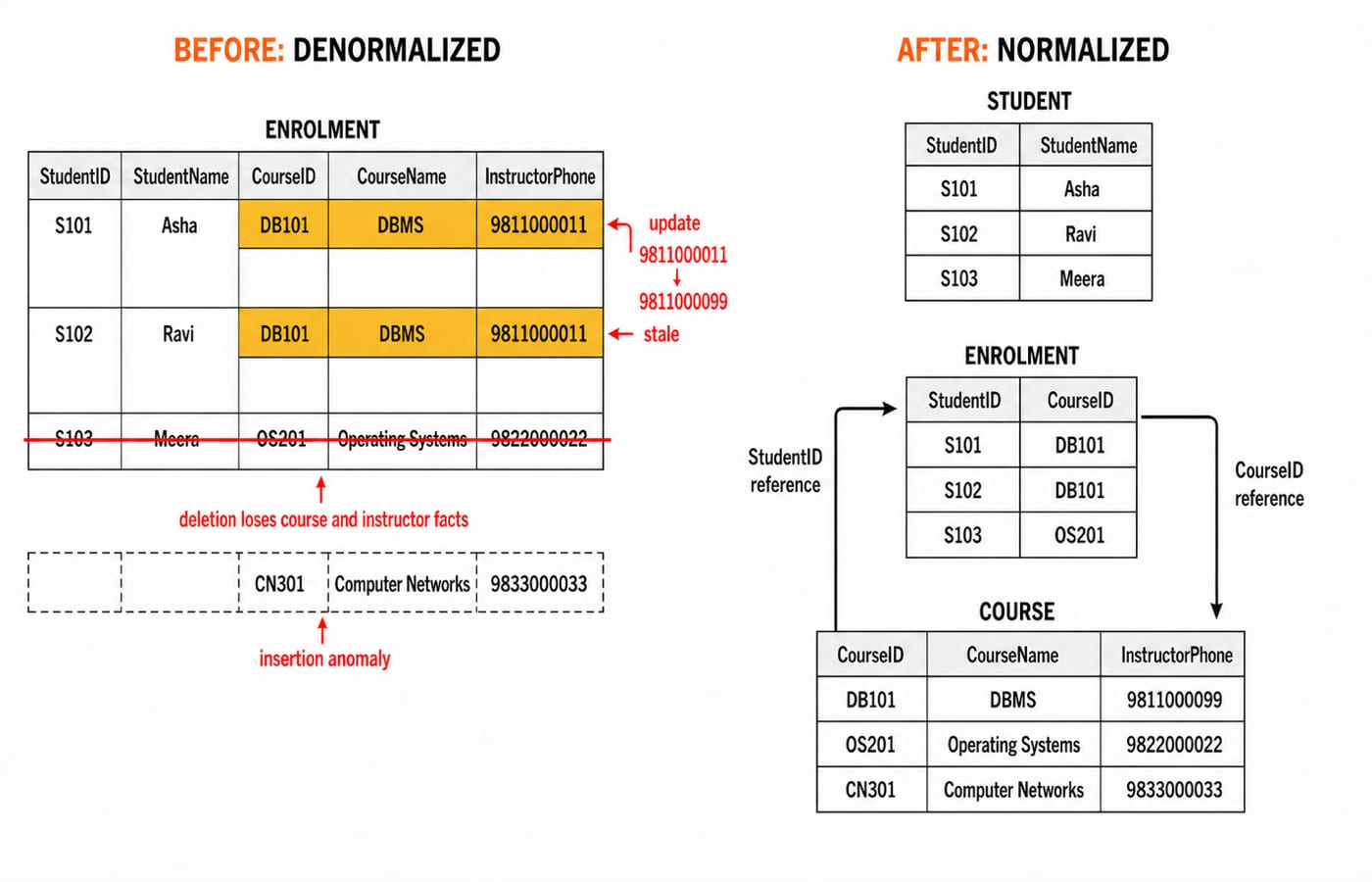
The figure applies the same diagnosis to a separate student-enrolment example, showing the repeated course facts before and after decomposition.
Relational model traps and the next practice step
Trap | Questions to revisit |
|---|---|
Relation vs attribute | Q1 and Q10 |
Schema vs instance | Q2 |
Cardinality vs degree | Q3 and Q9 |
ER multivalued attribute vs atomic relational cell | Q4 |
Domain vs key or referential constraint | Q5, Q6 and Q8 |
Redundancy vs anomaly | Q11 and the |
Use a 30-second routine: translate terms into table language, mark rows or columns, notice only, INCORRECT and NOT, then test one tuple. For anomalies, find the repeated fact and ask what insert, update or delete can break.
Next, study Attribute Closure and Candidate Keys for GATE. Use GATE Guidance by Sanchit Sir for sequenced GATE CS study.
The short version is simple: rows determine cardinality, columns determine degree, schema rules protect integrity, and repeated facts create the conditions for anomalies.
Keep learning
SQL Library Functions MCQs: 12 Solved Math, Aggregate, String and Date Questions
Practise 12 solved SQL library function MCQs with inside-out calculations, exact intermediate values and clear explanations of the common traps.
Updated 3 Oct 20268 min readDBMS MCQs
SQL Introduction, Components & Structure MCQs: 12 Solved Questions
Test your SQL foundations with 12 explained MCQs covering terminology, query behaviour, metadata, dynamic SQL, database models and QBE.
28 Sep 20267 min readDBMS MCQs
GROUP BY Clause MCQs: 10 Solved SQL Questions with Explanations
Solve ten published GROUP BY questions, then check each answer with row-level and group-level reasoning. Two full traces make the common SQL traps visible.
Updated 25 Sep 20268 min readDBMS MCQs
Third Normal Form (3NF) MCQs: 12 Solved Questions with Explanations
Solve 12 real 3NF exam MCQs with clear explanations, candidate-key closures, a raw-row decomposition, and the prime-attribute exception that separates 3NF from BCNF.
Updated 24 Sep 20267 min readDBMS MCQs