ER Diagram to Relational Model MCQs: 12 Solved Questions
Solve 12 ER mapping questions, then use a compact rule table and a five-relation worked example to check every table count and key placement.
KnowledgeGate Team
Exam prep & CS education
16 Sep 20267 min read63 views

Before counting tables, identify cardinality, participation, weak entities, multivalued attributes and relationship attributes. The usual error is treating every diamond as a table.
Sketch relations and mark primary and foreign keys before checking the options. CS Fundamentals for Placements connects this topic to wider DBMS.
ER-to-relational mapping rules to use before the MCQs
ER component | Relational mapping |
|---|---|
Regular entity | One relation. |
1:1 or 1:N relationship without attributes | Usually a foreign key on the suitable side. |
M:N relationship | A bridge containing both entity keys. |
Multivalued attribute | A relation with the owner key and attribute. |
Weak entity | A relation including its owner's key. |
Relationship attribute | Store in the relation representing the relationship. |
Total participation affects nullability or merging, not entity existence. ER Model to Relational Mapping for GATE gives the full method.
Map Department(DeptID, DeptName), Student(StudentID, StudentName, {Phone}) and Course(CourseID, CourseTitle). Department-Student is 1:N; Student-Course is M:N through Enrols with Grade and EnrolledOn.
DEPARTMENT(DeptID PK, DeptName):(D10, CSE).STUDENT(StudentID PK, StudentName, DeptID FK):(101, Asha, D10)and(102, Rohan, D10).DeptIDabsorbs1:N; no sixth table is needed.COURSE(CourseID PK, CourseTitle):(DB201, Database Systems)and(CN202, Computer Networks).ENROLMENT(StudentID FK, CourseID FK, Grade, EnrolledOn, PK(StudentID, CourseID)):(101, DB201, A, 2026-07-01),(101, CN202, B+, 2026-07-02)and(102, DB201, A-, 2026-07-01).STUDENT_PHONE(StudentID FK, Phone, PK(StudentID, Phone)):(101, 9876501111),(101, 9876502222)and(102, 9876503333).
The count is 3 entity relations + 1 M:N bridge + 1 multivalued-attribute relation = 5.
MCQs 1-3: relationship types, participation and bridge relations
Question 1
TPSC 2025, Assistant Programmer.
Which of the following is a type of relationship in a relational database ?
A. One-to-one
B. One-to-many
C. Many-to-many
D. All of the above
Answer: D. All of the above. Foreign keys map 1:1 and 1:N; M:N needs a bridge.
Question 2
Coal India 2017.
Which of the following is used to specify whether the existence of an entity depends on its being related to another entity via the relationship type?
A. Entity integrity constraint
B. Foreign key constraint
C. Cardinality ratio
D. Participation constraint
Answer: D. Participation constraint. Cardinality gives counts; participation says whether involvement is mandatory.
Question 3
LTI Mindtree 2025.
Which of the following results in each related entity set having its own schema, along with an additional schema being created for the relationship set?
A. A many-to-many relationship set
B. A multivalued attribute of an entity set
C. A one-to-many relationship set
D. None of the mentioned
Answer: A. A many-to-many relationship set. Student and Course remain; ENROLMENT(StudentID, CourseID, Grade, EnrolledOn) represents their matches.
MCQs 4-6: multivalued attributes, relationship merging and 3NF counts
Question 4
CoCubes 2024.
In which of the following, a separate schema is created consisting of that attribute and the primary key of the entity set.
A. A many-to-many relationship set
B. A multivalued attribute of an entity set
C. A one-to-many relationship set
D. All of the mentioned
Answer: B. A multivalued attribute of an entity set. STUDENT_PHONE(StudentID, Phone) keeps values atomic; both columns form the key.
Question 5
GATE 2017, Set 2.
An ER model of a database consists of entity types A and B. These are connected by a relationship R which does not have its own attribute. Under which one of the following conditions, can the relational table for R be merged with that of A?
A. Relationship R is one-to-many and the participation of A in R is total
B. Relationship R is one-to-many and the participation of A in R is partial
C. Relationship R is many-to-one and the participation of A in R is total
D. Relationship R is many-to-one and the participation of A in R is partial
Answer: C. A carries B's foreign key, and total participation permits merging.
Question 6
GATE 2004, Information Technology.
Consider the following entity relationship diagram (ERD), where two entities E1 and E2 have a relation R of cardinality 1 : m.

The attributes of E1 are A11, A12 and A13 where A11 is the key attribute. The attributes of E2 are A21, A22 and A23 where A21 is the key attribute and A23 is a multi-valued attribute. Relation R does not have any attribute. A relational database containing minimum number of tables with each table satisfying the requirements of the third normal form (3NF) is designed from the above ERD. The number of tables in the database is
A. 2
B. 3
C. 5
D. 4
Answer: B. 3. Create E1 and E2, with A11 in E2 as a foreign key. Add E2_A23(A21, A23) for A23. Thus 2 + 0 + 1 = 3; R adds nothing.
MCQs 7-9: why a 1:N plus M:N pattern gives three tables
For each count, model the 1:N relationship with a foreign key and the M:N relationship with a bridge.
Question 7
ISRO 2025.
Let A and B be two entities in an E-R diagram, each having only simple single-valued attributes. R1 and R2 are two relationships between A and B. R1 is one-to-many from A to B, and R2 is many-to-many from A to B. What is the minimum number of tables required to represent A, B, R1 and R2 in the relational model?
A. 4
B. 2
C. 6
D. 3
Answer: D. 3. A and B give two relations. R1 becomes B's foreign key; R2 adds a bridge: 2 + 0 + 1 = 3.
Question 8
GATE 2005.
Let E₁ and E₂ be two entities in an E/R diagram with simple single-valued attributes.
R₁ and R₂ are two relationships between E₁ and E₂, where R₁ is one-to-many and R₂ is many-to-many.
R₁ and R₂ do not have any attributes of their own.
What is the minimum number of tables required to represent this situation in the relational model?
A. 2
B. 3
C. 4
D. 5
Answer: B. 3. E₁ and E₂ give two relations. R₁ becomes a foreign key; R₂ needs a bridge.
Question 9
UGC NET January 2017.
Let M and N be two entities in an E-R diagram with simple single value attributes. R1 and R2 are two relationship between M and N, where as
R1 is one-to-many and R2 is many-to-many.
The minimum number of tables required to represent M, N, R1 and R2 in the relational model are _______.
A. 4
B. 6
C. 7
D. 3
Answer: D. 3. M and N give two relations, R1 a foreign key, and R2 a bridge.
MCQs 10-12: weak entities, relationship attributes and multivalued mappings
Question 10
GATE 2008.
Consider the following ER diagram.
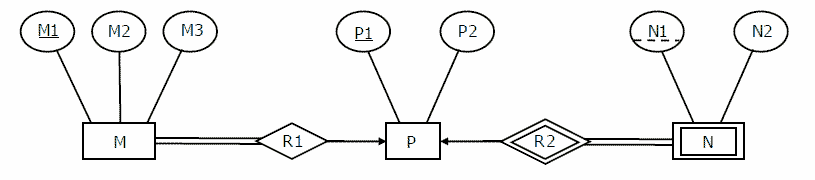
The minimum number of tables needed to represent M, N, P, R1, R2 is
A. 2
B. 3
C. 4
D. 5
Answer: B. 3. Create M, P and weak N. P's key enters M and combines with N1 in N; neither relationship adds a table.
Question 11
ISRO 2015.
Consider the following Relationship Entity Diagram(ERD)
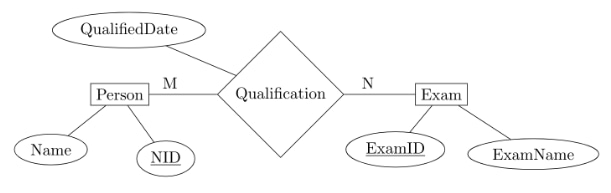
Which of the following possible relations will not hold if the above ERD is mapped into a relation model?
A. Person (NID, Name)
B. Qualification (NID, ExamID, QualifiedDate)
C. Exam (ExamID, NID, ExamName)
D. Exam (ExamID, ExamName)
Answer: C. Exam (ExamID, NID, ExamName) will not hold. The M:N association belongs in Qualification, not Exam.
Question 12
TPSC 2026.
When converting an E-R diagram to a relational schema, how is a multivalued attribute typically represented in the relational model?
A. As a composite attribute
B. As a nullable column in the same table
C. As an attribute with CHECK constraints
D. As a separate relation with a foreign key
Answer: D. As a separate relation with a foreign key. A multivalued attribute can contain several values for one entity row, so placing it in one column would violate first normal form. Create a separate relation containing the owner's key as a foreign key and the attribute value; together they usually form the relation's key.
The five ER-mapping traps these questions expose
Trap | Questions that expose it |
|---|---|
Every diamond becomes a table | 3 and 7-9 |
Cardinality confused with participation | 1 and 2 |
Multivalued attribute left in the entity row | 4 and 6 |
Foreign key placed on the wrong side | 5 |
Weak entity or relationship attribute missed | 10-12 |
Count entities, then add M:N or n-ary relationships and multivalued attributes. Check 1:1 and 1:N for foreign-key absorption. Participation affects nullability.
ER diagram to relational model MCQs: the next practice step
Redo Questions 5, 6, 10 and 11 without options. Write schemas, mark primary and foreign keys, then verify the counts.
Use Attribute Closure and Candidate Keys for GATE to identify keys after deriving relations. GATE Guidance by Sanchit Sir provides a sequenced DBMS route; CS Fundamentals for Placements by Sanchit Sir provides broader placement coverage.
Entities give base relations. M:N and multivalued attributes add relations. 1:N usually becomes a foreign key on the many side.
Keep learning

SQL Library Functions MCQs: 12 Solved Math, Aggregate, String and Date Questions
Practise 12 solved SQL library function MCQs with inside-out calculations, exact intermediate values and clear explanations of the common traps.
Updated 3 Oct 20268 min readDBMS MCQs

SQL Introduction, Components & Structure MCQs: 12 Solved Questions
Test your SQL foundations with 12 explained MCQs covering terminology, query behaviour, metadata, dynamic SQL, database models and QBE.
28 Sep 20267 min readDBMS MCQs

GROUP BY Clause MCQs: 10 Solved SQL Questions with Explanations
Solve ten published GROUP BY questions, then check each answer with row-level and group-level reasoning. Two full traces make the common SQL traps visible.
Updated 25 Sep 20268 min readDBMS MCQs

Third Normal Form (3NF) MCQs: 12 Solved Questions with Explanations
Solve 12 real 3NF exam MCQs with clear explanations, candidate-key closures, a raw-row decomposition, and the prime-attribute exception that separates 3NF from BCNF.
Updated 24 Sep 20267 min readDBMS MCQs