C Tutorial: The Complete Learning Path from First Program to Pointers and Projects
Learn C in dependency order, from compiling your first program to understanding pointers, allocating memory, reading files, and completing a useful project.
KnowledgeGate Team
Exam prep & CS education
Updated 27 Jul 20266 min read
You searched for a C tutorial and found either a 40-hour video or a random page that starts in the middle. C becomes confusing when pointers arrive before functions or files arrive before arrays. Take the rungs in dependency order instead, from the first compile through pointers to a working project, and every new idea has something to attach to.
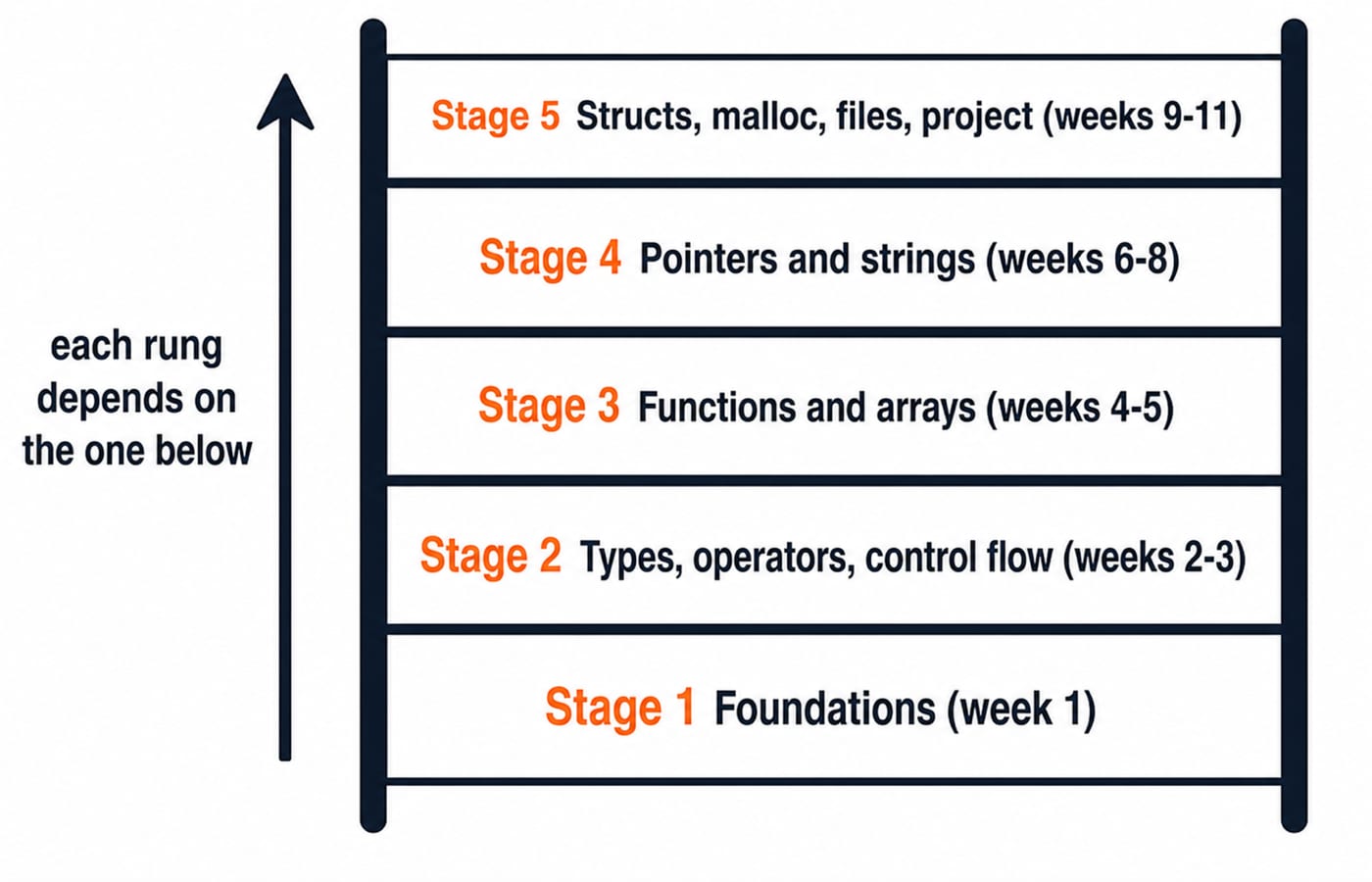
The C learning ladder at a glance
Order matters because later ideas build on earlier ones. Arrays need loops, pointers need arrays, dynamic memory needs pointers, and data structures need both structures and dynamic memory. A skipped rung creates gaps that slow every later topic.
For a college learner studying for about one hour a day, this is a realistic first pass:
Stage | Topics | Rough time |
|---|---|---|
1. Foundations | Setup, first program, compilation | Week 1 |
2. Core mechanics | Types, operators, control flow | Weeks 2 to 3 |
3. Functions and arrays | Decomposition, parameters, array processing | Weeks 4 to 5 |
4. Pointers and strings | Addresses, pointer arithmetic, character arrays | Weeks 6 to 8 |
5. Building programs | Structures, dynamic memory, files, small project | Weeks 9 to 11 |
Stage 1: Setup, your first program, and compilation
Choose one toolchain and one plain editor. On Windows, GCC through MinGW or WSL is enough. On Linux or macOS, use GCC or Clang. Do not spend this week comparing IDEs. Focus on what happens between source code and a running program.
Save this as hello.c:
#include <stdio.h>

int main(void) {
    printf("Hello, C!\n");
    return 0;
}
Compile it with:
gcc hello.c -o helloThe preprocessor expands directives such as #include. The compiler translates C into assembly. The assembler creates an object file such as hello.o, then the linker resolves printf through the C library and creates the executable.
Your self-check is simple: explain why editing hello.c does not change the old executable. The source must be compiled and linked again before the executable contains the change.
Stage 2: Data types, operators, and control flow
Start with int, float, double, and char; arithmetic and relational operators; if and else; and the three loops. Prefer for for counted repetition, know while, and recognise when do-while guarantees one execution.
Learn integer division now, because the same trap returns inside larger programs:
7 / 2     /* 3 */
7 % 2     /* 1 */
7 / 2.0   /* 3.5 */
Both operands in 7 / 2 are integers, so C produces the integer result 3. The remainder is 1. In 7 / 2.0, one operand is a double, so the calculation produces 3.5.
Before moving on, write a loop that prints the table of 7 from 7 x 1 = 7 through 7 x 10 = 70 without looking anything up.
Stage 3: Functions and arrays, with a worked example
Functions come before pointers because ordinary parameter passing teaches the baseline: C passes arguments by value. Pointers later let a function work with an address deliberately. Functions in C: Call by Value vs Simulated Call by Reference traces the classic swap that fails for exactly this reason.
Consider this array:
int marks[5] = {62, 74, 58, 91, 80};An averageMarks function can loop from index 0 to 4. Trace the sum instead of trusting the code:
Start with
sum = 0.0 + 62 = 62.62 + 74 = 136.136 + 58 = 194.194 + 91 = 285.285 + 80 = 365.The average is
365 / 5 = 73.
The return type still matters even though this answer is exact. If the last mark were 81, the sum would be 366. Integer division would produce 366 / 5 = 73, while the true average is 73.2. Casting the sum before division preserves the fractional part:
double averageMarks(const int marks[], int count) {
    int sum = 0;
    for (int i = 0; i < count; i++) {
        sum += marks[i];
    }
    return (double)sum / count;
}
For the stage self-check, add a function that finds the maximum mark. It must return 91 for this array.
Stage 4: Pointers and strings, the hard middle
Use the same array to make pointer arithmetic visible. Assume marks starts at address 1000 and an int occupies 4 bytes. Then the five elements sit at addresses 1000, 1004, 1008, 1012, and 1016. The expression marks + 3 points to address 1012, so *(marks + 3) reads the value 91.
Pointer arithmetic moves in units of the pointed-to type. Adding 3 to an int * advances by three integers, which is 12 bytes under this assumption, not 3 bytes.
![A row of five boxes for int marks[5] containing 62, 74, 58, 91, and 80, with addresses 1000, 1004, 1008, 1012, and 1016 below them, plus an arrow labelled "marks + 3" pointing to 91 at address 1012.](https://cdn.knowledgegate.ai/blog-assets/blog_asset_1784121918737_hvd1jw.jpg)
A C string is a char array ending with the null character \0. The text "hello" needs 6 bytes: five visible letters and one terminator. strlen("hello") returns 5 because it counts characters before the terminator.
This stage takes longer than expected. Draw boxes and addresses by hand, predict each expression, then run the program. Rewatching explanations without tracing memory rarely fixes the confusion.
Stage 5: Structures, dynamic memory, files, and a project
A structure lets a program keep related fields together. For example, struct Student { int roll; int marks; }; pairs a student's roll number with the mark that earlier arrays kept separately. A structure can also be larger than the sum of its fields once the compiler pads it for alignment, which Structures and Unions in C works out with sizeof problems.
Dynamic memory lets the program choose its storage size at run time. Under the same 4-byte int assumption, malloc(5 * sizeof(int)) requests 5 x 4 = 20 bytes, the same payload size as int marks[5]. Check that allocation succeeded, and ensure every successful malloc has one matching free when the owner is finished with it.
Files are how the same data survives the program exiting. fopen("marks.txt", "r") hands back a FILE *, or NULL when the file is missing, so test the result before reading anything. fscanf(fp, "%d %d", &roll, &marks) converts one roll-and-marks pair per call and returns the number of values it actually converted, so 2 on a good line and EOF once the file runs out. That return value, not a guessed count, is what the read loop should stop on, and fclose(fp) flushes and releases the handle at the end. File Handling in C works through the full mode table and the fscanf versus fgets choice.
Finish with a marks manager that reads N students from a file, stores dynamically allocated structures, and prints the average and topper. With the sample marks, it must report average 73 and topper 91. This project makes every stage work together.
After that, data structures are the natural next climb. Start with the memory-level view in Binary Trees and Binary Search Trees, where pointers connect nodes and traversal functions process them.
How exams and interviews test C
C appears in college exams, placement aptitude and coding rounds, and CS fundamentals tests. Output-prediction MCQs can test several concepts in a short program. You should trace expressions such as 7 / 2 and *(marks + 3) without guessing.
After each stage, solve output-prediction questions only on that stage's topics. Move up when you can explain every answer, including the wrong options. Once C is stable, the Data Structures MCQs guide gives you the post-C practice layer for arrays, linked structures, trees, and related reasoning.
The short version and your next step
Foundations: compile one program and explain the build pipeline.
Core mechanics: write the table-of-7 loop and predict integer division.
Functions and arrays: calculate the average and maximum correctly.
Pointers and strings: draw addresses and trace dereferences.
Building programs: complete the file-based marks manager.
For a taught version of this path, the C Programming Course covers the full ladder. The C Language Course with concepts, MCQs and coding adds question practice for each stage. Both sit in the Coding and DSA Courses catalogue.
Start Stage 1 today, compile one program, and do not touch Stage 4 until the Stage 3 self-check passes.
Keep learning
ctype.h Functions in C: Classify Characters and Convert Case Safely
Learn which character test to choose, trace a complete C classifier, and avoid signed-char and EOF mistakes. Worked examples separate classification from case conversion.
Updated 5 Oct 20266 min readC
Key Features of the C Programming Language: Code Examples
What do C's features actually do in a program? Follow an even-number sum and a pointer update, then test your understanding with small code changes.
Updated 30 Sep 20266 min readC
Preprocessor and Macros in C: Expansion Rules and Worked Examples
Learn what happens before C compilation, expand object-like and function-like macros by hand, and avoid precedence and repeated-evaluation bugs.
Updated 18 Sep 20266 min readC
Variables and Data Types in C: Declarations, Conversions and Runnable Examples
Learn how C types control stored values, expressions and I/O. Compile a complete marks program, trace its conversions and repair common type mistakes.
Updated 17 Sep 20266 min readC