BPSC Teaching Eligibility and Exam Structure: A Post-by-Post Notification Check
Build a post-specific BPSC teaching eligibility matrix, test your documents against official wording, and separate notified rules from study planning.
KnowledgeGate Team
Exam prep & CS education
Updated 28 Jul 20266 min read
BPSC teaching is not one universal eligibility row or exam pattern. The answer changes with the advertised class level, subject, post and recruitment cycle, while your degree title, teacher-training credential and eligibility-test certificate must match that exact row. The useful question is never whether you are eligible for BPSC teaching, but whether your paperwork matches the row printed in the advertisement you are applying under. The applicable BPSC advertisement and its corrections settle every point of dispute.
1. Start with the exact BPSC teaching post, not the exam nickname
Before checking eligibility, copy a six-field identity card:
advertisement number | recruitment cycle as printed | exact post and class level | subject | department or service | category claimed
For example:
Advt. No. ___ | cycle exactly as notified | Higher Secondary Teacher | Computer Science | department exactly as notified | BC
Keep the blanks until an official document supplies them. Primary, Middle, Secondary and Higher Secondary are useful ways to describe a class level while you study, but they are not interchangeable official qualification rows: two of them can demand different degrees for the same subject. Do not fill the advertisement number, cycle or department from memory, from news reports or from an expected TRE 4.0 pattern.
2. Turn the applicable notification into an eligibility matrix
Copy the official text and your document text side by side. Do not paraphrase degree titles.
Notification field | Exact official wording | Source page or clause | Candidate document | Exact document wording | Status | Missing evidence |
|---|---|---|---|---|---|---|
Post and class level | Application target | |||||
Concerned subject | Mark sheet or degree | |||||
Essential academic qualification | Degree | |||||
Accepted degree or branch titles | Degree | |||||
Minimum marks or class, if stated | Mark sheets | |||||
Teacher-training credential | Training certificate | |||||
CTET, BTET or STET, only if named | Test certificate | |||||
Age on notified cutoff date | Date-of-birth proof | |||||
Category or relaxation evidence | Category proof | |||||
Recognition, experience or domicile, only if required | Relevant proof |
Use MATCH only when the two wordings align. Use HOLD when a notification, equivalence order, cutoff, certificate-validity rule or document is missing. Use DOES NOT MATCH only when the official text excludes the route or an essential condition is absent. A higher degree, similar syllabus or another recruiter's acceptance cannot convert HOLD into MATCH.
3. Worked document audit: Ananya's Computer Science file
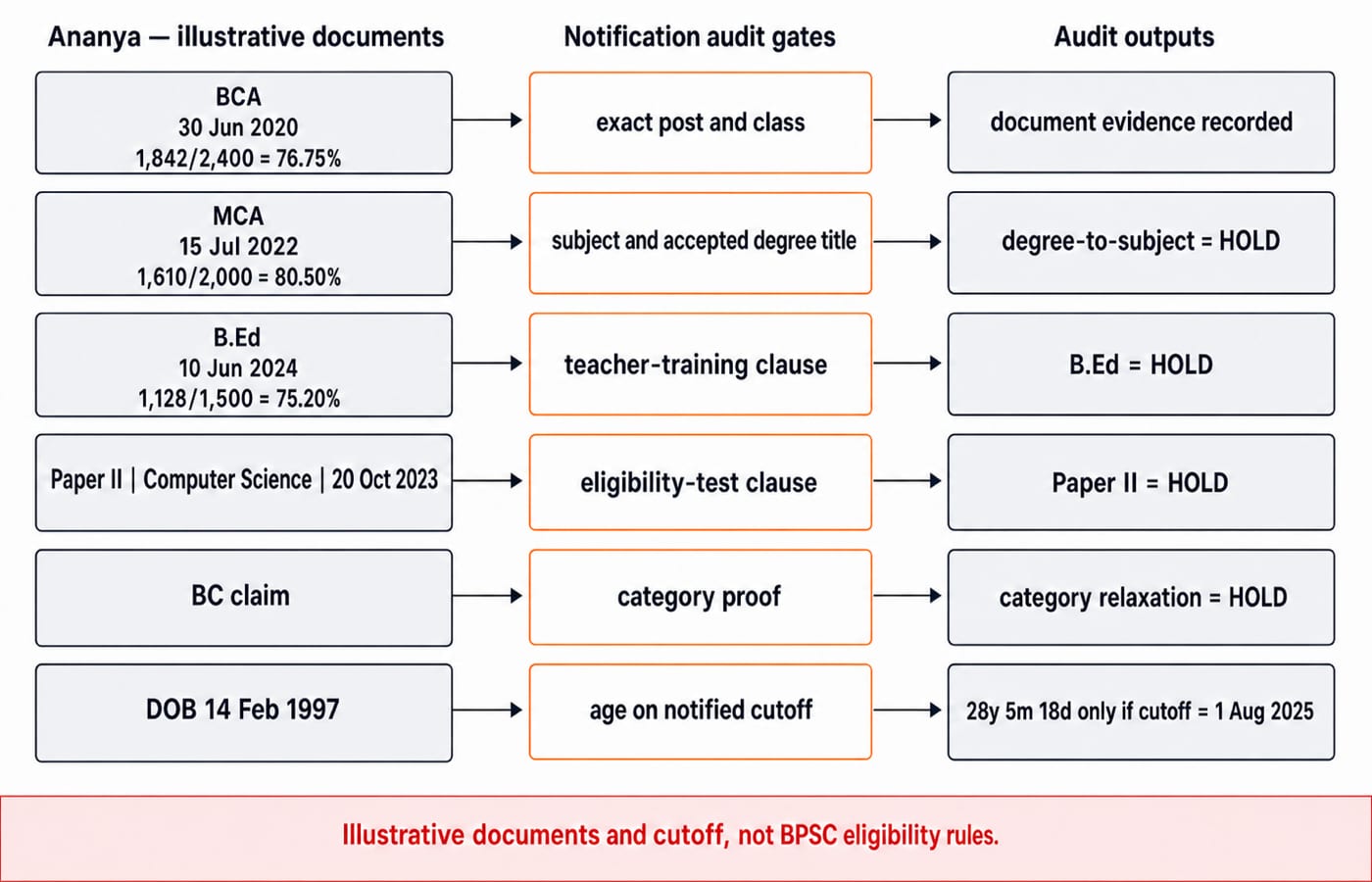
Ananya targets Higher Secondary Teacher | Computer Science, claims BC, and was born on 14 February 1997. Her documents are recorded exactly as they print, and the verdict stays with the notification.
BCA:
1,842 ÷ 2,400 × 100 = 76.75%, awarded30 June 2020.MCA:
1,610 ÷ 2,000 × 100 = 80.50%, awarded15 July 2022.B.Ed:
1,128 ÷ 1,500 × 100 = 75.20%, awarded10 June 2024.Certificate:
Paper II | Computer Science | qualified 20 October 2023.
Until an official row is in front of her, those printed titles, dates and percentages are recorded evidence and nothing more. Degree-to-subject match, B.Ed applicability, eligibility-test applicability and category relaxation all stay at HOLD.
Age also remains HOLD. For calculation practice only, suppose a notice used 1 August 2025 as its cutoff. From 14 February 1997 to 14 February 2025 is 28 years, to 14 July 2025 is another 5 months, and to 1 August 2025 is 18 days. The result is 28 years, 5 months, 18 days. An actual decision must use the notified cutoff.
Never rewrite Master of Computer Applications as Computer Science. Neither a B.Ed nor a Paper II certificate is sufficient unless the applicable row says so.
4. Map the BPSC exam and selection structure from the same document stack
Our BPSC TRE 4.0 preparation course is built around three parts of the written examination: a language part in English and Hindi, a general part covering maths, reasoning and general awareness, and a concerned-subject part, which for Computer Science spans the core stack from digital electronics through databases, operating systems, networks and programming. The test series splits the same way, with unit tests across Computer Science, General Awareness, and Mental Aptitude and Reasoning, and previous-year papers from TRE 1, TRE 2 and TRE 3.
That tells you which subjects to open tomorrow morning. It does not tell you how many questions each part carries, how long the paper runs, whether a part is qualifying or merit-bearing, or whether a wrong answer costs marks. Take those from the notification, confirming each part against the notice’s own wording:
Exam part | Who takes it | Qualifying or merit-bearing | Questions or marks | Duration | Negative marking | What follows | Official page |
|---|---|---|---|---|---|---|---|
Language part | |||||||
General part | |||||||
Concerned subject |
An exam part and a recruitment stage are different things. The three parts above sit inside one written examination. What follows it, scrutiny of documents, a merit list, verification, counselling, is a separate sequence, and you record a stage only where the applicable advertisement names it.
Against every number and every yes/no rule, write the page or clause it came from. A figure with no clause beside it is a rumour in a neat box. Numbers quoted for an earlier TRE phase, for a different post, or in a news report do not carry over, and a blank cell is more honest than a borrowed one.
5. Check corrections and addenda before making the verdict
Search the Bihar Public Service Commission home page, advertisements area, What's New section and archives for the exact advertisement number. Save the base notice, then place every correction and addendum in issue-date order.
Official item | Issue date | Advertisement number | What changed | Rows affected | Supersedes | Saved filename |
|---|---|---|---|---|---|---|
Base advertisement | Not applicable | Not applicable | ||||
Correction or addendum 1 | ||||||
Correction or addendum 2 |
A later official item wins only for the clause it changes; the rest of the base notice still applies. Your final gate has three parts: the identity card matches, the latest official wording is the one you applied, and every document is saved. If any part fails, mark HOLD. Run the search again in the week you apply, because a correction issued after you downloaded the notice still binds you.
6. Keep BPSC rules separate from other teaching recruitments
Why it happens | What goes wrong | What to do instead |
|---|---|---|
Another recruiter accepts a similar degree title. | The candidate assumes BPSC equivalence and risks rejection during scrutiny. | Wait for BPSC wording or a BPSC-recognised equivalence decision. |
A previous TRE phase is treated as current. | Changed post rows or selection parts are missed. | Rebuild both matrices for the exact advertisement. |
A course description is read as an official rule. | Preparation coverage becomes an unsupported official claim. | Use BPSC for rules and KnowledgeGate for study planning. |
Applying outside Bihar too? The DSSSB TGT Computer Science eligibility guide runs this same audit against a different recruiter, and the teaching Computer Science exams comparison sets the routes side by side so you can see where the qualification rows diverge. Then come back to the BPSC advertisement for the verdict.
7. Choose preparation only after the eligibility audit
Need | What the page gives you | What it cannot settle |
|---|---|---|
Understand the current BPSC offering | The BPSC category page lists the preparation course and test series. | Your eligibility. |
Build structured Computer Science coverage | The BPSC TRE 4.0 preparation course supports syllabus planning. | An official post row, paper structure or selection formula. |
Practise after or alongside coverage | The BPSC TRE 4.0 test series lists 26 tests: 16 unit tests + 7 full-length mocks + 3 previous-year papers. | The official BPSC exam pattern. |
That count is what the test series contains, 16 + 7 + 3 = 26, and it says nothing about the examination: it is not a question count, a marks split or a selection rule. A course tells you what to study. Only the advertisement tells you whether you may sit the paper at all.
8. BPSC teaching eligibility: the short version
Identify the exact advertisement and post. Copy the official qualification row, compare the printed wording on every degree and certificate, apply corrections, and map only selection parts from that same document stack. Then choose the course for structured study and the test series for practice. MATCH: begin post-specific preparation. HOLD: resolve the named evidence gap. DOES NOT MATCH: do not apply on assumption. Return to BPSC for the applicable notification.
Keep learning
BPSC Headmaster Selection Process: Written Exam, Merit List and Document Verification
Trace the completed 2024 BPSC Head Master route from one objective paper to provisional merit and certificate checks. Includes checked arithmetic and a practical six-week plan.
Updated 14 Aug 20264 min readBPSC Teaching
BPSC Teaching vs KVS/NVS: Bihar Posting, Transfers and Best Fit
Choose by document fit, mobility and work context, not by the recruiting body's name. Compare the Bihar state cadre against central-school postings and score the routes against your own constraints.
Updated 7 Aug 20266 min readBPSC Teaching
BPSC Teaching CS PYQs: Four-Pass Revision Plan
Turn one 40-question PYQ set into four rounds that expose weak concepts, repair them, add a practice clock and test mixed recall with a usable error log.
Updated 5 Aug 20265 min read65 viewsBPSC Teaching

BPSC Computer Science: DBMS, SQL and Data Structures Worked Guide
Follow one student-result example from functional dependencies and 3NF through SQL aggregation, queues, stacks, hashing and max-heap extraction.
Updated 2 Aug 20266 min readBPSC Teaching