

Counting Figures Reasoning: Shortcuts for Triangles, Squares and Rectangles
Learn a checkable method for counting composite figures, with fully worked triangle, rectangle, crossed-square and painted-cube examples.
KnowledgeGate Team
Exam prep & CS education
Updated 28 Oct 20265 min read67 views

You can spot every small triangle or square and still get a counting-figures question wrong. The usual misses are larger shapes assembled from smaller ones, inverted figures, and the same outline counted twice during an unplanned scan. Use one checkable method instead of a visual guess: fix the target shape, group figures by size and orientation, record each group once, then reconcile the subtotals. This method complements broader logical reasoning methods for placement tests.
What counts as one figure: trace a closed boundary
A valid figure is determined by its complete boundary, not by one shaded cell. A triangle needs three straight boundary directions. A square needs four equal sides and four right angles, while a rectangle needs four right angles. One side may contain several collinear pieces, so a larger composite outline counts if every part of its boundary is drawn.
Record each accepted outline using four fields: shape, orientation, size, and position. In a triangle grid, useful rows might be upward size 1, downward size 1, upward size 2, and upward size 3. In a rectangular grid, classify by width and height.
Start with three collinear points A-B-C. The elementary pieces are AB and BC, but their union also forms the straight segment AC. A request for all line segments therefore has 3, not 2. The same composite-boundary idea creates larger triangles and rectangles.
Fully worked triangle count: 13 triangles
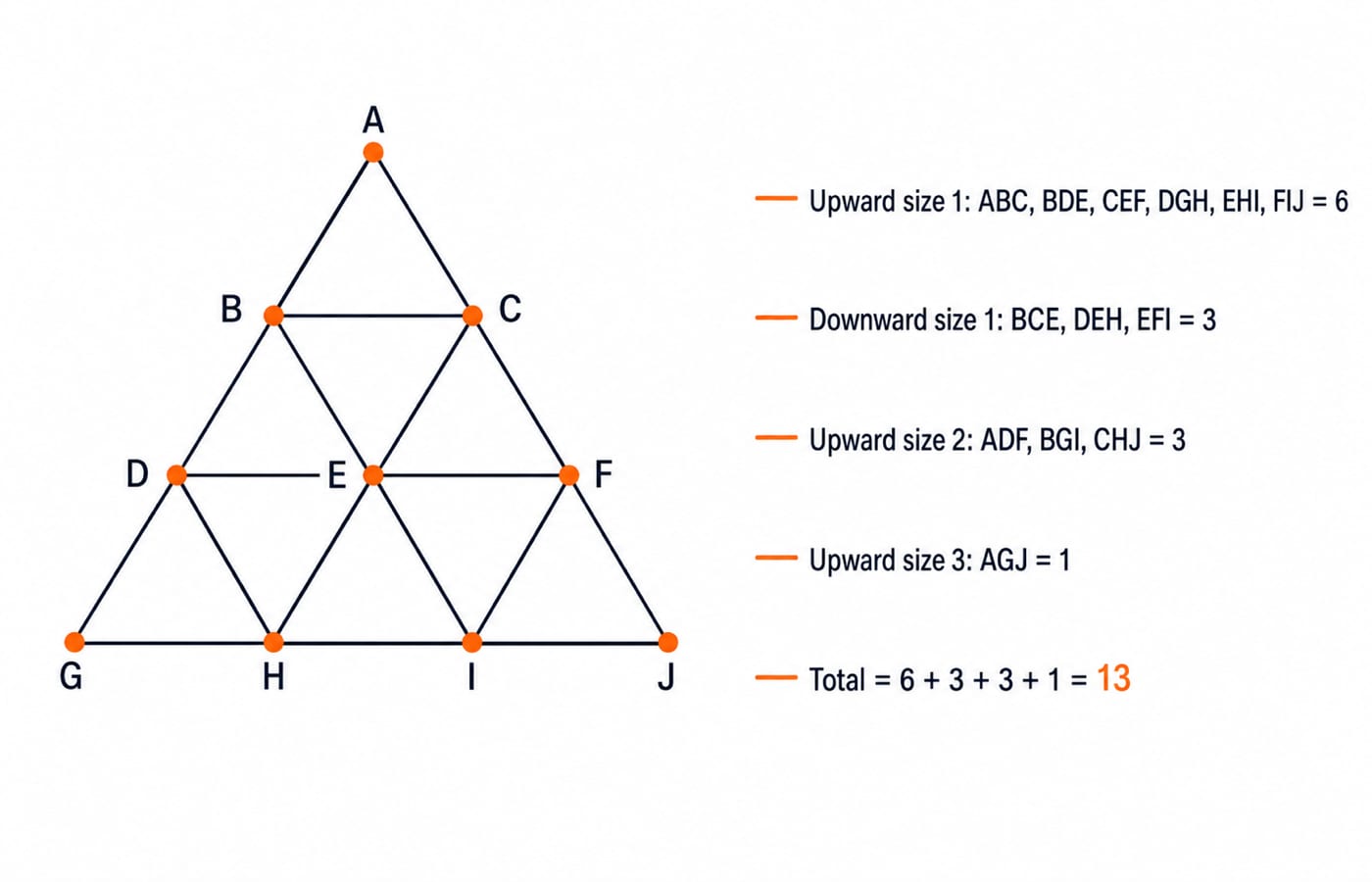
Consider an order-3 triangular grid. Arrange points in four horizontal rows: A; B, C; D, E, F; and G, H, I, J. Draw these adjacent segments:
AB, AC, BC, BD, BE, CE, CF, DE, EF, DG, DH, EH, EI, FI, FJ, GH, HI, IJ.
Collinear adjacent pieces combine into the longer sides of composite triangles. Now finish one size and orientation before moving to the next:
Orientation and size | Triangles | Count |
|---|---|---|
Upward, size 1 |
| 6 |
Downward, size 1 |
| 3 |
Upward, size 2 |
| 3 |
Upward, size 3 |
| 1 |
The reconciliation is 6 + 3 + 3 + 1 = 13. Each name has three complete straight boundaries, and no two names identify the same region. Stopping after the six smallest upward triangles would miss the three inverted triangles and four larger composite triangles, which is seven valid figures.
Rectangle-grid shortcut: 18 rectangles, including 8 squares
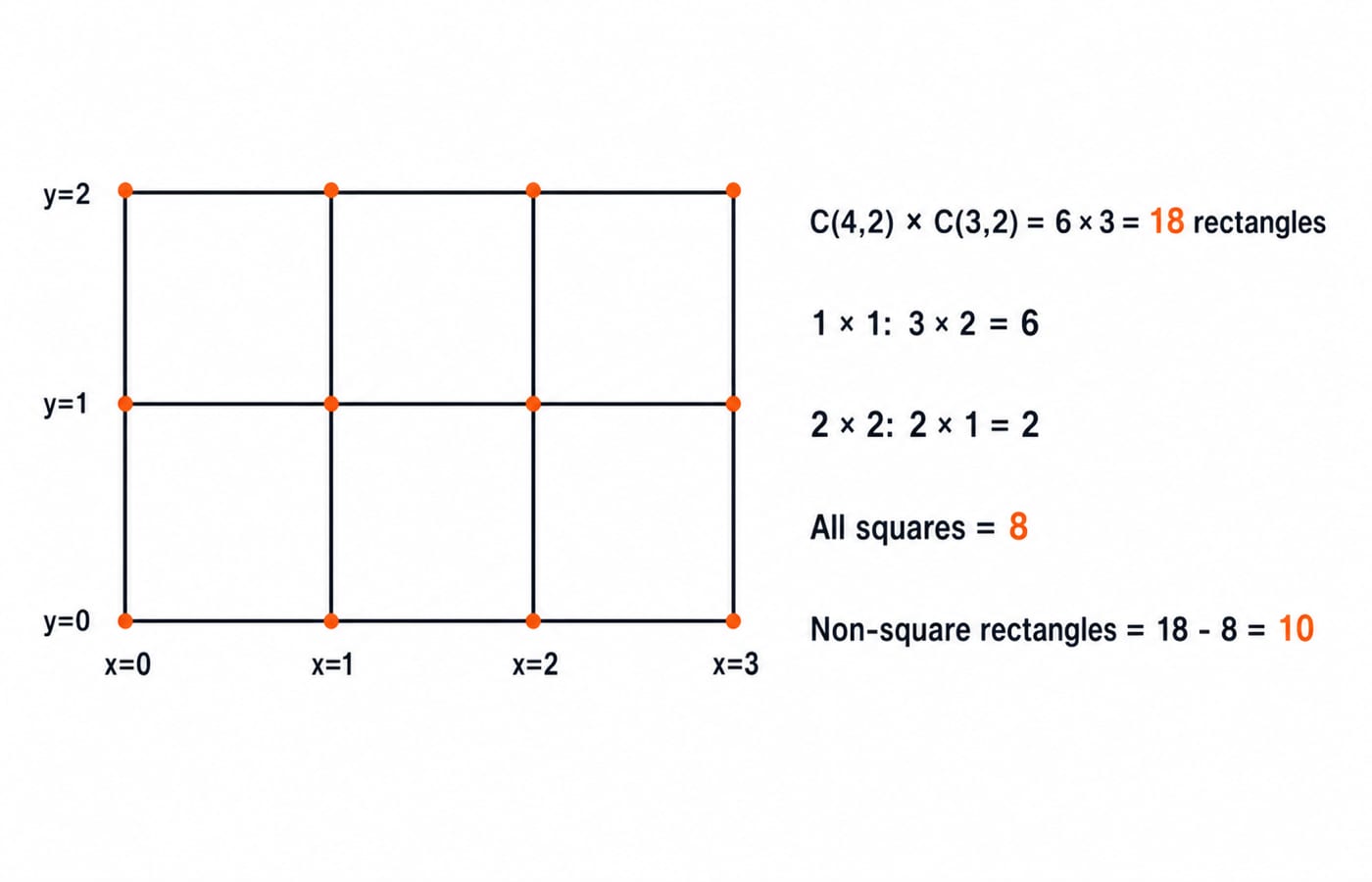
Take a complete grid with 3 unit columns and 2 unit rows. It has four vertical lines at x = 0, 1, 2, 3 and three horizontal lines at y = 0, 1, 2. Any rectangle is fixed by choosing two vertical boundaries and two horizontal boundaries:
C(4,2) x C(3,2) = 6 x 3 = 18.
Count squares independently. The 1 x 1 squares contribute 3 x 2 = 6. The 2 x 2 squares contribute 2 x 1 = 2. A 3 x 3 square cannot fit in two rows. Therefore the grid has 6 + 2 = 8 squares and 18 - 8 = 10 non-square rectangles.
When the prompt asks for rectangles, include the eight squares because every square is a rectangle. Subtract them only when it asks for non-square rectangles. The combination shortcut works only when all required grid lines are complete and continuous.
Irregular figures and cubes: switch to an inventory
Let PQRS be a square in clockwise order. Draw diagonals PR and QS, meeting at O. The four small triangles are POQ, QOR, ROS, SOP. The four large half-square triangles are PQR, QRS, RSP, SPQ. The total is 4 + 4 = 8. Sets PRO and QOS do not count because their points are collinear. Naming the same large triangle from a different starting vertex does not create a new figure.
A broken or diagonal overlay does not satisfy the assumptions behind the rectangular-grid formula. List the smallest shapes, then composites, and check each orientation. Name or lightly mark every accepted outline once.
The same inventory habit transfers to three dimensions. A 3 x 3 x 3 cube painted on all six outside faces and cut into 27 unit cubes has:
8corner cubes with three painted faces12edge non-corner cubes with two painted faces6face-centre cubes with one painted face1inner cube with no painted face
The classes cover every unit cube exactly once, and 8 + 12 + 6 + 1 = 27.
Shortcuts that save time without weakening the count
Use this scan order: identify the requested shape, count one size at a time, change orientation only after finishing that size, record the subtotal, then check boundaries and symmetry. The triangle grid produces 6, 3, 3, 1. The rectangle grid gives three linked checks: 18 total rectangles, 8 squares, and 10 non-square rectangles.
Choose the shortcut to match the drawing:
Use combinations for a complete rectangular grid.
Use size-and-orientation enumeration for a regular triangular grid.
Use a named-boundary inventory for irregular overlays.
Use corner, edge, face and interior classes for painted cubes.
For a mixed routine, use the Aptitude for Placements guide. The SSC CGL Reasoning guide also shows how solving order can organise reasoning practice.
Common counting-figures traps and the final check
Trap | Consequence | Repair |
|---|---|---|
Count only unit shapes | Composite outlines disappear | Rescan at every larger size |
Ignore inverted triangles | One orientation is missing | Finish upward and downward lists separately |
Rename an existing outline | The total is inflated | Compare the actual vertices and boundary |
Accept an open boundary | An incomplete shape is counted | Trace every side end to end |
Use a grid formula with a missing segment | Choices include shapes that are not drawn | Confirm every required line is continuous |
Exclude squares from all rectangles | A valid rectangle class is lost | Subtract squares only for non-square rectangles |
A 20-second audit should reconcile independent classes. For the triangle grid, check 6 + 3 + 3 + 1 = 13. For the rectangle grid, check 8 squares + 10 non-square rectangles = 18 rectangles. For the cube, check 8 + 12 + 6 + 1 = 27. If a total fails, rescan the missing class instead of restarting randomly.
Prompts may ask for all figures, only highlighted shapes, a missing-line variant, painted-cube classes, or a timed mixed set. Before relying on marks, timings, section distribution or negative-marking details, check the current official notice and instructions for your chosen exam.
Counting Figures short version and the next practice step
Remember the chain: target shape -> size -> orientation -> position -> subtotal -> reconciliation. It gives 13 triangles in the order-3 triangular grid, 18 rectangles including 8 squares in the 3 x 2 grid, 8 triangles in the crossed square, and 27 unit cubes split as 8, 12, 6, 1 by painted-face class.
Start with a 12-question diagnostic: four triangle counts, three square or rectangle grids, three irregular mixed figures, and two cube counts. Label each miss as a size, orientation, boundary, double-count, or formula-choice error.
First, redraw the 13-triangle tally from the labels without looking. Then explore Aptitude for Placement for structured aptitude, reasoning and verbal-ability study, or browse the learning library for related learning paths.
Keep learning
Fallacy in Logical Reasoning: Types, Shortcuts and Solved Examples
Learn to test fallacy questions by separating the conclusion, evidence and hidden bridge. Includes conditional, survey, analogy, causation and language examples.
Updated 18 Nov 20266 min readAptitude & Reasoning

Cubes and Dice Reasoning: Concepts, Shortcuts and Solved Examples
Learn cubes and dice through ordered face positions, anchored net folding, and disjoint painted-cube counts, with shortcuts and fully checked examples.
Updated 10 Nov 20265 min readAptitude & Reasoning
Clock Reasoning for Competitive Exams: Concepts, Shortcuts and Solved Examples
Clock questions become easier when you treat both hands as moving objects. Derive the core formulas, solve angle and meeting problems, and handle mirrors and faulty clocks without guesswork.
Updated 1 Nov 20266 min readAptitude & Reasoning

Calendar Reasoning for Competitive Exams: Shortcuts and Solved Examples
Turn calendar questions into small remainder calculations. Learn the core rules, follow solved dates, and avoid the inclusion errors that spoil otherwise correct work.
Updated 31 Oct 20266 min readAptitude & Reasoning