Managerial Interview Questions: Show Ownership Under Deadlines and Ambiguity
Learn to answer managerial scenarios with clear priorities, early communication and evidence. Practise ownership, deadline trade-offs and ambiguous requests through three fictional examples.
KnowledgeGate Team
Exam prep & CS education
Updated 22 Aug 20265 min read
A campus candidate hears, “What would you do if the deadline was impossible?” and assumes the answer is “I would work all night” or “I would ask my manager.” Yet a managerial round can test decision quality even if you have never managed employees. Use college projects, clubs and hackathons to structure your answers. Keep every detail in your own answer tied to facts you can defend.
1. Know what a managerial scenario answer must prove
A strong answer makes four signals visible:
Ownership: take responsibility for your decision without claiming everybody’s work.
Priority: choose according to the goal, not personal preference.
Communication: raise risk and trade-offs early.
Closure: check the result, update people and capture the lesson.
Do not assume a universal format or scorecard. A technical question usually centres on a domain problem; an HR question often explores motivation or fit. A managerial scenario focuses on how you decide and communicate when people, scope or time conflict. Use the technical interview preparation guide and HR interview questions guide for adjacent preparation.
2. Build answers with Clarify, Choose, Communicate and Close
Use this four-step spine:
Clarify: name the outcome, deadline, owner and one or two unknowns.
Choose: rank options by impact, effort and risk, then say what will not be done.
Communicate: tell the relevant people the choice, trade-off, checkpoint and escalation trigger.
Close: verify the result, update stakeholders and explain what should change next time.
If the prompt does not allow real follow-up questions, make your assumptions conditional: “I would first confirm whether the non-negotiable outcome is X and whether Y can move. If X is fixed, I would...” This shows judgment without inventing missing facts. The Resume & Interview preparation category can help you connect this structure with wider placement preparation.
3. Worked answer 1: take ownership without becoming the solo hero
Consider a college project in which five students must submit an event-registration system by Friday at 5:00 pm. At Wednesday 5:00 pm, 48 hours remain, but email confirmation has not started. I am the integration coordinator, another teammate owns email, and 8 of 12 acceptance checks pass. Registration and confirmation are mandatory; analytics is optional.
A private 10-minute conversation reveals that exam preparation cost them a day. We would split the module into template, trigger and test tasks. I would pair with them for 90 minutes on the trigger, not silently take over their module. I would move analytics to a post-submission list, set Thursday 6:00 pm as the integration checkpoint, and update all five teammates with the revised owners and scope.
By Friday 1:30 pm, all 12 checks pass. We submit at 2:00 pm, three hours early. Next time, I would add a midweek integration check. The right tone owns coordination, credits the teammate’s work and avoids turning one missed day into a character judgment.
4. Worked answer 2: protect a deadline with an explicit trade-off
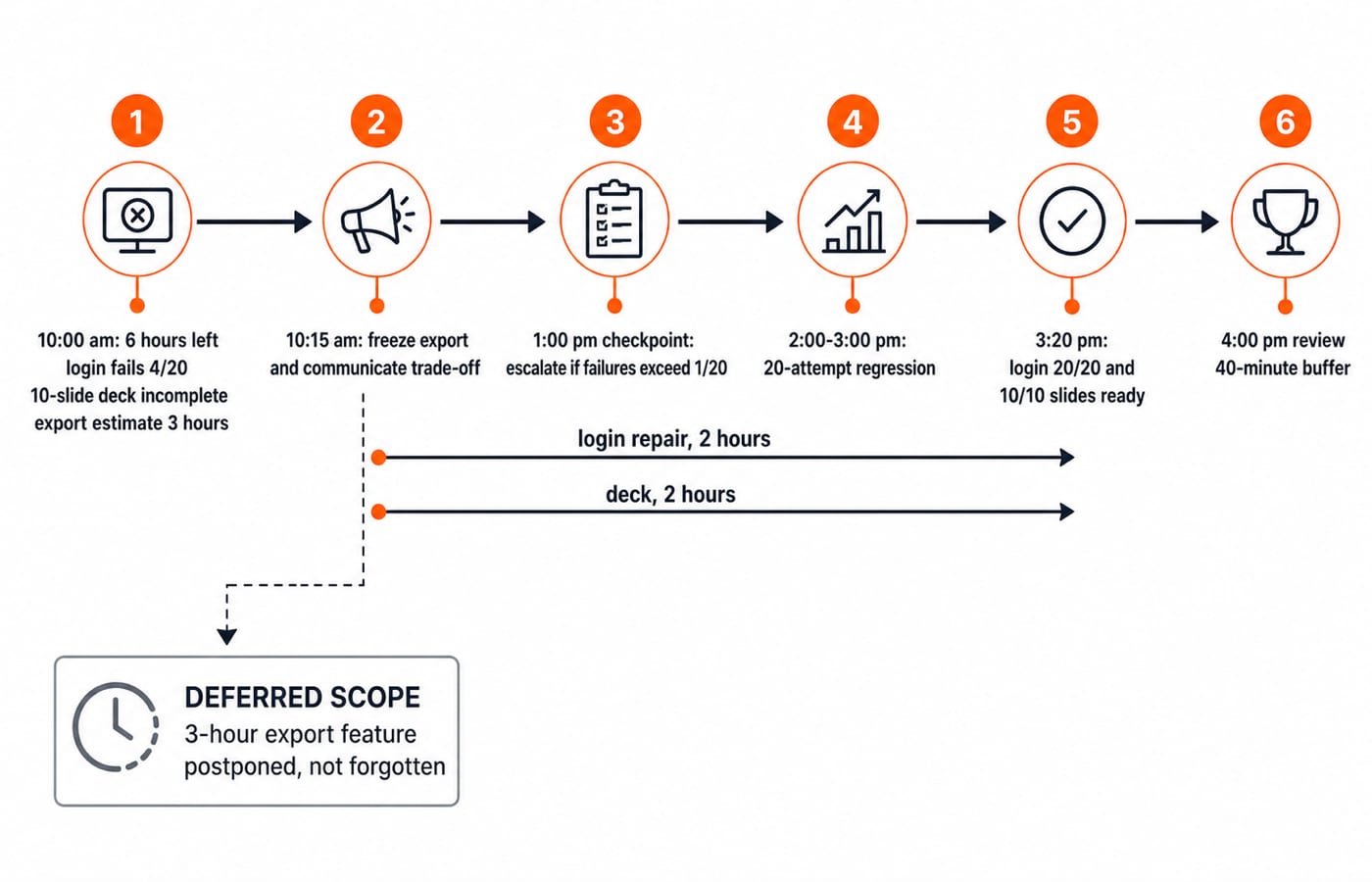
Consider a three-student team with six hours until a 4:00 pm review. At 10:00 am, login fails in 4 of 20 attempts, a 10-slide deck is incomplete, and a requested export feature needs an estimated 3 hours.
Login blocks the demonstration, the deck explains finished work, and export is optional. I would allocate 2 hours to login repair, assign a teammate 2 hours for the deck, reserve 1 hour for a 20-attempt regression run, and keep 1 hour for integration and buffer. At 10:15 am, I would freeze export, record it as deferred and tell the faculty guide. At 1:00 pm, I would check progress. If login still failed more than 1 of 20 attempts, we would use a seeded account and disclose the limitation.
The result: login passes 20 of 20, and all 10 slides are ready at 3:20 pm. That leaves 40 minutes before the review. The lesson is to agree on must-have and optional scope before the final day.
5. Worked answer 3: turn ambiguity into a testable first delivery
Suppose a student-club lead says, “Make registration smoother by Friday,” with 8 volunteer hours available. I would ask: Who registers? Which device matters? Which fields are mandatory? Is payment included? What must be ready by Friday?
Assume the answers are first-year students, mobile, name plus email plus branch, no payment, and a working form by Friday 3:00 pm. An 18-hour member portal cannot fit, but a 6-hour focused form can. I would choose the form and keep 2 hours for user testing.
I would build a 2-hour prototype, then use 2 hours to arrange and observe four submissions each from 5 students. If 18 of 20 submissions succeed, I would spend 2 hours fixing branch validation and mobile spacing, then reserve 2 hours for final checks and handover. The final check reaches 20 of 20. I would give the lead the live form, both test results and a separate portal backlog. The lesson is to turn “smooth” into a user, scope, deadline and observable check.
6. Find managerial evidence without formal management experience
Build a three-row evidence bank from real student experience: one moment when something slipped, one when two priorities competed, and one when the ask was unclear. For each, record the deadline, people affected, options considered, your decision, communication, check or result, and lesson.
Recover accurate scope, dates and contributions from your resume, commits, messages, reports or submission history. The resume guide for freshers explains how to turn evidence into defensible bullets. Never invent percentages, user counts or authority. Replace “I made everyone do it” with the actual mechanism: “I proposed the scope cut, asked the five-person team to confirm it, recorded the owners, and checked integration at 6:00 pm.”
7. Rehearse three scenarios in six hours over one week
Evidence, Days 1 and 2: 45 minutes daily to list six moments, verify facts and choose three: 45 × 2 = 90 minutes.
Build, Days 3 to 5: 45 minutes per scenario: 15 to outline, 15 to record and 15 to repair: 45 × 3 = 135 minutes.
Stress-test, Days 6 and 7: 60 minutes for six follow-ups and 75 for a mock plus repairs: 60 + 75 = 135 minutes.
Total: 90 + 135 + 135 = 360 minutes = 6 hours. Keep answers within a self-set 90 to 120 seconds. Ask: “Who disagreed?”, “What did you deprioritise?”, “When did you escalate?” and “How did you know it worked?” This is a rehearsal heuristic, not a rule.
Miss one day: use 30 minutes of Day 7 for recovery and run a 45-minute mock. Miss two: finish two evidence-backed scenarios this week and move the third to next week. Never invent results to keep the plan.
8. Final check and next action
Ask: Did I identify the goal? Did I expose the unknown? Did I compare real options? Did I state what moved or stopped? Did I communicate before the deadline? Did I close with evidence and a lesson? Remove details that cannot survive “How do you know?”
Clarify the outcome, choose by impact and risk, communicate the trade-off early, and close the loop. Tonight, create one evidence-bank row from a college deadline and record a 90 to 120-second answer. For structured resume feedback and mock practice, explore the Interview & Resume Preparation Course.
Keep learning
React Controlled Components: Interview Questions and Coding Problems
Trace a five-field React form, build one safe change handler, and debug the controlled-input mistakes that commonly appear in interviews and coding rounds.
Updated 25 Oct 20265 min readInterview Corner

Asymptotic Notations Interview Questions and Answers: Big-O, Omega and Theta with Worked Examples
Prepare for Big-O, Omega and Theta questions with proof-ready answers, exact loop and recurrence traces, and a method for avoiding common interview traps.
Updated 24 Oct 20266 min readInterview Corner
Advanced DP Interview Questions and Answers: Four Worked Patterns
Work through four advanced dynamic programming patterns with exact states, transitions, reconstructions, proof hooks, and interview-ready explanations.
Updated 21 Oct 20266 min readInterview Corner
Algorithm Interview Questions and Answers: Cross-Concept DSA Problems
Practise cross-concept DSA questions with defensible answers, complete dry runs and the follow-ups that change which algorithm you should choose.
Updated 17 Oct 20266 min readInterview Corner