

Python Arithmetic and Assignment Operators MCQs: 10 Solved Questions
Solve 10 Python MCQs by tracing operators, intermediate values and result types. Each answer includes a step-by-step explanation.
KnowledgeGate Team
Exam prep & CS education
Updated 26 Nov 20267 min read
Arithmetic and assignment questions look short, but one symbol can change the result's type, evaluation order or stored value. Common misses include treating /, // and % as interchangeable, evaluating ** left to right, and reading += or //= as comparison operators.
For numeric types, negative floor division, floating-point precision and rounding, first study Numbers and Arithmetic in Python: Operators, Precision, and Worked Examples. Python Operators and Expressions: Precedence, Types and Worked Output Traces extends that foundation to comparison, membership, identity, logical and bitwise operators with a multi-step score program. This ten-question set narrows practice to arithmetic results and augmented assignment. Choose an option and write one intermediate value before revealing each answer.
Python arithmetic and assignment rules to use before the MCQs
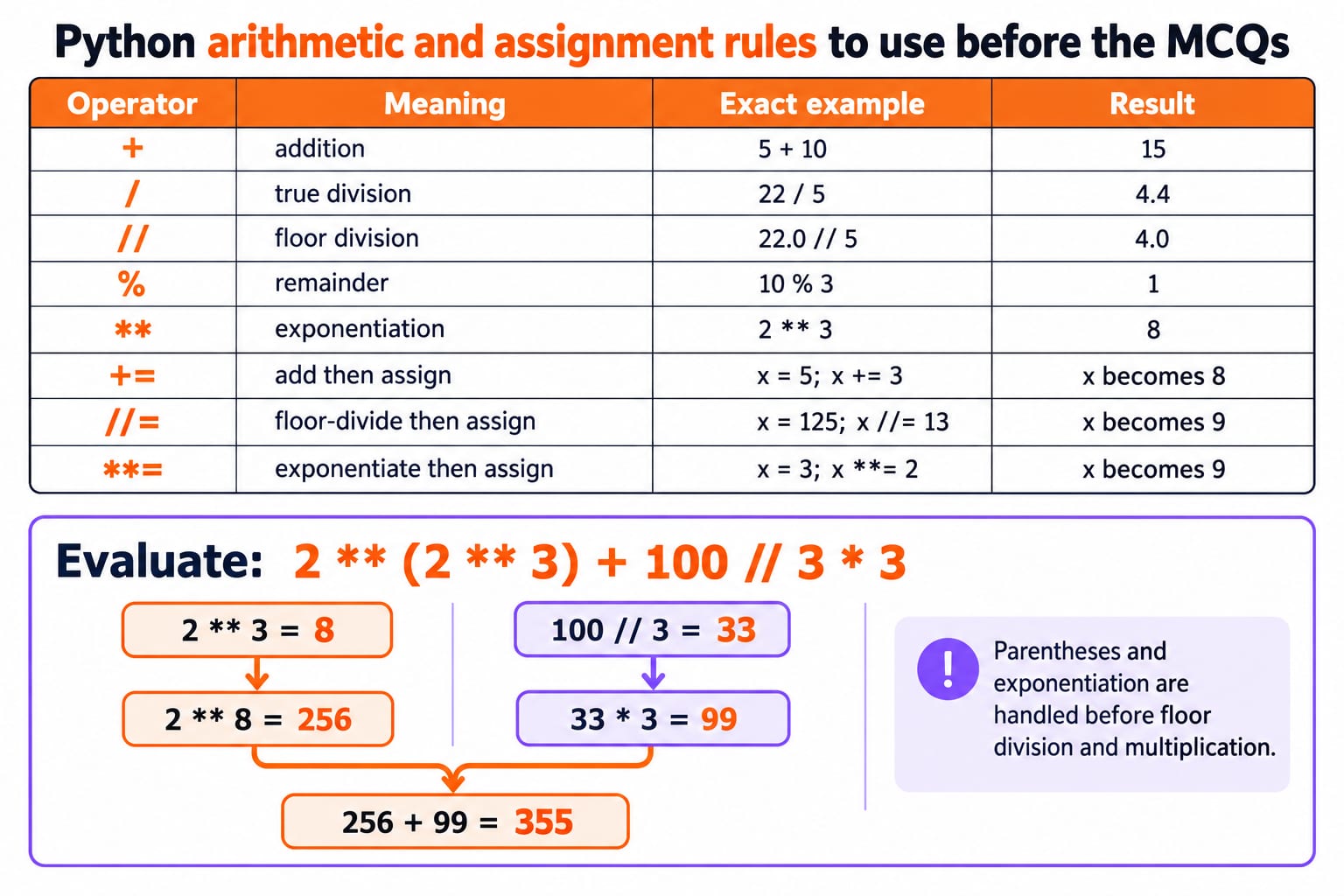
Use the exact operator first, then apply precedence and check the result type. Name the operator's job before calculating its operands.
Operator | Meaning | Exact example | Result |
|---|---|---|---|
| addition |
|
|
| true division |
|
|
| floor division |
|
|
| remainder |
|
|
| exponentiation |
|
|
| add then assign |
|
|
| floor-divide then assign |
|
|
| exponentiate then assign |
|
|
Calibrate the order with 2 ** (2 ** 3) + 100 // 3 * 3. First, 2 ** 3 = 8, then 2 ** 8 = 256. Separately, 100 // 3 = 33, then 33 * 3 = 99. Therefore, the result is 256 + 99 = 355. Parentheses and exponentiation are handled before floor division and multiplication. At their shared precedence level, // and * group from left to right where applicable.
Floor division also satisfies 125 = (125 // 13) * 13 + (125 % 13) = 9 * 13 + 8 = 117 + 8. That is why 125 //= 13 stores 9, not 9.62 or 10. For a sequenced learning route, use Python Course: Concepts, MCQs & Coding.
Arithmetic MCQs 1-3: addition, remainder and float floor division
Question 1
What is the output of the following Python code?
Python
x = 5
y = 10
print(x + y)
A. 5
B. 10
C. 15
D. Error
Answer: C. 15. The assignments store 5 in x and 10 in y. The call evaluates x + y = 5 + 10 = 15. Both operands are integers, so Python prints the integer 15. Options A and B leave one operand unchanged, while no error occurs because both names are already bound.
Question 2
What is the output of the following Python code?
Python
print(10 % 3)
A. 3.33
B. 3
C. 1
D. Error
Answer: C. 1. Use 10 = 3 * 3 + 1. The % operator returns the remainder, so the result is 1. In contrast, 10 // 3 = 3, while 10 / 3 = 3.333.... None of those operations raises an error here.
Question 3 (RSSB Senior Computer Instructor 2023)
Identify the output of the Python Command:
print(22.0//5)
A. 4.4
B. 4
C. 4.0
D. 2
Answer: C. 4.0. True division gives 22.0 / 5 = 4.4. Floor division takes the floor value 4, but the float operand makes the returned value 4.0. This rules out integer 4, while 4.4 belongs to /, not //. Review the Python arithmetic module hub after tracing it yourself.
Assignment MCQs 4-5: updating a variable and auditing the exact code
Question 4 (RSSB Senior Computer Instructor 2021)
What is the output of this code in Python Language:
>>> x = 125
>>> y = 13
>>> x //= y
>>> x
A. 9
B. 125/13
C. 10
D. 9.62
Answer: A. 9. Expand the augmented assignment to x = x // y. Since 13 * 9 = 117 and 125 - 117 = 8, 125 // 13 = 9. The assignment replaces 125 in x with 9, which the final prompt displays. The Python arithmetic module hub keeps this item available for a retest.
Question 5 (BPSC 2025)
What will be the output of the following statement?
print(14 % 3 ** 2 * 4)
A. 16
B. 64
C. 20
D. 256
Answer: C. 20. Exponentiation is evaluated first: 3 ** 2 = 9, followed by remainder: 14 % 9 = 5. Multiplication then gives 5 * 4 = 20, so option C is correct.
Retest the solved-question page, reading the source page’s leading Print as Python’s lowercase print; the options test the intended precedence calculation.
Arithmetic MCQs 6-7: numeric types and nested exponentiation
Question 6 (BPSC 2025)
What is the value of the following Python expression?
3 + 3.00,
3**3.0
A. (6.0, 27.0)
B. (6.0, 9.0)
C. (6, 27)
D. Error
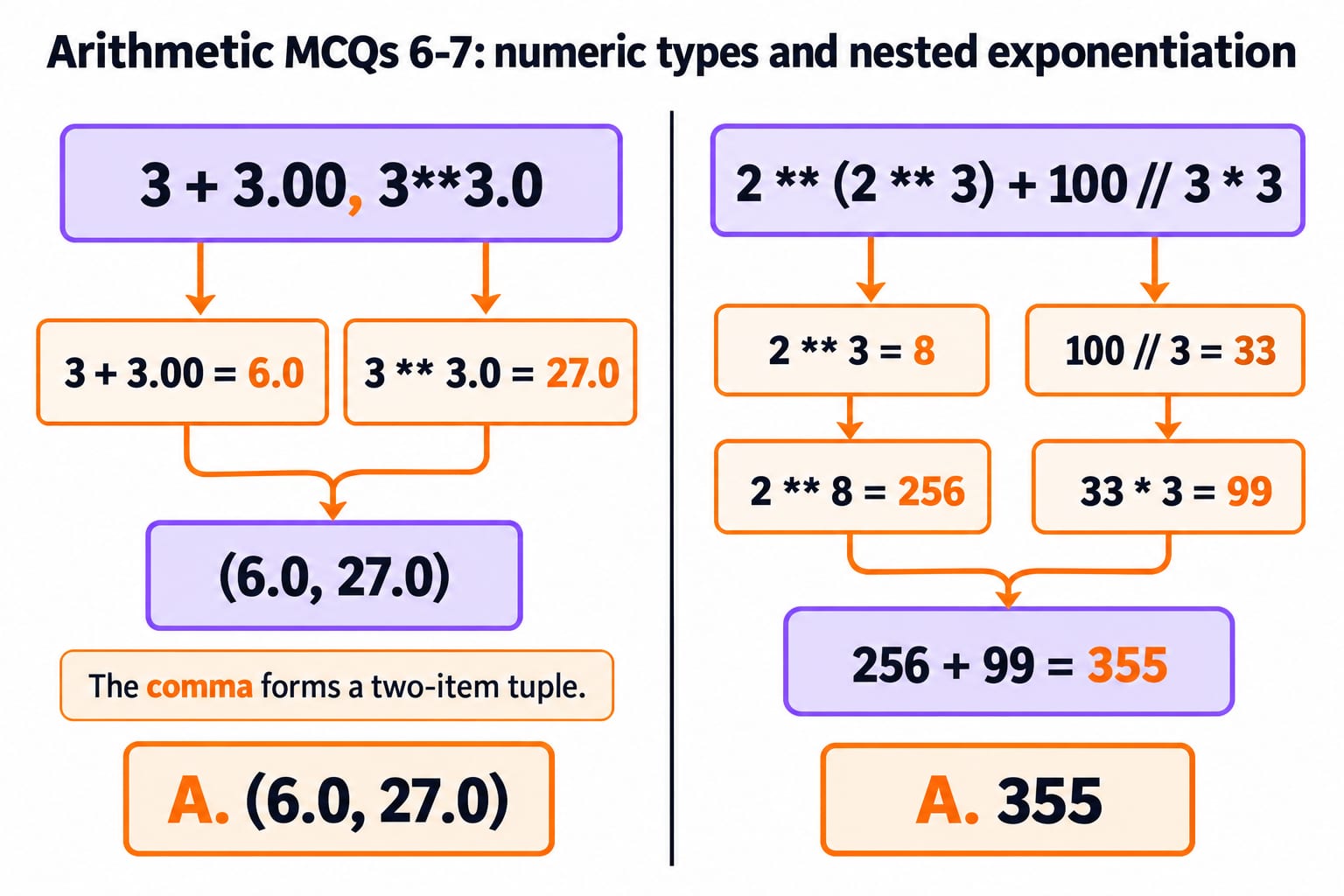
Answer: A. (6.0, 27.0). The comma forms a two-item tuple. Its first item is 3 + 3.00 = 6.0; the float operand produces a float. Its second item is 3 ** 3.0 = 27.0; the float exponent also produces a float result. Together they give (6.0, 27.0). Use the solved-question page for another clean attempt.
Question 7 (RSSB Senior Computer Instructor 2026)
Identify the correct value of the given arithmetic expression in Python from the following options:
2 ** (2 ** 3) + 100 // 3 * 3
A. 355
B. 356
C. 164
D. 163
Answer: A. 355. Inside the parentheses, 2 ** 3 = 8, so the left term is 2 ** 8 = 256. On the right, 100 // 3 = 33, then 33 * 3 = 99. Finally, 256 + 99 = 355. Replacing // with / or flattening exponentiation into multiplication leads away from the correct option. Retest it on the Python arithmetic module hub.
Assignment MCQs 8-10: augmented operators and Boolean numeric behaviour
Question 8 (RSSB Senior Computer Instructor 2026)
In Python programming, which of the following symbols represents an augmented arithmetic operator?
A. ==
B. >=
C. =
D. +=
Answer: D. +=. An augmented assignment combines an operation with assignment. If x = 5, then x += 3 means x = x + 3, so x becomes 8. The token == tests equality, >= compares values, and = performs simple assignment. The Python arithmetic module hub provides the original practice context.
Question 9 (RSSB Senior Computer Instructor 2026)
What will be the output of the following Python code?
print(min(max(False, -2, -5), 2, 5))
A. -2
B. 2
C. False
D. -5
Answer: C. False. For this comparison, False has the numeric value zero. Zero is greater than -2 and -5, so max(False, -2, -5) returns the original argument False. Next, min(False, 2, 5) keeps that same object because zero is the minimum. Printing it displays False, not 0. This numeric relationship does not make Boolean and integer types identical. Check the Python arithmetic module hub only after predicting it again.
Question 10 (RSSB Senior Computer Instructor 2026)
Which of the following is an example of an augmented operator in Python?
A. <
B. not in
C. and
D.
**=
Answer: D. **=. With x = 3, the statement x **= 2 means x = x ** 2, so x becomes 9. The token < compares values, not in tests membership, and and is a Boolean operator. Only **= combines exponentiation with assignment. After the Python arithmetic module hub.
Common traps in arithmetic and assignment operators
Trap to check | Questions |
|---|---|
Operator identity | 8 and 10 |
True division versus floor division | 3 and 4 |
Quotient versus remainder | 2 |
Precedence and grouping | 5 and 7 |
Numeric type propagation | 3 and 6 |
Boolean values in numeric comparison | 9 |
Do not memorise floor division only with positive values. Python gives -7 // 3 = -3 and -7 % 3 = 2. The identity still holds: (-3) * 3 + 2 = -9 + 2 = -7. Floor division moves toward negative infinity, not simply toward zero.
Use this five-step routine under time pressure:
Circle the operator.
Mark the parentheses.
Evaluate every
**from its proper grouping.Resolve
*,/,//and%in precedence order.Apply the assignment, then check the resulting type.
Finally, audit exact capitalisation and spelling before choosing an output option. Question 5 shows why that source check matters. Then apply the same operators inside Fibonacci, prime and GCD traces in Classic Programs in C, Java and Python. Memorising a program is not a substitute for tracing its operators.
Python arithmetic and assignment operators: the next practice step
Redo Questions 3, 4, 5, 7 and 9 without looking at the answers. The relevant concepts are float floor division, state mutation, exact identifier case, nested exponentiation and Boolean numeric comparison. Write at least one intermediate line for each before choosing an option. Repeat this short retest tomorrow before moving to new questions.
The short version is precise: / performs true division, // floors, % returns the paired remainder, and ** binds before multiplicative operators. An augmented token such as +=, //= or **= both computes and stores a new value. Continue through Coding & DSA Courses for Placements for the wider programming route, or return to Python Course: Concepts, MCQs & Coding for sequenced Python study.
Go deeper with the full coursePython
Keep learning
Numbers and Arithmetic in Python: Operators, Precision, and Worked Examples
Understand how Python evaluates numeric expressions, from result types and precedence to negative floor division and floating-point comparison. Runnable examples culminate in one complete practice-session calculation.
Updated 21 Aug 20266 min readPython

Date and Time in Python: datetime Tutorial with Parsing, Arithmetic and Time Zones
Build reliable Python date-time values from input text, calculate across midnight, and convert one instant between Asia/Kolkata and UTC.
Updated 8 Nov 20265 min readPython
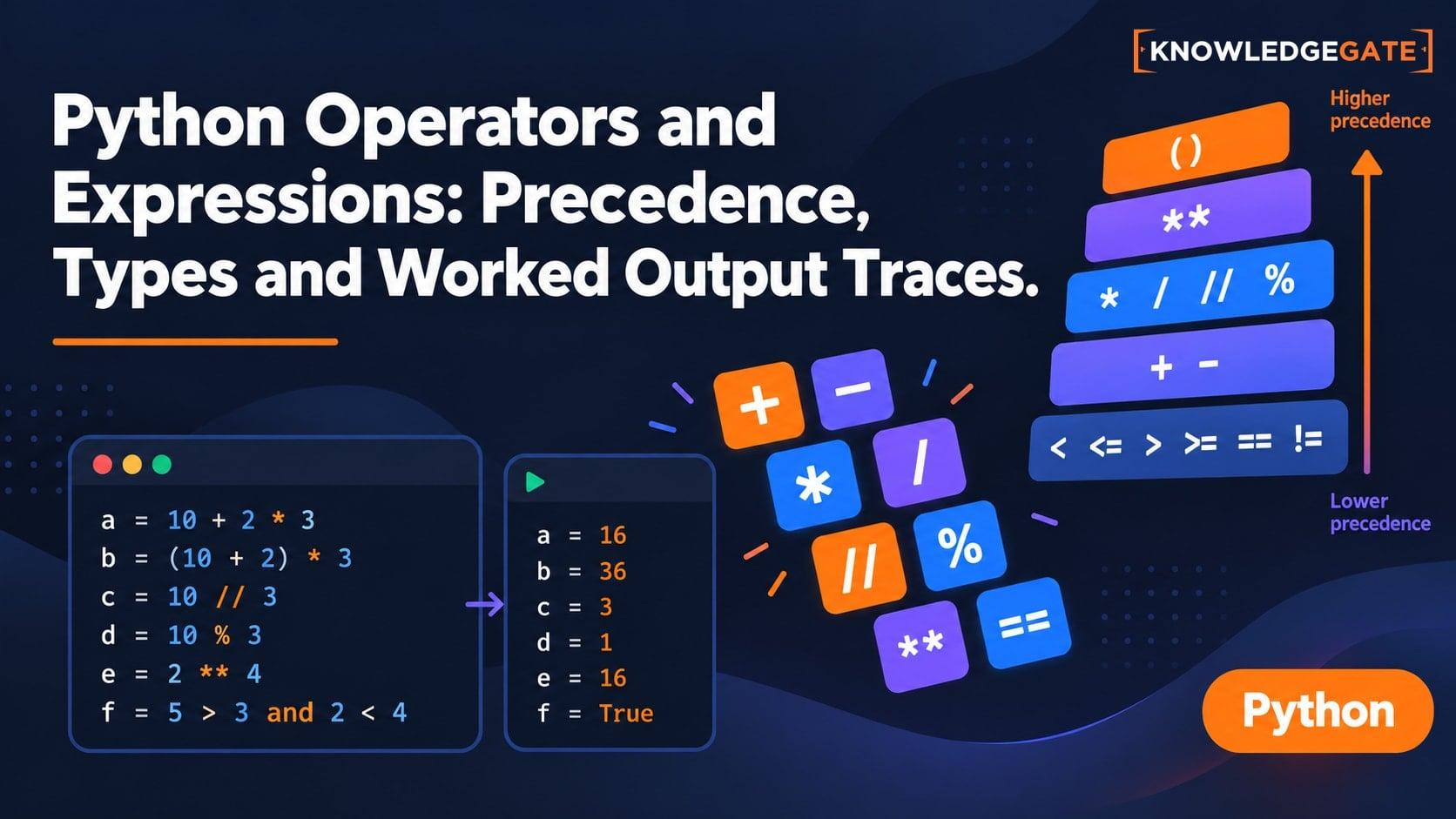
Python Operators and Expressions: Precedence, Types and Worked Output Traces
Trace Python expressions without guessing. This guide connects operator families, precedence, types, short-circuiting and exact output through worked examples.
Updated 23 Sep 20266 min readPython
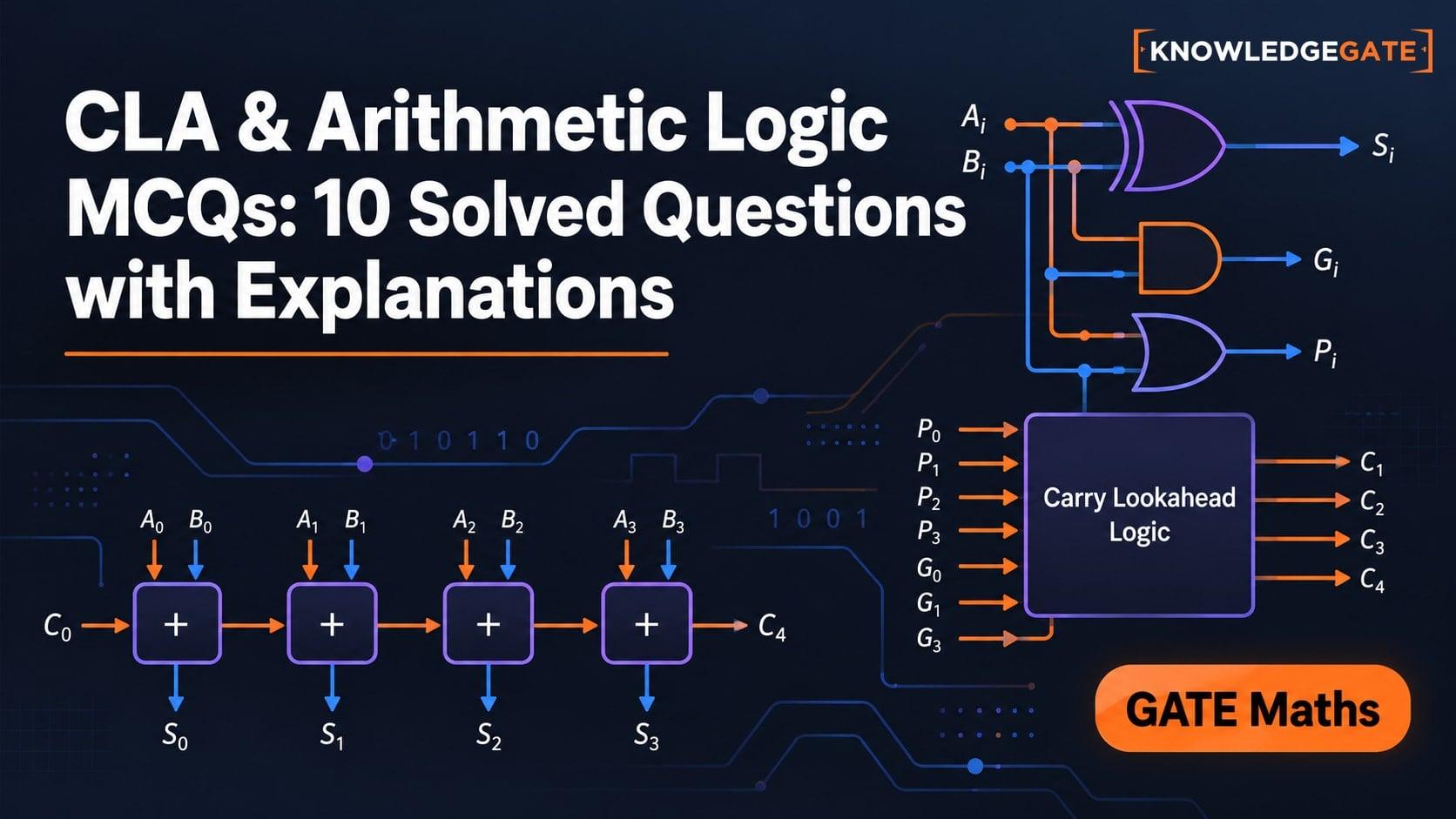
CLA & Arithmetic Logic MCQs: 10 Solved Questions with Explanations
Solve ten CLA and arithmetic logic MCQs with compact workings for carry equations, timing paths, hardware sizing and operand-pair counting.
Updated 16 Sep 20267 min read60 viewsDigital Electronics MCQs