Classic Programs in C, Java and Python
Learn six placement-programming methods through one clean implementation each. The focus is logic, edge cases, complexity and porting, not memorised code.
KnowledgeGate Team
Exam prep & CS education
Updated 20 Jul 20266 min read
Placement drives reuse a small family of programming tasks because each reveals whether you can turn a method into a correct loop. Interviewers watch how you handle input, invariants and edge cases, not whether you memorised a particular language's syntax.
Six methods cover almost everything these rounds ask: Fibonacci terms, primality, Armstrong numbers, GCD, digit reversal and palindromes. Each one reduces to a single loop carrying one invariant, and once that invariant is clear the C, Java and Python versions differ only in syntax and integer width.
Fibonacci sequence in C
Start with 0 and 1. Print the current term, then replace the pair (a, b) with (b, a + b). At every iteration, the pair holds two consecutive Fibonacci terms.
#include <stdio.h>

int main(void) {
    int n;
    scanf("%d", &n);

    long long a = 0, b = 1;
    for (int i = 0; i < n; i++) {
        printf("%lld%s", a, i + 1 == n ? "\n" : " ");
        long long next = a + b;
        a = b;
        b = next;
    }
    return 0;
}
For n = 7, the output is 0 1 1 2 3 5 8. Check the updates: (0,1) becomes (1,1), then (1,2), then (2,3), so each printed value is the previous pair's first term.
Two edge cases matter. For n = 0, the loop prints no terms. For n = 1, it prints only 0; code that prints 0 1 before looping mishandles this case. Time is O(n) and auxiliary space is O(1). In Java or Python, the pair update is identical, though Python integers grow rather than overflowing at a fixed width.
Prime check in Java
A number below 2 is not prime. For larger numbers, it is enough to test possible divisors up to the square root because any larger factor must be paired with a smaller one.
public class PrimeCheck {
    static boolean isPrime(int n) {
        if (n < 2) return false;
        if (n == 2) return true;
        if (n % 2 == 0) return false;

        for (int d = 3; d <= n / d; d += 2) {
            if (n % d == 0) return false;
        }
        return true;
    }

    public static void main(String[] args) {
        System.out.println(isPrime(29));
    }
}
The output is true. Testing only odd divisors avoids redundant even checks, and d <= n / d avoids the overflow risk of forming d * d with large int values.
The usual traps are 0 and 1, which are not prime, and 2, which is the only even prime. The loop takes O(sqrt n) trial divisions and O(1) space. C uses the same remainder test; Python uses % and can express the same odd-divisor loop as range(3, int(n ** 0.5) + 1, 2).
Armstrong number in Python
For a non-negative decimal integer with d digits, raise each digit to power d and add the results. The number is an Armstrong number when that sum equals the original.
def is_armstrong(n):
    if n < 0:
        return False
    digits = str(n)
    power = len(digits)
    total = sum(int(ch) ** power for ch in digits)
    return total == n

print(is_armstrong(153))
The output is True because 1^3 + 5^3 + 3^3 = 1 + 125 + 27 = 153. A second check in the opposite direction is 154: the same digit powers total 1 + 125 + 64 = 190, so it is not an Armstrong number.
Treat 0 correctly: it has one digit, and 0^1 = 0, so the function returns True. Negative inputs are rejected before any digit work, because the digit-power definition is stated for non-negative integers only. With ordinary digit operations treated as constant-time, the scan is O(d) in the number of decimal digits and stores O(d) characters. In C or Java, extract digits using % 10 and count the digits before summing powers.
GCD with Euclid's algorithm in C
Euclid's method uses the identity gcd(a, b) = gcd(b, a % b). Replacing the larger problem by its remainder preserves the common divisors and rapidly shrinks the second value.
#include <stdio.h>

unsigned int gcd(unsigned int a, unsigned int b) {
    while (b != 0) {
        unsigned int remainder = a % b;
        a = b;
        b = remainder;
    }
    return a;
}

int main(void) {
    printf("%u\n", gcd(252, 105));
    return 0;
}
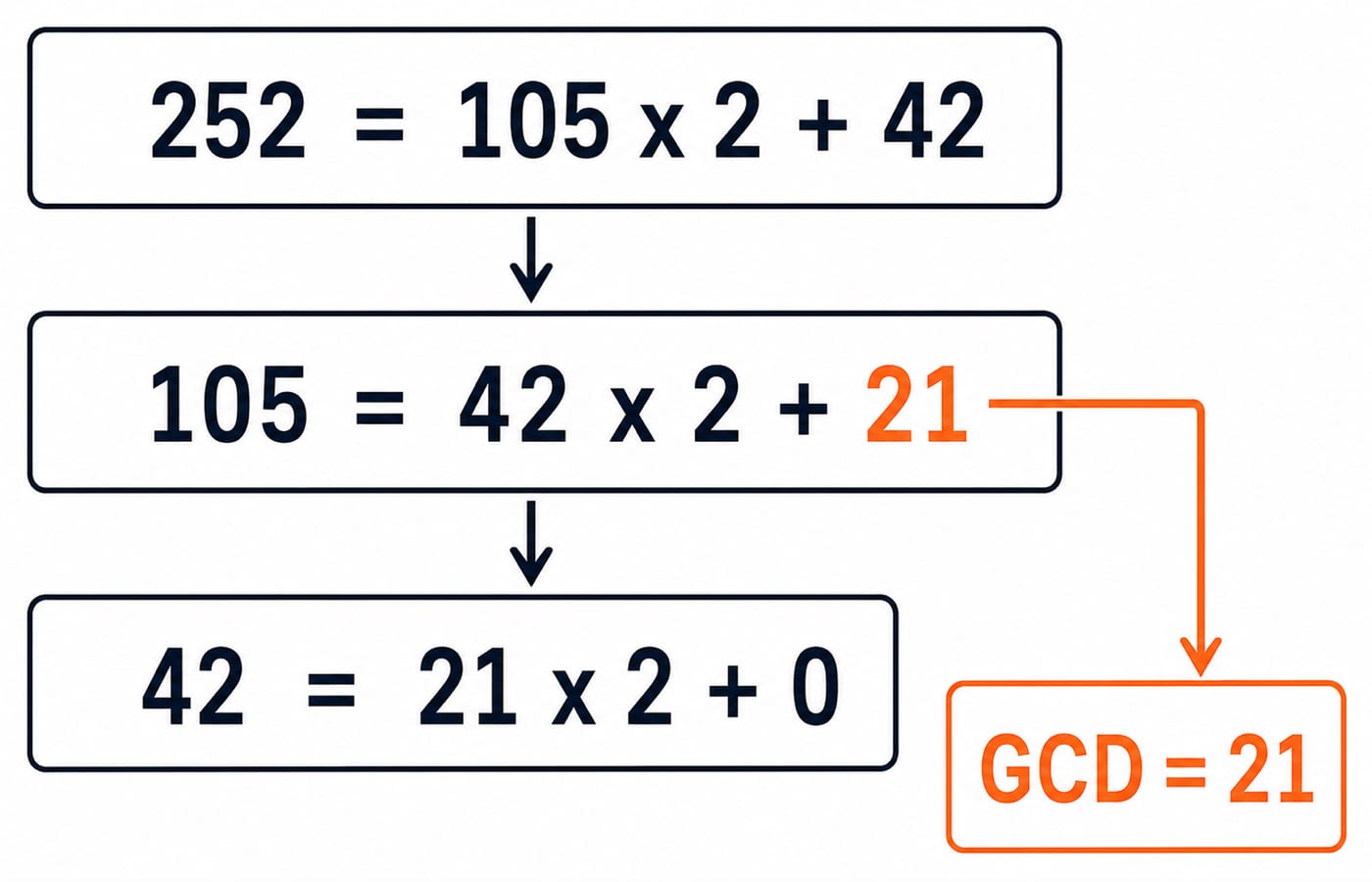
The three-step trace is:
252 = 105 * 2 + 42, so replace(252, 105)with(105, 42).105 = 42 * 2 + 21, so replace(105, 42)with(42, 21).42 = 21 * 2 + 0, so stop. The GCD is21.
Verify it independently: 252 / 21 = 12 and 105 / 21 = 5, so 21 divides both. Since 12 and 5 share no factor greater than 1, no larger common divisor exists.
If one input is zero, the loop returns the other input, matching gcd(a, 0) = a. If both are zero the function returns 0, which is not a positive common divisor of anything, so reject that pair in input validation rather than reading the return value as an answer. Euclid's algorithm takes O(log min(a, b)) iterations and O(1) space. Its loop ports directly to Java or Python.
Reverse a number in Java
Repeatedly take the last digit with % 10, append it to the result using reversed * 10 + digit, and remove it from the input with integer division by 10.
public class ReverseNumber {
    static long reverse(int n) {
        long value = Math.abs((long) n);
        long reversed = 0;

        while (value > 0) {
            reversed = reversed * 10 + value % 10;
            value /= 10;
        }
        return n < 0 ? -reversed : reversed;
    }

    public static void main(String[] args) {
        System.out.println(reverse(12030));
    }
}
The output is 3021. The original trailing zero becomes a leading zero in the reversed digit sequence, and integer representation does not retain leading zeros.
For input 0, the loop does not run and the function returns 0. For a negative such as -120, the sign is restored after reversing, producing -21. Processing d digits takes O(d) time and O(1) auxiliary space. C needs careful choice of a wide result type, while Python removes fixed-width overflow concerns.
Palindrome number in Python
A non-negative integer is a palindrome if it equals its digit reversal. Preserve the original, build the reverse numerically, then compare.
def is_palindrome(n):
    if n < 0:
        return False

    original = n
    reversed_number = 0
    while n > 0:
        reversed_number = reversed_number * 10 + n % 10
        n //= 10
    return original == reversed_number

print(is_palindrome(12321))
The output is True: the constructed reverse is 12321, equal to the saved original. This numeric method also demonstrates the reverse-number invariant without converting to text.
Input 0 returns True because the original and initial reversed value are both zero. Negative integers return False under the common programming-question convention that the minus sign is not mirrored. Time is O(d) and extra space is O(1). The same arithmetic loop works in C and Java with integer division.
How placement rounds use these programs
TCS and Infosys-style rounds may present these methods as direct coding tasks, dry runs, debugging questions or viva prompts. The exact platform and permitted languages vary by drive, so read that drive's instructions. The reusable preparation is to state the invariant, handle two boundary cases, and give time and space costs before typing.
A drive frames the same tasks its own way: the TCS NQT coding questions guide sorts them into six recurring question patterns, and the TCS NQT exam structure guide places the coding round among the other sections. The broader Placements guide helps organise aptitude, coding and interviews together.
The short version
Learn six methods, not eighteen memorised code blocks. Practise them through the Coding for Placements course, then use the Coding Skills category to extend the same habits to arrays, strings and DSA. During every dry run, write the state after each loop iteration and test zero before declaring the program finished.
Keep learning
Polymorphism in Java: Overloading, Overriding and Runnable Examples
Learn how Java chooses overloaded methods at compile time and overridden methods at runtime. Trace two complete programs, common traps and practice targets.
Updated 22 Oct 20266 min readJava

Packages and Access Modifiers in Java: Visibility Rules with Runnable Examples
Learn how Java package boundaries change member visibility. Compile a complete example covering public, protected, package-private and private access.
Updated 18 Oct 20265 min readJava
OOP Basics in Java: Classes, Objects and the Four Pillars with Runnable Examples
Connect Java's OOP syntax to design decisions with a complete Account example. Trace two objects through validation, overriding and runtime dispatch to exact output.
Updated 14 Oct 20265 min readJava
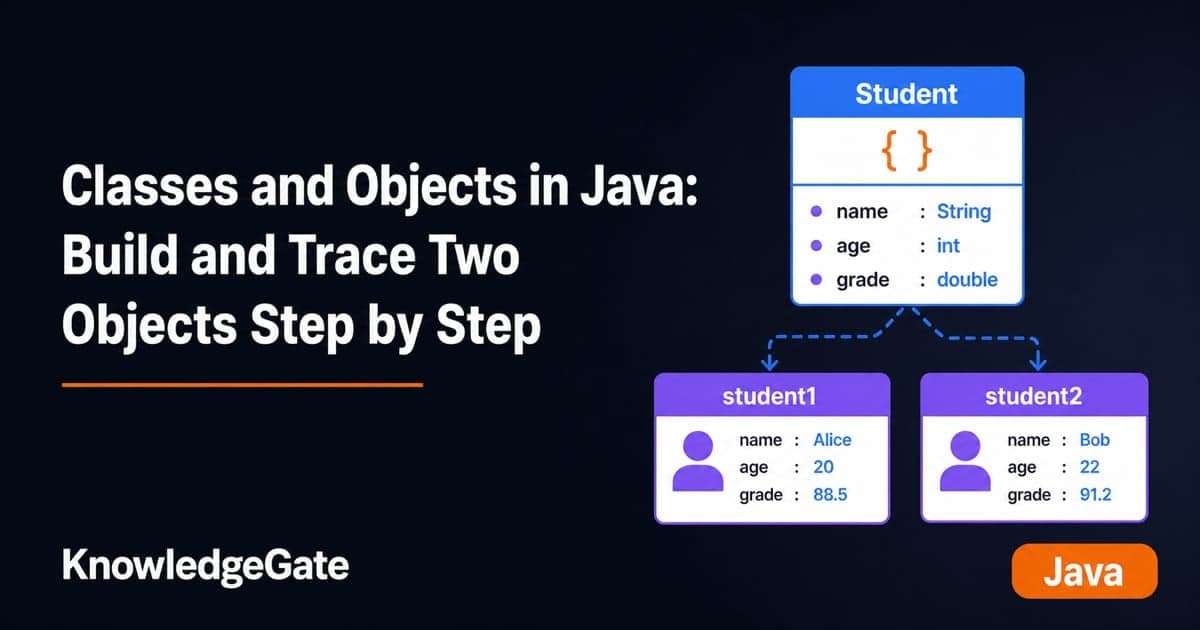
Classes and Objects in Java: Build and Trace Two Objects Step by Step
Build a Java Student class, create two independent objects, and trace fields, methods, aliases, null references, output, and common errors step by step.
Updated 10 Oct 20266 min readJava