C++ auto and decltype: Trace Every Deduced Type
Trace what C++ actually deduces when auto, references, const, decltype, and decltype(auto) interact, then confirm each result at compile time.
KnowledgeGate Team
Exam prep & CS education
Updated 20 Aug 20266 min read

Shorter declarations help only when you can still predict what each name means. Does it own a value, point at an object, or alias one? auto, const, references, decltype, and decltype(auto) each answer that question differently, and a compiler-specific type-name string from typeid will not tell you which answer you got.
Start with the three questions behind every inferred type
Use the same order for every declaration:
What is the initializer expression, and what is the declared type of the object behind it?
Does the new declaration ask for a value, a pointer, an lvalue reference, or a forwarding reference?
Which
autoordecltyperule applies to that pairing?
Type inference removes spelling. It does not remove value semantics.
Top-level const applies to the object itself. In const int score = 42;, score is const. Low-level const applies to what a pointer or reference reaches. In const int* ptr = &score;, ptr is a non-const pointer to a const int.
For structured C++ practice, use the C++ Programming course. The Coding & Skills category is the broader route for language and DSA study.
Worked trace: what plain auto keeps and drops
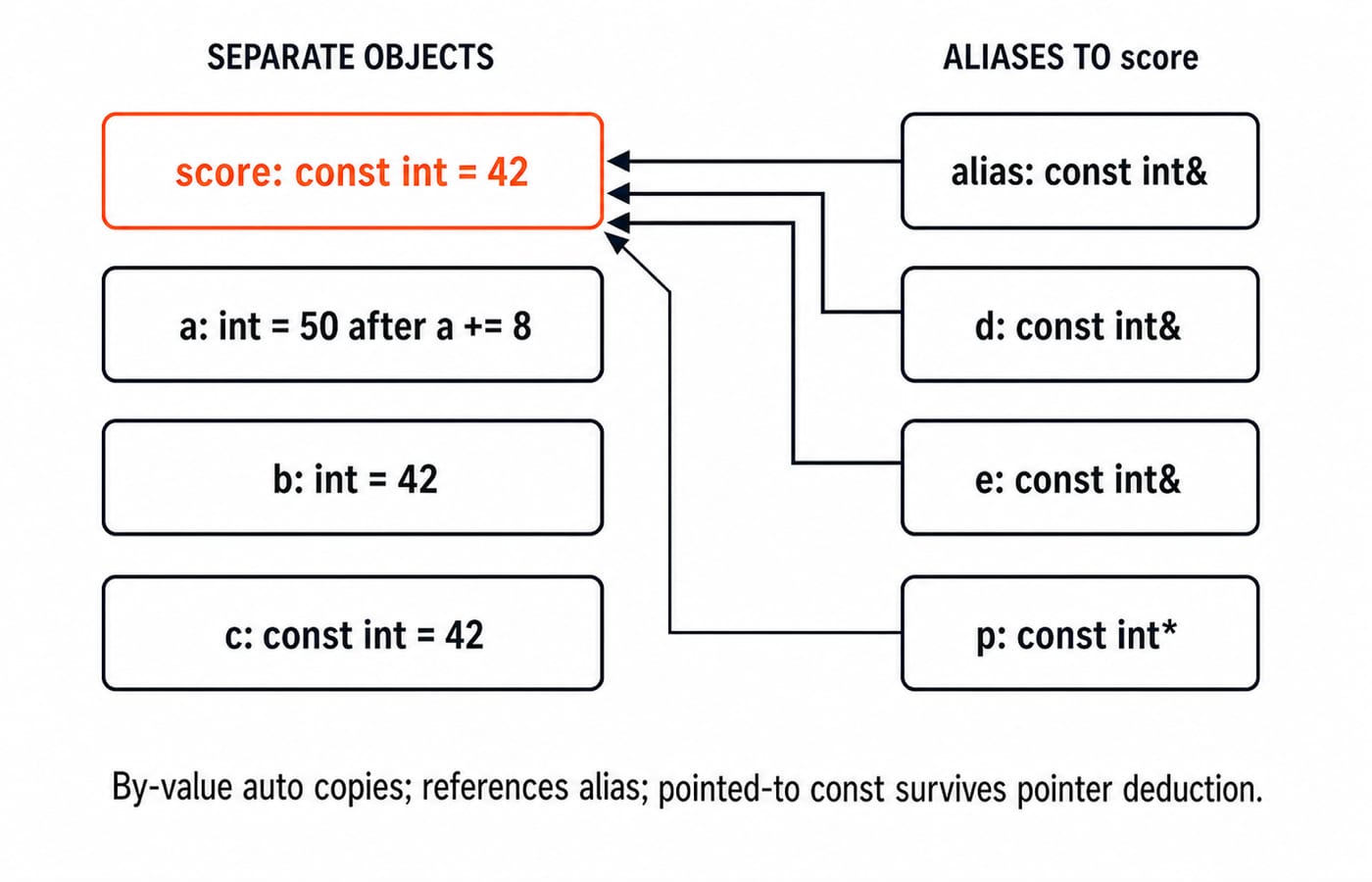
Start with one const object and one reference to it:
const int score = 42;
const int& alias = score;

auto a = score;        // int, value 42
auto b = alias;        // int, value 42
const auto c = alias;  // const int, value 42
auto* p = &score;      // const int*, points to score
By-value auto drops the initializer's reference and top-level const. Thus, a and b are separate, modifiable int objects. The explicit const makes c a separate const int.
Pointer deduction preserves the pointed-to constness, so p is const int*, not int*.
Now execute a += 8. The arithmetic is 42 + 8 = 50, so a becomes 50. Nothing else changes: b, c, alias, and score still read 42. Writing through *p is ill-formed because its pointee is const.
Add references without losing object identity
Reference syntax changes whether a new integer is created:
auto& d = alias;         // const int&, aliases score
const auto& e = score;   // const int&, aliases score

int attempts = 3;
auto&& left = attempts;  // int& after reference collapsing
auto&& right = 7;        // int&& bound to the temporary 7
Neither d nor e creates an integer. Both alias score, and neither can modify it. Deduced auto&& becomes an lvalue reference for an lvalue and an rvalue reference for an rvalue. Thus, left = 5 changes attempts from 3 to 5, while right = 9 changes its bound temporary from 7 to 9.
A reference is an alias, while a pointer is a separate object that stores an address. The Pointers in C memory-diagram article gives the pointer side of that comparison.
Read decltype in its two modes
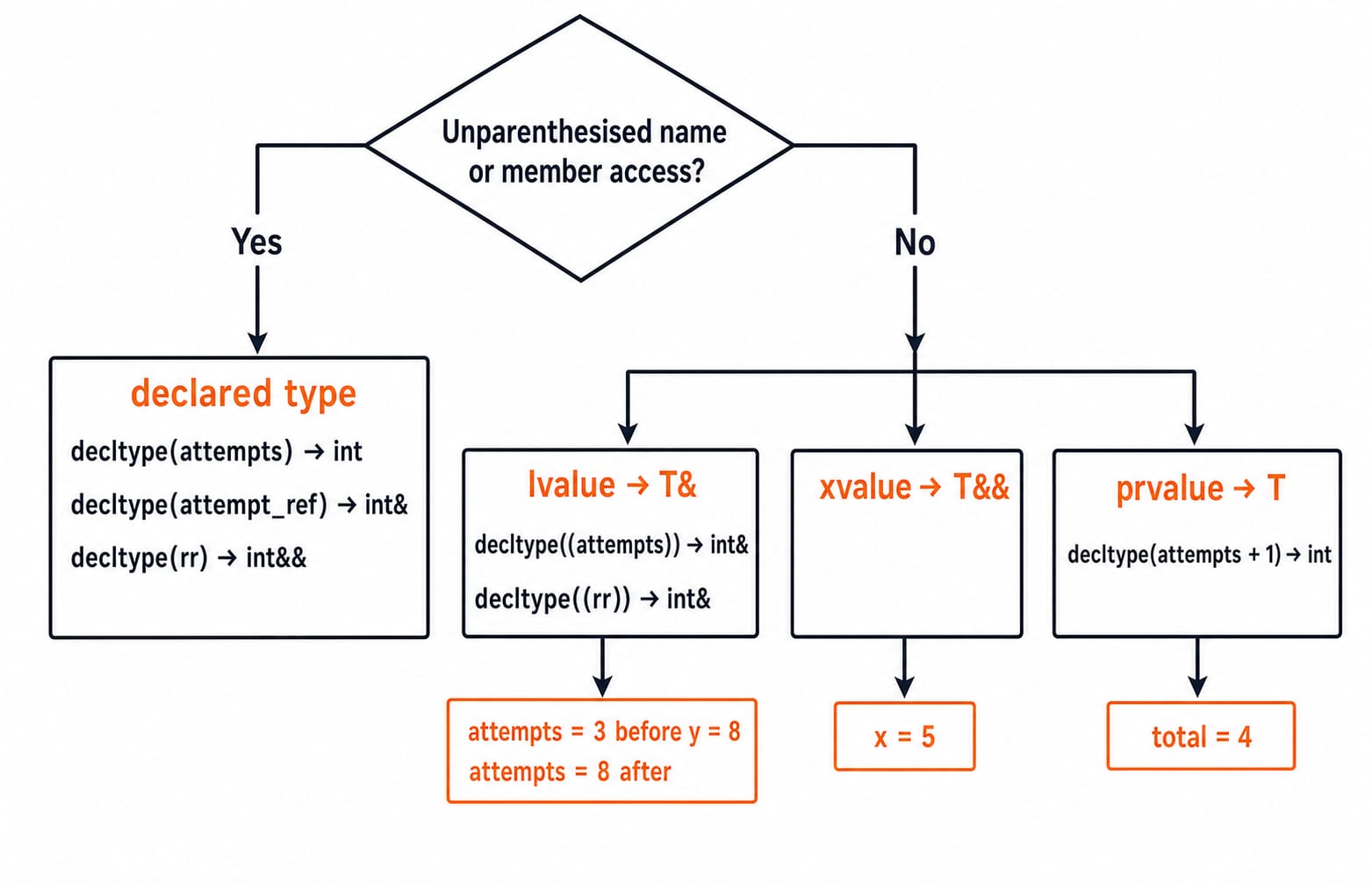
First check for the special case. Applied to an unparenthesised name or member access, decltype reports the entity's declared type. Otherwise, it follows the expression category: an lvalue produces T&, an xvalue produces T&&, and a prvalue produces T.
int attempts = 3;
int& attempt_ref = attempts;

decltype(attempts) x = 5;          // int
decltype((attempts)) y = attempts; // int&
decltype(attempt_ref) z = attempts;// int&
decltype(attempts + 1) total = 4;  // int

y = 8;
decltype(attempts) uses the special case, so x is an independent int. The extra parentheses make decltype((attempts)) an lvalue query, so y is int&. decltype(attempt_ref) returns its declared type, int&. Finally, attempts + 1 is a prvalue, so total is int.
After y = 8, attempts reads 8, and z also reads 8 because both references reach the same object. The independent objects do not change: x stays 5, and total stays 4.
There is one famous trap. Given int&& rr = 7;, decltype(rr) is int&& because it queries the declared type. However, decltype((rr)) is int& because any named variable used as an expression is an lvalue.
Use decltype(auto) for exact preservation
Return syntax can decide whether a caller receives a value or an alias:
int reading = 30;

decltype(auto) reading_copy() { return reading; }   // int
decltype(auto) reading_ref()  { return (reading); } // int&

auto first = reading_ref();           // int, value 30
decltype(auto) second = reading_ref(); // int&, aliases reading
second = 34;
The unparenthesised reading triggers the declared-type rule and returns int. The parenthesised lvalue in reading_ref returns int&. At the call site, ordinary auto copies the result into first, while decltype(auto) preserves the reference in second.
After second = 34, reading and second both read 34. The copied first remains 30.
Do not run this dangerous version:
decltype(auto) bad() { int local = 5; return (local); }It deduces int&, but local dies on return, leaving a dangling reference. Prefer auto for a local value, spell auto& or const auto& for an alias, and reserve decltype(auto) for forwarding or wrappers that require exact preservation.
Traps and compiler checks that expose them
Keep these four corrections ready:
Plain
autodoes not retain top-levelconst.Plain
autodoes not retain a reference.decltype(name)anddecltype((name))can differ.A named rvalue-reference variable is an lvalue expression.
Check important deductions at compile time instead of printing typeid(...).name(). Displayed type names are implementation-specific and can hide reference or cv detail.
#include <type_traits>

static_assert(std::is_same_v<decltype(a), int>);
static_assert(std::is_same_v<decltype(c), const int>);
static_assert(std::is_same_v<decltype(d), const int&>);
static_assert(std::is_same_v<decltype(p), const int*>);

static_assert(std::is_same_v<decltype(attempts), int>);
static_assert(std::is_same_v<decltype((attempts)), int&>);

int&& rr = 7;
static_assert(std::is_same_v<decltype(rr), int&&>);
static_assert(std::is_same_v<decltype((rr)), int&>);
Those assertions assume the earlier declarations are still in scope. Every trap in the list above now has one behind it, including the two where a single pair of parentheses changes the answer.
Compiler errors are evidence too. Uncommenting d = 43; or *p = 43; must fail because both access paths lead to the const score object.
Test yourself with a timed deduction trace
Give yourself four minutes. Before reading the answer, write the type of every new name, identify the valid assignments, and calculate all final values.
const int k = 12;
const int& ref = k;
auto x = ref;          // int
auto& y = ref;         // const int&
decltype(ref) z = k;   // const int&
decltype((x)) w = x;   // int&

x = 20;                // valid
w = 25;                // valid
// y = 20;             // ill-formed
// z = 20;             // ill-formed
x begins as an independent copy of 12. First it becomes 20; then w = 25 changes that same object to 25. Therefore, both x and w finish at 25. Meanwhile, ref, y, and z alias const k, so k, ref, y, and z all remain 12.
The short version
First decide copy versus alias. Then apply the matching deduction rule. Use static_assert whenever the distinction matters enough to become part of the program's contract. Copies come from auto and const auto, aliases from auto& and const auto&, the declared type from decltype(name), and an lvalue reference from decltype((name)).
For mixed-language interview practice, continue with Coding For Placements. For the related conceptual side of C++, read OOP concepts for teaching and CS exams.
Keep learning

C++ Rule of Three, Five and Zero: Safe Object Copying and Moving
Follow one four-integer Buffer from a dangerous shallow copy to correct copy and move operations, then remove the lifetime code with std::vector.
Updated 23 Oct 20265 min readC++

C++ Object Lifetime and Storage Duration: Trace Construction, Destruction, and Dangling State
Learn to separate scope, storage duration, lifetime, and ownership. Trace seven objects precisely, then repair dangling pointers, references, and views.
Updated 19 Oct 20265 min readC++

C++ Diamond Problem: Ambiguity, Duplicate State and Virtual Inheritance
See why a C++ diamond duplicates base state, how virtual inheritance shares it, and when qualification, interfaces, or composition is the clearer design.
Updated 15 Oct 20265 min readC++

C++ Abstract Classes and Interfaces: Build a Usable Storage Contract
Build a C++17 ScoreStore interface, swap vector and hash-backed implementations behind it, and verify both with the same runnable contract test.
Updated 11 Oct 20265 min readC++