TPSC Computer Science PYQs: A No-Guesswork Trend Analysis Method
Turn a small set of Computer Science papers into a careful personal study plan. This method separates observed patterns from guesses and converts errors into scheduled drills.
KnowledgeGate Team
Exam prep & CS education
Updated 1 Aug 20266 min read
In the TPSC Assistant Technical Officer exam, Computer Science is Paper 2, and our TPSC ATO (CS) exam preparation pages work that paper as separate blocks, from digital logic and computer organization through data structures and algorithms to databases, networks and software engineering. Three or four past papers cannot rank that much ground. So code every question you attempt by topic, depth and error, and let your own record choose what you study next.
Build one evidence ledger before calling anything a trend
Ledger columns: source, paper ID, question number, topic, micro-concept, depth, result, error type, time in seconds, answer-key status, and next retest. Label the papers you collect P1, P2 and P3 until you can confirm each one's source, post and exam date. Those labels number your own pile; they are not the exam's Paper 1 and Paper 2.
Result codes: S, solved with a full reason; G, guessed or eliminated without one; W, wrong; U, unattempted. Anything other than S is risky. Three rows:
P2-Q7 | Computer Networks | IPv4 subnetting | apply | W | procedure | 210 s
P1-Q4 | DBMS | normal forms | apply | G | concept | 95 s
P3-Q9 | C and Data Structures | pointer trace | trace | W | interpretation | 260 s
A question earns a ledger row only if you can trace it to an actual paper. A syllabus listing, a coaching handout or your memory of one does not qualify, for the reason set out in Why Solving PYQs Beats Buying Another Question Bank. Until you have enough TPSC papers, KnowledgeGate's TPSC practice set runs to over 1,200 questions, most of them Computer Science.
Code topic depth and error type with fixed rules
R retrieves a fact, A applies one rule, formula or transformation, and T traces dependent states through code, tables or calculations. Code consistently: a single prefix-length step is A, while walking an address through dependent subnet or routing steps is T.
Error codes sit on a separate axis: C, the rule was not known; P, known steps were run wrongly; I, the question was misread; R, recall failed. Read the axes separately: R as a depth means the question only asked for recall, R as an error means recall failed. When two apply, record the earlier one.
Take P2-Q7. You know /26 leaves 64 addresses but count blocks from 0, dropping 172.16.5.130 into the wrong one. Depth A, result W, error P: block selection failed, not your grasp of addressing.
Read a 30-question sample without inventing weightage
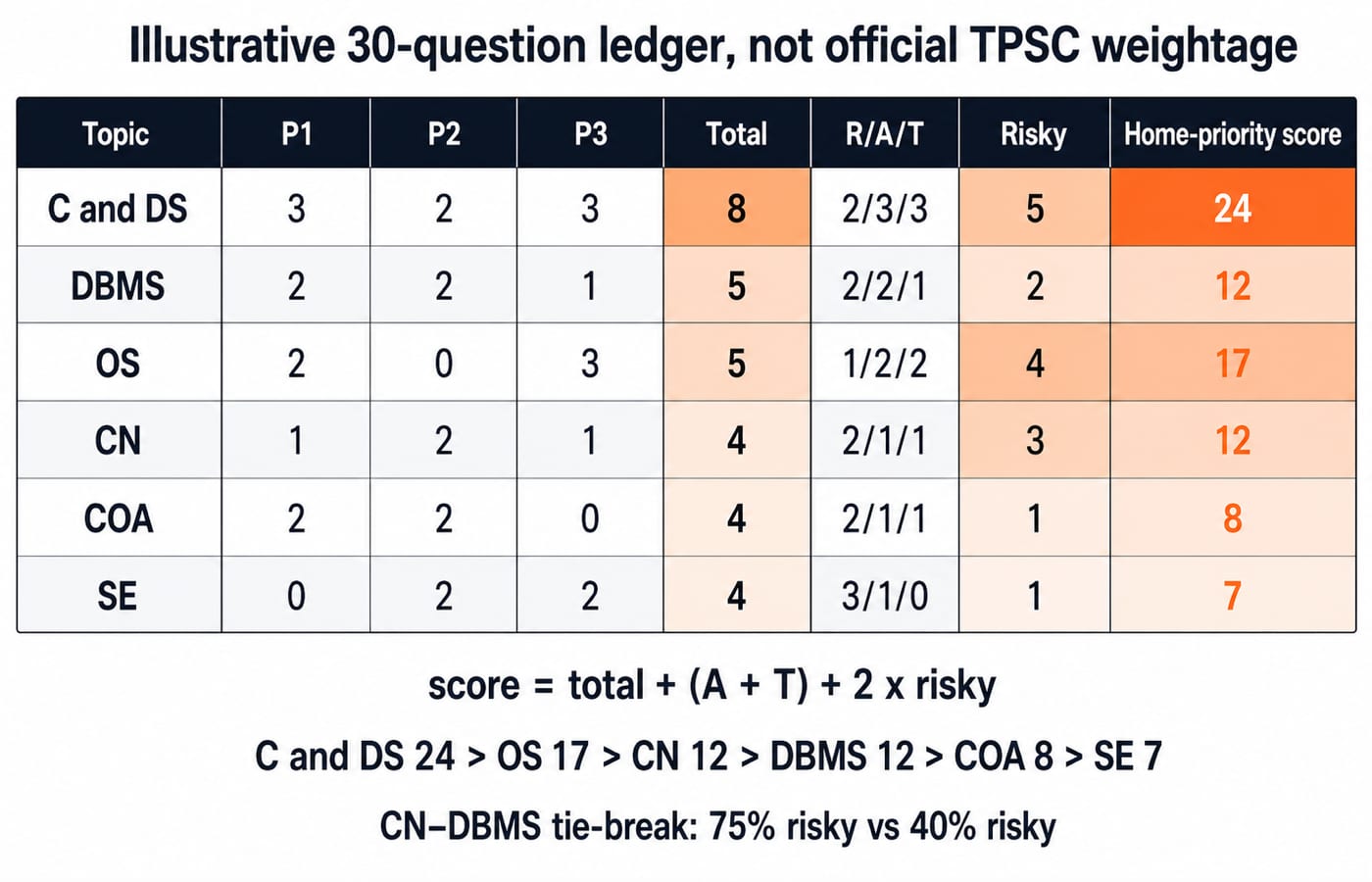
The counts below are one aspirant's tally across three papers: they rank that person's study queue, not the paper.
Topic | P1 | P2 | P3 | Total | R/A/T | Risky | Score |
|---|---|---|---|---|---|---|---|
C and Data Structures | 3 | 2 | 3 | 8 | 2/3/3 | 5 | 24 |
DBMS | 2 | 2 | 1 | 5 | 2/2/1 | 2 | 12 |
Operating Systems | 2 | 0 | 3 | 5 | 1/2/2 | 4 | 17 |
Computer Networks | 1 | 2 | 1 | 4 | 2/1/1 | 3 | 12 |
COA | 2 | 2 | 0 | 4 | 2/1/1 | 1 | 8 |
Software Engineering | 0 | 2 | 2 | 4 | 3/1/0 | 1 | 7 |
Each paper contributes 10 questions and the topic rows add to 8 + 5 + 5 + 4 + 4 + 4 = 30, so the tally balances both ways. Priority is question count + non-recall count + 2 x risky count, where non-recall means the A and T questions.
Results: C and DS 8 + 6 + 10 = 24; OS 5 + 4 + 8 = 17; CN 4 + 2 + 6 = 12; DBMS 5 + 3 + 4 = 12; COA 4 + 2 + 2 = 8; SE 4 + 1 + 2 = 7.
CN and DBMS tie at 12; CN takes the higher slot on risky rate, 3/4 = 75% against DBMS at 2/5 = 40%. C and DS holding 8 of 30 questions is a fact about these three papers and nothing else: note it as observed in this sample.
Turn each error into a fresh-value drill
For P2-Q7, 172.16.5.130/26 has 32 - 26 = 6 host bits, so block size is 2^6 = 64. The last-octet blocks are 0-63, 64-127, 128-191 and 192-255. Since 130 lies in 128-191, the network is 172.16.5.128, broadcast is 172.16.5.191, usable range is .129-.190, and usable hosts are 64 - 2 = 62.
Repair with these closed-book variants:
Day 2:
172.16.5.77/27, network.64, broadcast.95, usable.65-.94,30hosts.Day 7:
10.0.0.174/28, network.160, broadcast.175, usable.161-.174,14hosts.Day 14:
192.168.1.203/27, network.192, broadcast.223, usable.193-.222,30hosts.
The same repair works on the other error types. A C error on normal forms means relearning the rule, then applying it to an unseen dependency set: in R(A, B, C) with A to B and B to C, the transitive dependency leaves R in 2NF but not 3NF, so split it into R1(A, B) and R2(B, C). Reused numbers test memory, not transfer.
Run the evidence loop inside a nine-hour week
Nine hours is 540 minutes, spent only on work the ledger has already named.
Day | Minutes | Work |
|---|---|---|
Monday | 60 | Highest-priority repair |
Tuesday | 60 | Fresh 12-question set |
Wednesday | 60 | Second-priority repair |
Thursday | 60 | Fresh 12-question set |
Friday | 45 | Clean the ledger |
Saturday | 150 | Two 45-minute repairs, then 60 mixed |
Sunday | 105 | 60 retest, 30 review, 15 plan |
Check: 240 + 45 + 150 + 105 = 540.
Week 1 splits the 540 as 180 minutes on paper fragments, 150 coding, 150 correcting risky answers, 60 planning. Weeks 2 to 4 run the daily loop. Weeks 5 and 6 shift to 180 fresh mixed, 120 timed, 180 review and 60 planning. Both total 540. Repeat the block up to the written exam, listed as tentatively 17 January 2027, and confirm that date against the notification.
Miss one weekday and keep the next block at 60 minutes, giving up 30 minutes of Saturday practice rather than stretching the week. Miss two and defer the lower-priority drill, still inside 540.
Retest on intervals chosen by the error
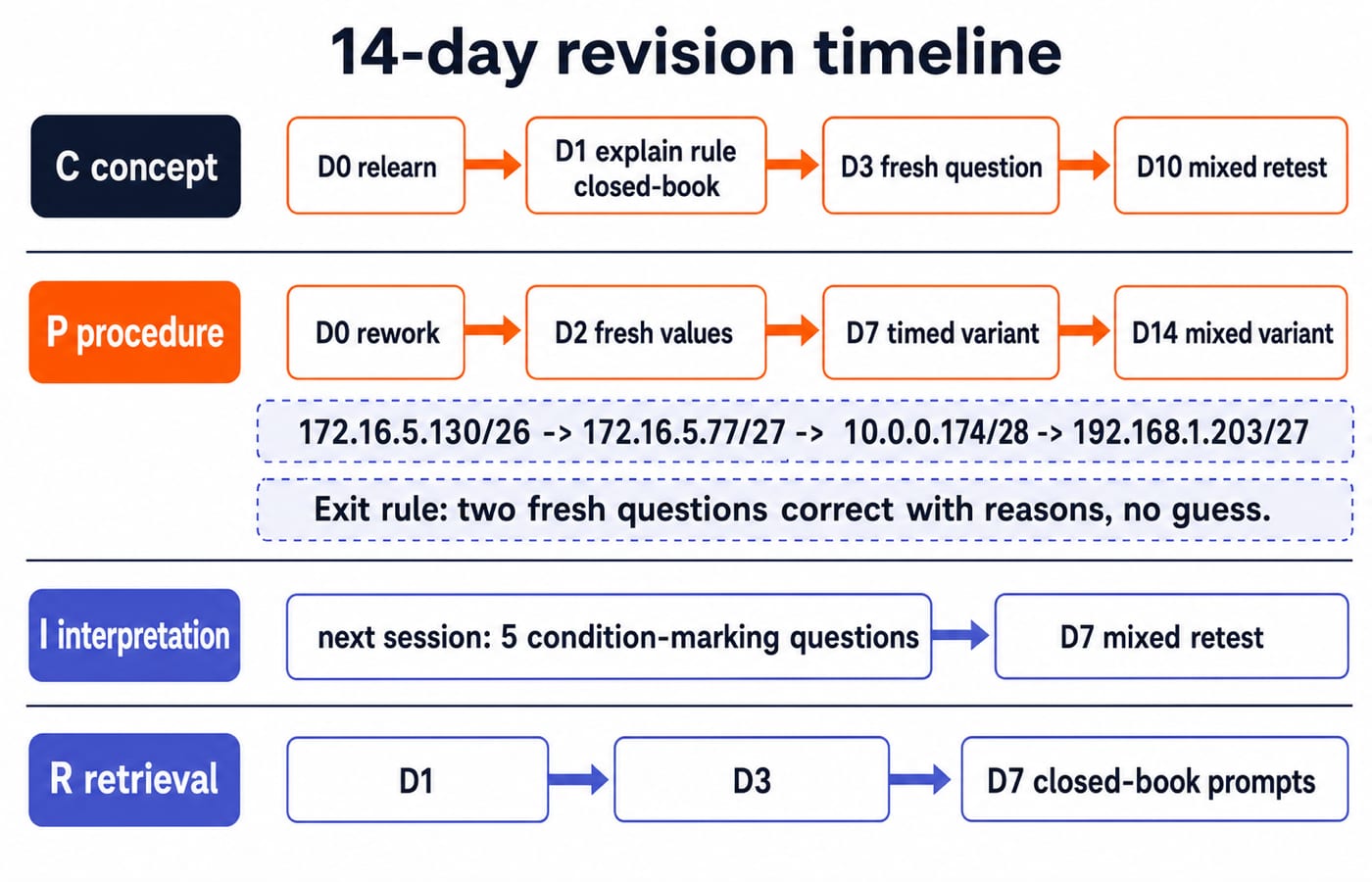
C: relearn day 0; explain the rule closed-book day 1; answer fresh day 3; mixed retest day 10.P: no-notes rework day 0; fresh values days 2, 7 and 14.I: five condition-marking questions next session; mixed retest day 7.R: closed-book prompts days 1, 3 and 7.
Close after two fresh, reasoned, no-note, unguessed answers. For the subnet, both day-7 and day-14 variants must be correct; day-2 alone is insufficient.
For the cadence of timed work, the Teaching Exam Mock Strategy for CS Papers sets out when to add mocks and how to review them. The TPSC Assistant Technical Officer (ATO - CS) Test Series supplies the papers, once your repair queue is short enough to sit a full test.
Keep the claims smaller than the evidence
Use recurring in my sample after two independent papers, single observation after one, and unknown with incomplete sources. Absence from three papers does not rule out appearance.
Before naming a paper, post, year, correction or rule, check the issued document on the Tripura Public Service Commission website. Mark its key provisional or final.
Short version and the next 60 minutes
Code every question, count guesses as risk, rank repairs by priority score, drill with fresh values, retest by error type. Spend the next 60 minutes entering one paper fragment rather than predicting what Paper 2 will ask. The TPSC Assistant Technical Officer (ATO - CS) complete course sequences the Paper 2 blocks; the ledger still says which to slow down on.
Keep learning
TPSC vs BPSC Teaching Exams: Which State CS Route Fits You?
Compare TPSC and BPSC as conditional Computer Science teaching routes through a five-gate audit that separates official eligibility from personal readiness.
Updated 3 Aug 20266 min readTPSC Computer Science
TPSC Computer Science Weightage: Rank High-Return Topics with Syllabus and PYQs
A fixed TPSC CS weightage chart would be convenient, but the official syllabus does not provide one. Learn to turn verified papers and diagnostic gaps into a personal revision order.
Updated 29 Jul 20265 min readTPSC Computer Science
TPSC Computer Science 14-Week Study Plan: Weekly Topics, PYQs and Mocks
Turn 8 to 12 reliable study hours into a practical weekly cycle of CS repair, PYQs, unit tests, full mocks and two evidence-led revision passes.
Updated 26 Jul 20266 min readTPSC Computer Science
TPSC Computer Science: C Programming and Data Structures Worked Playbook
Trace one complete C program from recursive pointer calls to exact stack and queue output, then extend the same state-table method to linked lists, trees and complexity.
Updated 29 Jul 20267 min readTPSC Computer Science