
AMCAT can decide which recruiters even see your profile, yet many students prepare for it like an ordinary fixed paper. That misses two important decisions: the test adapts to your answers, and your optional modules shape the roles for which your score is useful. Preparing blindly can waste a serious attempt.
The compulsory aptitude core is the same for everyone who sits AMCAT. What varies is the set of optional and domain modules on your paper, and those are the ones a recruiter reads as evidence that you can do a particular job.
What AMCAT is and why recruiters use it
AMCAT is an employability assessment used by multiple recruiters rather than an entrance test for one company. A candidate completes the assessment, receives scores across the modules taken, and can use that profile in hiring processes where an employer accepts AMCAT.
Think of it as a qualifier that can open several doors. It does not guarantee an interview or an offer, because each recruiter applies its own role criteria. It does, however, give recruiters a common view of verbal, quantitative, logical, personality, coding, or domain ability, depending on the modules in your test.
That is why the module choice matters. A good score in an irrelevant module may say little about the job you want, while skipping a useful domain module can leave a recruiter without evidence of that skill.
The AMCAT module map
The usual starting point is a compulsory aptitude core:
English Comprehension checks grammar, vocabulary, and the ability to understand written passages.
Quantitative Ability checks arithmetic, algebra, percentages, ratios, data interpretation, and related numerical reasoning.
Logical Ability checks patterns, arrangements, deductions, and analytical reasoning.
Candidates may then encounter optional or domain modules. For technology roles, the important names include Computer Programming, Automata, Automata Fix, and Computer Science. Automata modules focus on coding or correcting code, while Computer Science tests domain concepts. AMPI is a personality inventory rather than a subject paper.
Do not assume that every sitting presents the same menu. Module availability can depend on the assessment booked, the recruiter, and the current AMCAT design. Treat the compulsory core as the transferable base, then confirm the exact modules offered for your slot.
AMCAT adaptive scoring: how it changes your strategy
In a computer-adaptive test, candidates do not all get the same questions in the same order. Your response helps determine the difficulty of the next question. A correct response generally moves the path towards harder material; an incorrect response can move it towards easier material. The scoring model uses both response accuracy and the difficulty level reached to estimate ability.
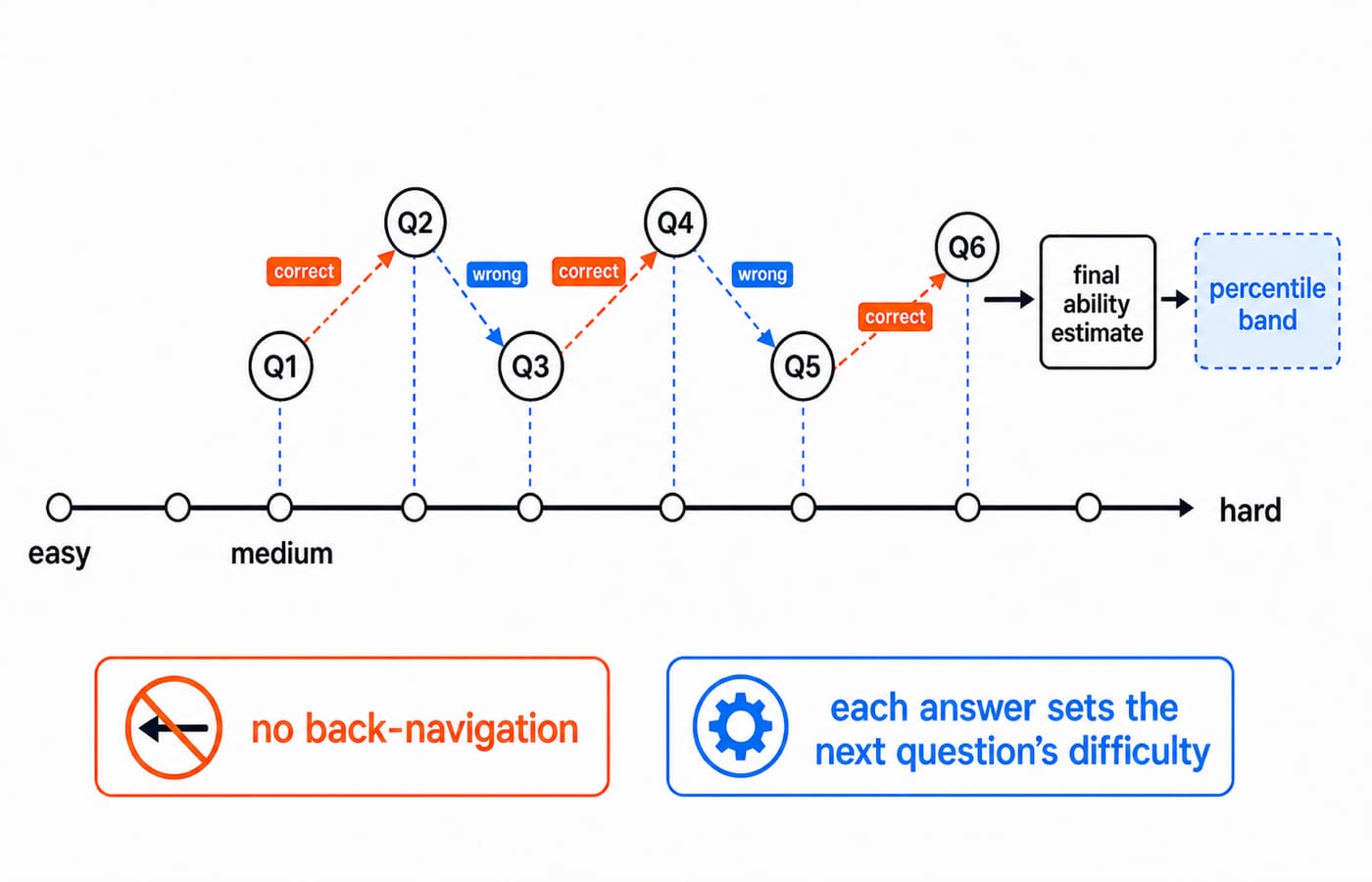
The useful consequence is simple: do not guess-rush the opening questions. Early responses help the system locate your ability band. Read the condition, calculate carefully, and answer only after checking what is actually being asked. You generally cannot return to a previous question, so a careless click cannot be repaired later.
This does not mean spending unlimited time on the first question. An adaptive assessment is still timed. It means replacing panic-speed with controlled speed: identify the topic, select a method, compute, check once, then move on. Blind guessing at the start can place you on an easier path from which it is harder to demonstrate your real level.
Which AMCAT optional modules to pick for your target role
Start from job families, not from the module that sounds easiest.
Target role | Useful module choice | What the score demonstrates |
|---|---|---|
IT services or software development | Automata plus Computer Programming | You can read logic, write code, and solve programming tasks |
Core CS or systems role | Computer Science, with coding modules where offered | You understand CS subjects as well as implementation |
Analyst or data-oriented role | Strong Quantitative Ability, plus the relevant domain option | You can work accurately with numbers and structured reasoning |
Broad placement search | Compulsory core plus the modules shared by your likely roles | Your profile remains relevant across more openings |
Adding every available module is not automatically better. A weak or empty-looking score can become part of the profile a recruiter sees. Pick modules you can prepare properly and that match the jobs you will apply for. If two target roles require different evidence, prepare both deliberately rather than adding one at the last minute.
For a wider comparison of how employers use assessment platforms, read AMCAT, CoCubes and eLitmus explained: which aptitude test decides your offer. Recruiters differ in which platform they trust, so knowing where AMCAT sits changes how much weight a single scorecard can carry.
How to prepare for AMCAT modules
Build the compulsory core first because it transfers to many company tests. For Quantitative Ability and Logical Ability, practise in timed sets, but record accuracy as well as speed. After each set, classify the miss: concept gap, calculation error, misread condition, or time pressure. The label tells you what to fix.
KnowledgeGate's question bank carries about 8,000 quantitative-aptitude questions for AMCAT-style practice. Use them in three passes: untimed concept work, timed topic sets, and mixed mocks. Aptitude for placements: quant, logical reasoning and verbal, section by section gives a route through the transferable core.
For Automata, work on a real compiler. Write the full solution, test edge cases, and learn to read compiler errors. For Automata Fix, practise finding boundary errors, wrong conditions, and incorrect updates rather than rewriting everything. Time English comprehension separately so that you learn to extract the main claim and supporting detail without rereading the whole passage.
The AMCAT Preparation course brings these modules into one sequence. If AMCAT is only one part of your search, use the Placement Preparation catalogue to connect aptitude work with coding and interview preparation.
Before your AMCAT slot, and the short version
The exact module list, duration, navigation rules, and available domain options can change. Confirm them on the official AMCAT site at myamcat.com and in your slot instructions before the test. Do not carry an old pattern into a new assessment.
The short version is this: master the compulsory aptitude core, choose optional modules that support your target roles, and treat the adaptive opening with care. Controlled accuracy gives the test better evidence of your ability than a burst of hurried guesses.