eLitmus pH Test Pattern: Sections, Percentile Logic and Attempt Quality
Understand the current eLitmus pH Test structure, separate practice accuracy from pH Score and percentile, and use attempt logs to plan your next mock.
KnowledgeGate Team
Exam prep & CS education
Updated 22 Jul 20265 min read

Off-campus candidates see an absolute pH Score and a percentile after the eLitmus pH Test, and neither number is the count of correct answers. The pH Score reflects question difficulty and peer performance as well as your correct responses; the percentile only says where you sat relative to the pool that wrote the paper with you. Keeping both apart from your own practice accuracy is what turns a mock review into a decision about what to fix next.
eLitmus pH Test pattern: start with the current official wording
The official eLitmus test-taker page describes an aptitude assessment, not a technical exam. It assumes high-school mathematics and essential English, with required formulae supplied.
Item | What eLitmus currently says |
|---|---|
Time | Designed for two hours |
Sections | Often quantitative, verbal and analytical |
Questions | Currently 20 per section, 60 overall |
Maximum | Currently 600 marks |
eLitmus’s own wording is hedged: “often” is not “always”, and the structure can change between cycles. Confirm the section names, counts and duration on that page before you book a slot, because no preparation site defines the live pattern.
What quantitative, verbal and analytical sections measure
Each section rewards a different skill:
Quantitative: model and calculate with numbers. Worked example: production rises from 800 to 920 units, so the increase is
(920 - 800) / 800 × 100 = 15%.Verbal: understand and reason from language. From “Every shortlisted applicant completed the test; Mira was shortlisted”, the supported conclusion is “Mira completed the test”.
Analytical: organise conditions and infer a valid order. If P is before Q and R is after Q, the order is
P-Q-R.
Different failures need different repairs, so diagnose the section before you drill it. Work through Aptitude for placements: quant, logical reasoning and verbal for the foundations rather than grinding mixed sets and hoping the weak section corrects itself.
Raw performance, pH Score and percentile are different
Quantity | What it means |
|---|---|
Practice raw performance | Your correct, wrong and unattempted counts |
pH Score | The absolute score eLitmus reports, reflecting correct responses, difficulty and peer performance |
Percentile | Relative standing, not percentage of questions correct |
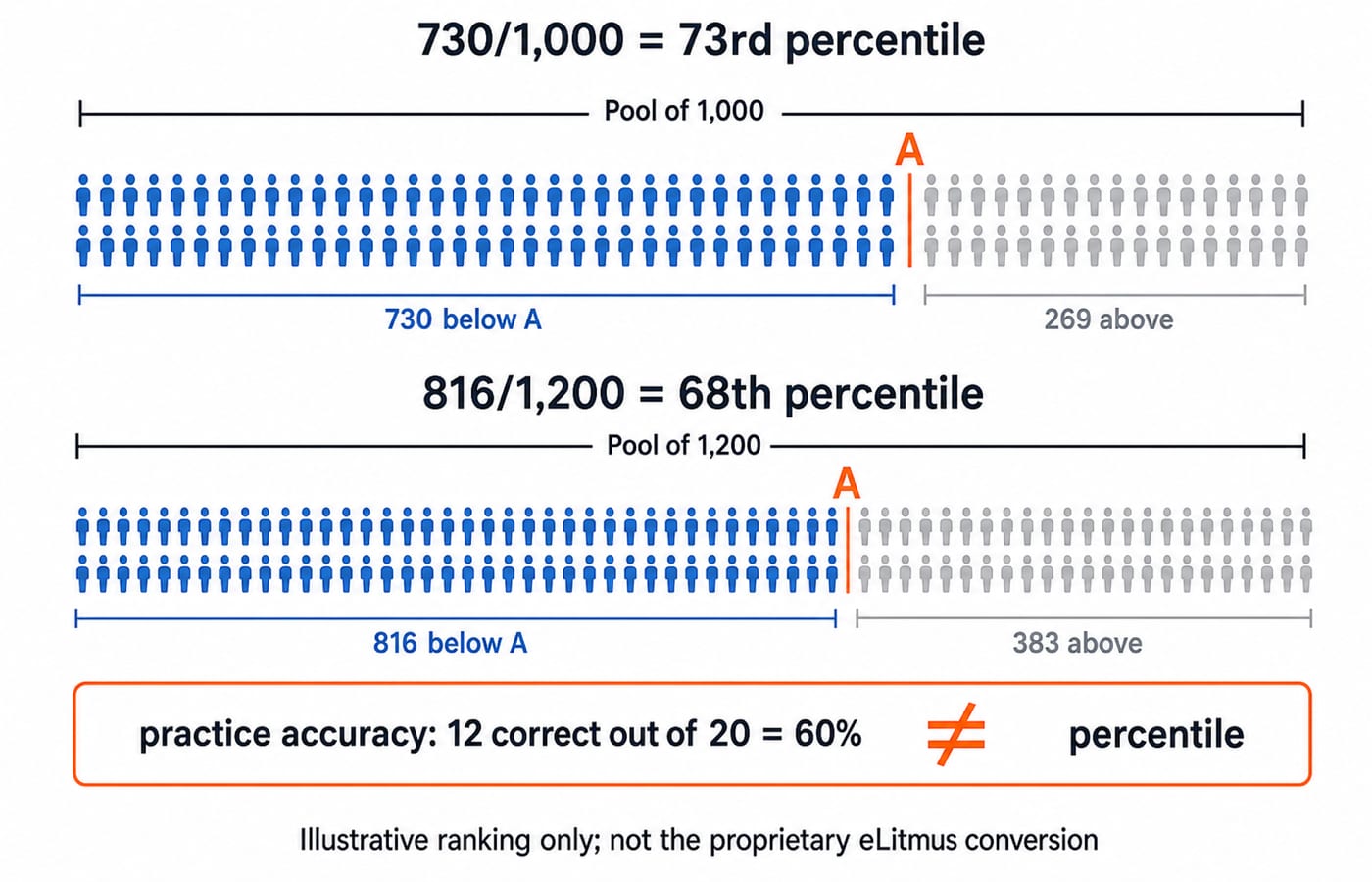
Take a pool of 1,000 in which 730 people score below candidate A: 730 / 1,000 × 100 = 73, so A sits at the 73rd percentile. A’s practice accuracy on that paper was 12 / 20 × 100 = 60%, which is neither a 60th percentile nor a pH Score.
Now put the same A in a pool of 1,200 with 816 below: 816 / 1,200 × 100 = 68. Same candidate, same answers, 68th percentile instead of 73rd, purely because the reference pool moved. The eLitmus help page on percentile calculation says exactly this: it counts the share scoring below you, and its reference pool changes. The percentile mechanics and the negative-marking rule behind them are worked through in eLitmus pH Test: the percentile system, negative marking and the hard DI section.
Why attempt quality beats chasing an attempt count
eLitmus says correct responses, question difficulty, peer performance and handicap-based negative marking all feed the result. That is why “attempt exactly N questions” advice, and the fixed wrong-answer penalties quoted alongside it, have nothing behind them.
Practice log | Correct | Wrong | Unattempted | Attempted accuracy | Correct-answer mix |
|---|---|---|---|---|---|
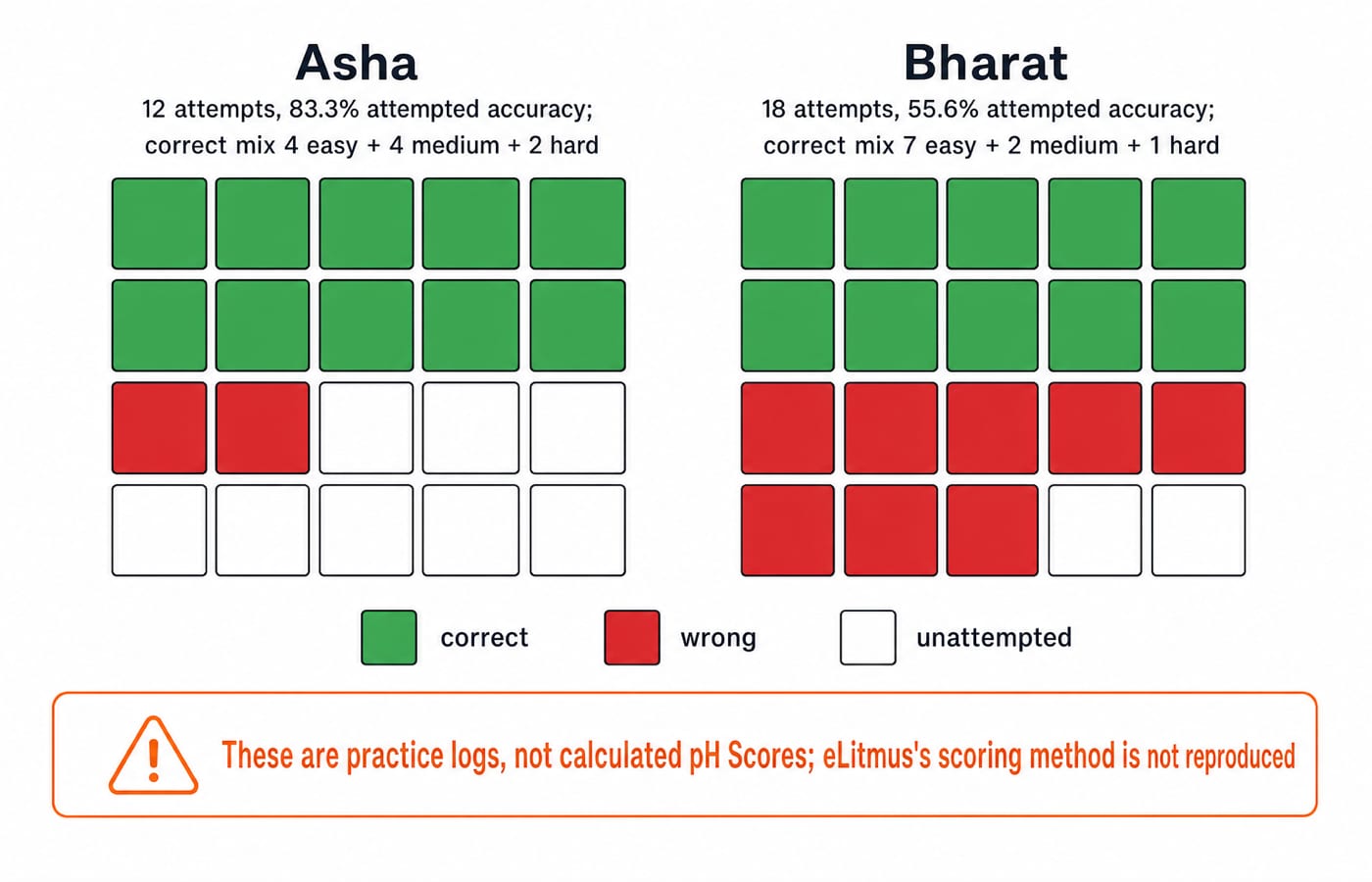
Asha, 12 attempts | 10 | 2 | 8 |
| 4 easy, 4 medium, 2 hard |
Bharat, 18 attempts | 10 | 8 | 2 |
| 7 easy, 2 medium, 1 hard |
Both logged 10 correct, but Bharat bought his with 8 wrong answers while Asha left 8 blank, and a wrong answer carries a penalty that a blank does not. Record why each attempt happened, solved outright, eliminated down to two, or guessed, and the reasoning that produced the wrong answers becomes visible instead of the count.
Read a percentile profile as a diagnosis
Say a profile reads quantitative 84th percentile, verbal 58th and analytical 76th. The 84 means 84% of the pool scored below, not 84% of the marks, and averaging the three into one number produces a figure nobody hires on.
Repair verbal first because it is weakest. Maintain analytical with mixed sets and give quantitative short accuracy drills. What counts as a shortlistable percentile is set by each hiring company, not by eLitmus and not by forum threads, so treat any single “good percentile” figure you read as one company’s rule at one moment.
Build a mock-review loop for better decisions
Assume the 60-question structure for a moment. A mock log worth reviewing looks like this:
Section | Attempted | Correct | Wrong | Unattempted | Attempted accuracy |
|---|---|---|---|---|---|
Quantitative | 20 | 12 | 8 | 0 |
|
Verbal | 14 | 10 | 4 | 6 |
|
Analytical | 8 | 8 | 0 | 12 |
|
Total | 42 | 30 | 12 | 18 |
|
Analytical is 100% accurate but covers only 8 / 20 × 100 = 40% of its section, so that accuracy figure is flattering rather than good. Quantitative needs stop rules and a verification habit, verbal needs its four errors classified by cause, and analytical needs more of the paper attempted. Next-mock targets: wrong answers from 8 down to 5 in quantitative, 4 down to 2 in verbal, and reasoned analytical attempts from 8 up to 12.
Repeat the loop with Aptitude for Placements: A 30-Day Practice Routine. If the live pattern differs from 60 questions, remap the log to the real counts rather than preserving this one.
The short version and the next verified step
Check the current pattern on eLitmus before anything else. Treat quantitative, verbal and analytical as three separate skills with three separate repair plans. Keep practice accuracy, pH Score and percentile apart in your head, and review why each answer was attempted rather than chasing a universal attempt count.
Now take a 20-question mixed set and record correct, wrong, unattempted, difficulty and the reason for each attempt. Work out your practice accuracy per section; there is no route from that number back to a pH Score, so do not spend the evening looking for one. Continue with eLITMUS Superset and browse IT Recruitment Exams for related paths.
Keep learning

TCS NQT Eligibility: Check Backlogs, Gaps and Degree Rules
Use a closed TCS hiring notice as a worked checklist for degree, backlog, course-duration and academic-gap rules, then verify the current drive.
Updated 2 Sep 20264 min readIT Recruitment Exams

CoCubes Preparation Plan: Six Weeks for Campus Hiring Tests
Build a practical six-week CoCubes study plan around the modules in your own test invitation, your diagnostic results, and 72 hours of focused work.
Updated 1 Sep 20266 min readIT Recruitment Exams
eLitmus Retake Decision: Read Section Percentiles Before Testing Again
Do not retake eLitmus on disappointment alone. Use your section pattern, target-job evidence, and fresh timed practice to decide whether to go, wait, or rebuild.
Updated 30 Aug 20264 min readIT Recruitment Exams
eLitmus Mock Analysis: Diagnose Knowledge Gaps and Attempt Errors
A worked mock-review method to separate concept gaps from calculation, reading and decision errors, recover marks, and plan the next four weeks.
Updated 29 Aug 20265 min readIT Recruitment Exams