वर्णमाला (Varnmala) for Teaching Exams: स्वर, व्यंजन, मात्रा and Solved Classification
Build वर्णमाला from concepts, then classify nine consonants by place, voice and aspiration. Includes vowel signs, special symbols and an exam-use checklist.
KnowledgeGate Team
Exam prep & CS education
Updated 3 Sep 20265 min read
वर्णमाला questions can look like simple memory work, yet errors happen when ध्वनि, वर्ण, अक्षर, मात्रा, उच्चारण-स्थान, घोष-अघोष and अल्पप्राण-महाप्राण get mixed together. ध्वनि is what you hear, वर्ण is what grammar counts, अक्षर is what the page shows and मात्रा is only a dependent sign, so का is a single अक्षर built from the two वर्ण क् and आ. Keep those four apart and one memorised 5 × 5 grid then settles place, voice and aspiration in a single step. For the broader language-paper plan, first see CTET Language I & II: A Scoring Strategy.
1. वर्णमाला basics: ध्वनि, वर्ण, लिपि and अक्षर are not synonyms
ध्वनि is a heard speech unit. वर्ण is the smallest contrastive sound in grammar. लिपि is the writing system, Devanagari here. अक्षर is a pronounceable written unit that may contain several वर्ण. Thus का = क् + आ and प्र = प् + र + अ; one visible group need not equal one consonant or sound.
वर्ण divide into स्वर and व्यंजन. A मात्रा is a dependent vowel sign, not a third sound class. वर्णमाला is the ordered inventory; words use consonants, inherent अ, signs and conjuncts.
When classifying any item, ask three questions:
Can it be pronounced without another sound?
Is it a consonant, vowel or sign?
Is the question about sound, spelling or school-grammar terminology?
2. स्वर and मात्राएँ: learn the sound-to-sign mapping
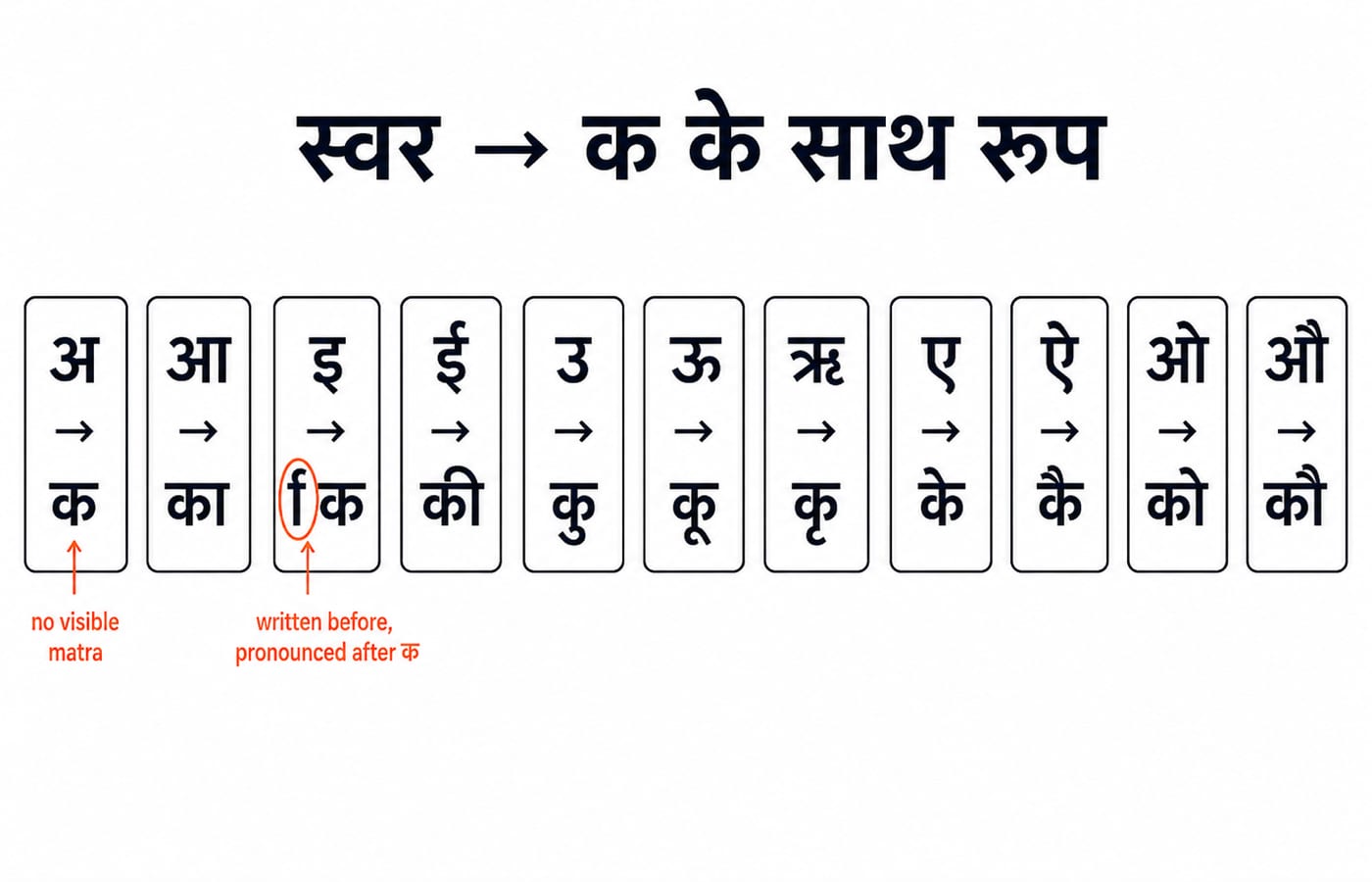
A common school list has 11 vowels: अ, आ, इ, ई, उ, ऊ, ऋ, ए, ऐ, ओ, औ. Traditional exam grouping calls अ, इ, उ, ऋ ह्रस्व and आ, ई, ऊ, ए, ऐ, ओ, औ दीर्घ. Terms can vary by prescribed grammar. अं and अः are अयोगवाह or signs, not silently added as basic vowels.
स्वर | क के साथ रूप | मात्रा note |
|---|---|---|
अ | क | No visible मात्रा |
आ | का | ा |
इ | कि | ि |
ई | की | ी |
उ | कु | ु |
ऊ | कू | ू |
ऋ | कृ | ृ |
ए | के | े |
ऐ | कै | ै |
ओ | को | ो |
औ | कौ | ौ |
The sign ि appears before क visually but is pronounced after it: कि is /ki/, not /ik/.
3. वर्गीय व्यंजन: the 5 × 5 grid explains three classifications at once
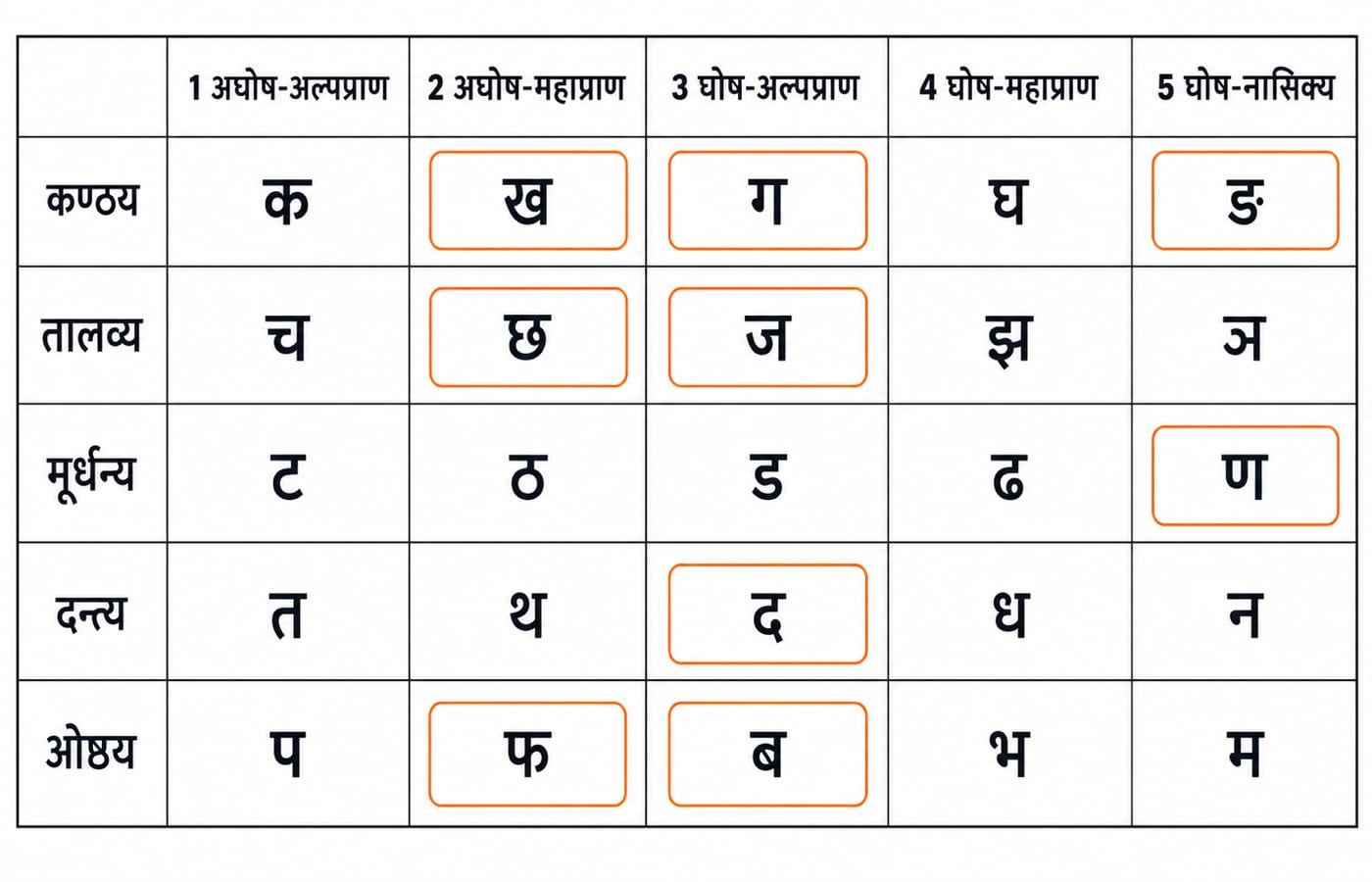
The 25 वर्गीय consonants form five rows:
क-वर्ग: क ख ग घ ङ, कण्ठ्य, throat regionच-वर्ग: च छ ज झ ञ, तालव्य, palateट-वर्ग: ट ठ ड ढ ण, मूर्धन्य, tongue turned towards the roofत-वर्ग: त थ द ध न, दन्त्य, teethप-वर्ग: प फ ब भ म, ओष्ठ्य, lips
The three classifications the grid carries are उच्चारण-स्थान down the rows, then घोष/अघोष and अल्पप्राण/महाप्राण across the columns. Column rule: positions 1-2 are अघोष and 3-5 घोष; positions 1 and 3 are अल्पप्राण, 2 and 4 महाप्राण, and 5 is the वर्ग nasal. Aspiration contrasts are क/ख, ग/घ, च/छ, द/ध, प/फ.क/ख, ग/घ, च/छ, द/ध, प/फ.
4. अन्तःस्थ, ऊष्म, संयुक्ताक्षर and special signs
अन्तःस्थ are य, र, ल, व; ऊष्म are श, ष, स, ह. Remember श तालव्य, ष मूर्धन्य, स दन्त्य and ह कण्ठ्य.
Decompose conjuncts: क्ष = क् + ष, त्र = त् + र, ज्ञ = ज् + ञ, श्र = श् + र. Do not count them as unexplained basic consonants. Distinguish ड़, ढ़ from ड, ढ; many school grammars call ड़, ढ़ उत्क्षिप्त, and the nukta matters.
Special signs are ं अनुस्वार, ः विसर्ग and ँ चंद्रबिंदु, as in अंग, दुःख and माँ. For a total, follow the named convention because signs and conjuncts may be included or excluded.
5. वर्णमाला solved classification: nine letters placed, then counted three ways
For S = {ख, ग, ङ, छ, ज, ण, द, फ, ब}, locate the वर्ग row and then the column.
Letter | Place | Voice | Breath | Column or extra |
|---|---|---|---|---|
ख | कण्ठ्य | अघोष | महाप्राण | 2 |
ग | कण्ठ्य | घोष | अल्पप्राण | 3 |
ङ | कण्ठ्य | घोष | अल्पप्राण | 5, नासिक्य |
छ | तालव्य | अघोष | महाप्राण | 2 |
ज | तालव्य | घोष | अल्पप्राण | 3 |
ण | मूर्धन्य | घोष | अल्पप्राण | 5, नासिक्य |
द | दन्त्य | घोष | अल्पप्राण | 3 |
फ | ओष्ठ्य | अघोष | महाप्राण | 2 |
ब | ओष्ठ्य | घोष | अल्पप्राण | 3 |
Check every partition:
By place: कण्ठ्य
3(ख, ग, ङ) + तालव्य2(छ, ज) + मूर्धन्य1(ण) + दन्त्य1(द) + ओष्ठ्य2(फ, ब) =3 + 2 + 1 + 1 + 2 = 9.By voicing: घोष
6(ग, ङ, ज, ण, द, ब) + अघोष3(ख, छ, फ) =6 + 3 = 9.By breath: महाप्राण
3(ख, छ, फ) + अल्पप्राण6(ग, ङ, ज, ण, द, ब) =3 + 6 = 9. Within the second group,ङandणare also nasals.
Every partition returns |S| = 9. Find the row, read the column, then attach place, voicing, breath and nasal labels.
6. वर्णमाला in teaching-exam papers: five question formats and a 30-second checklist
Typical forms:
Odd one out: Not दन्त्य among
त, द, न, ष?ष, because it is मूर्धन्य.Voice or breath: महाप्राण among
क, ख, ग, ङ?ख, in column 2.स्वर-मात्रा: Correct form of
क + इ?कि.संयुक्ताक्षर: Components of
त्र?त् + र.Special sign: Mark in
माँ? चंद्रबिंदुँ.
Find your target course in CTET & UPTET Teaching Eligibility Test Prep. Still deciding between the two? UPTET vs CTET: Scope, Papers, Which to Take compares eligibility scope and paper choice; the वर्णमाला content itself is identical for both.
Under time pressure, run the same four steps every time:
Name the dimension being tested: place, voice, breath, vowel sign or conjunct.
Rewrite any वर्ग letter as row plus column, for example थ = त-वर्ग, column 2.
Strike out every option that breaks the row rule or the column rule.
If a total is asked, apply the convention the question itself states rather than a remembered number.
7. वर्णमाला traps that cost avoidable marks
Trap 1: one universal total. A source may include or exclude अं, अः, ड़, ढ़ or संयुक्ताक्षर. Use its convention or supplied inventory.
Trap 2: मात्रा as vowel or visual order. In कि, ि represents इ. Contrast क, with inherent अ, and क्, where halant removes it.
Trap 3: mixed articulation labels. Recall श तालव्य, ष मूर्धन्य, स दन्त्य, ह कण्ठ्य. Rebuild the grid before guessing.
8. वर्णमाला revision card: five lines and a self-check
Five-line recall:
The stated convention uses 11 common core vowels.
The 25 वर्गीय consonants sit in five rows.
य, र, ल, वare अन्तःस्थ.श, ष, स, हare ऊष्म.Every वर्ग column encodes voice and aspiration, with the fifth carrying the nasal.
Self-check घ, झ, ठ, ध, म by row and column. For central primary eligibility, continue with CTET Paper 1 Course 2026. For Uttar Pradesh Paper 1, use UPTET Paper 1 2026 Complete Course.
If you need only this topic, redraw both charts from memory today, then solve ten classification prompts from your syllabus or question source and review the errors by category instead of rereading the chapter.
Keep learning

Guidance, Counselling and Mental Health for Teaching Exams: Concepts, Cases and Exam Traps
Learn to separate guidance, counselling and mental-health support, then apply the distinctions to learner cases without crossing a teacher's professional boundaries.
Updated 23 Oct 20266 min readCTET & UPTET

Classroom Management and Communication for Teaching Exams: Complete Notes and Worked Scenarios
Connect classroom management, communication, feedback, discipline, and teacher immediacy, then practise an exam-style vignette with a step-by-step solution.
Updated 19 Oct 20266 min readCTET & UPTET

Teaching-Learning Aids and ICT Integration for Teaching Exams: Notes with Worked Classroom Examples
Learn how to select and sequence teaching-learning aids, recognise genuine ICT integration, and solve classroom scenarios with worked calculations.
Updated 15 Oct 20265 min readCTET & UPTET
Nature, Objectives and Characteristics of Teaching: Concept Notes for Teaching Exams
Learn to separate what teaching is, what change it seeks and how an effective teaching process operates. A worked fraction lesson connects every concept.
Updated 10 Oct 20265 min readCTET & UPTET