Binary Arithmetic Operations Explained: Rules and Worked Examples
Learn binary addition, subtraction, multiplication and division with aligned worked examples, then separate carry, borrow and two's-complement overflow.
KnowledgeGate Team
Exam prep & CS education
Updated 19 Oct 20266 min read
Binary arithmetic looks like decimal arithmetic with fewer digits, yet most errors come from one lost carry, a borrow treated as decimal ten, or one fixed-width word read as both unsigned and signed. The four operations become reliable when every column retains its carry or borrow and every result is checked at a declared width. Addition, subtraction, multiplication and division use different mechanics; carry-out and signed overflow remain separate questions.
Binary arithmetic starts with place value, width and four rule sets
Place value comes first. 101101_2 = 1x2^5 + 0x2^4 + 1x2^3 + 1x2^2 + 0x2^1 + 1x2^0 = 45_10. Leading zeros do not change an unsigned value, so 101101_2 and 00101101_2 both equal 45_10. Width still matters because it controls range, carry and signed interpretation. For base conversion, signed encodings, BCD and floating point, use Number Representation in Digital Electronics: Conversions, Complements and Worked Examples. Those representation rules determine what the bits mean; arithmetic begins only after the representation is declared.
Operation | Small rules |
|---|---|
Addition |
|
Subtraction |
|
Multiplication |
|
Division | Compare, subtract when possible, then bring down the next bit |
An unmarked bit pattern is treated as unsigned; a signed result declares both fixed width and two's-complement interpretation. A space separates carry-out from the fixed-width word. Binary arithmetic sits inside GATE CS Exam Preparation.
Worked binary addition: 101101_2 + 011011_2
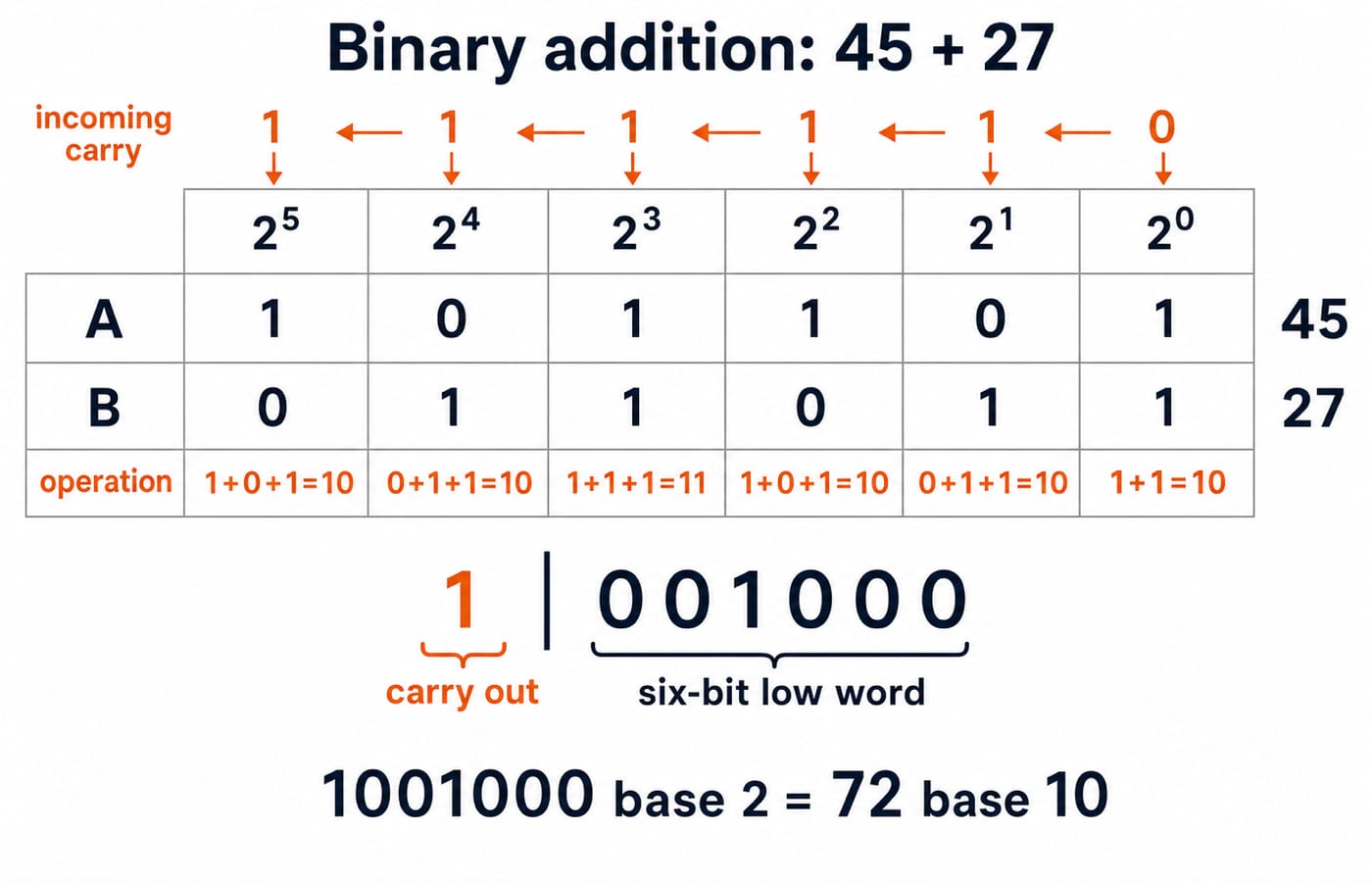
Decimal is only a check: 45+27=72. Add the six columns from right to left. The output and carry sequence is 1+1 -> 0, carry 1; 0+1+1 -> 0, carry 1; 1+0+1 -> 0, carry 1; 1+1+1 -> 1, carry 1; 0+1+1 -> 0, carry 1; 1+0+1 -> 0, carry 1. Write the final carry at the left.
  101101
+ 011011
--------
1 001000
Thus the full-precision answer is 1001000_2 = 64+8 = 72_10. In a six-bit register, the low word is 001000_2 = 8_10, with carry-out 1, not the full sum. As a shorter alignment check, 010101_2 + 001110_2 = 100011_2, or 21+14=35. A carry changes the next column, not the sum bit already written.
Worked binary subtraction: borrow, then verify by complement
Compute 101101_2 - 011011_2 in six bits. From the right: 1-1=0. At 2^1, borrow from 2^2, making 10_2-1=1; the lending 2^2 bit becomes 0, so 0-0=0. Next, 1-1=0. At 2^4, borrow from 2^5, so 10_2-1=1; the reduced top bit gives 0-0=0. The result is 010010_2 = 18_10, matching 45-27=18.
For a two's-complement check, use seven bits so both positive inputs fit: +45 = 0101101_2 and +27 = 0011011_2. Invert 0011011_2 to 1100100_2, then add 1, giving -27 = 1100101_2. Now 0101101_2 + 1100101_2 = 1 | 0010010_2. Discard the carry beyond seven bits and read 0010010_2 = 18_10. A borrow supplies decimal 2 in its lower column, and complement subtraction always uses invert plus one. For signed ranges, negative encodings, sign extension and overflow edge cases, use Two's Complement Arithmetic Explained: Signed Ranges, Subtraction, Overflow and Worked Examples. Invert-plus-one serves only as a cross-check for the unsigned subtraction above.
Worked binary multiplication: shift every partial product
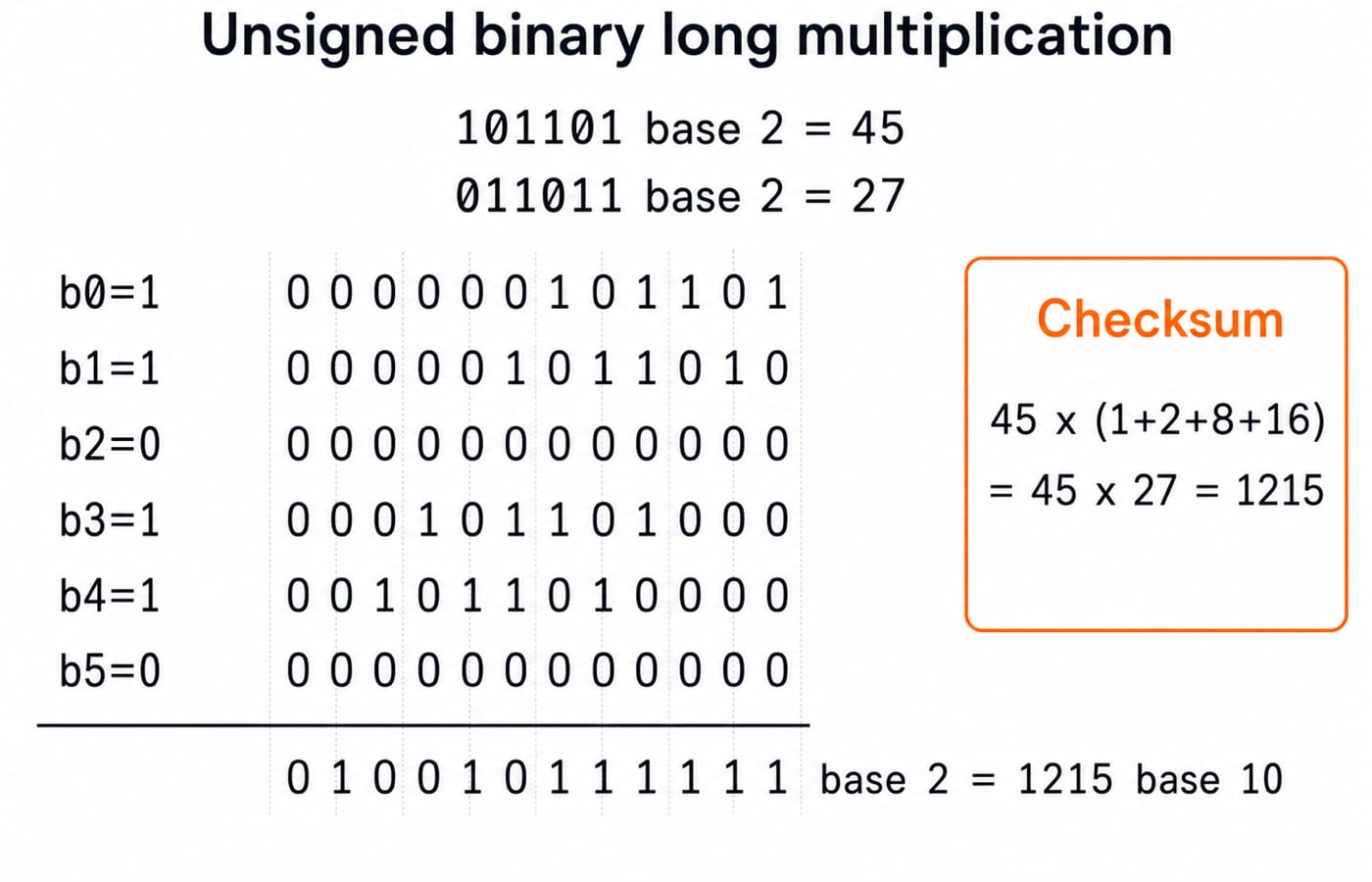
For unsigned 101101_2 x 011011_2, the multiplier has set bits at positions 0, 1, 3 and 4. The non-zero values are 45<<0=45, 45<<1=90, 45<<3=360 and 45<<4=720. Use 12 columns for the full product of two six-bit values:
000000101101
000001011010
000000000000
000101101000
001011010000
000000000000
------------
010010111111
The sum is 10010111111_2. Decimal confirms it twice: 720+360+90+45=1215, and 1024+128+32+16+8+4+2+1=1215. Each row shifts by its bit position; zero rows contribute nothing.
Worked binary division: quotient bits and remainder
Divide 110101_2 = 53_10 by 000101_2 = 5_10. Bring down dividend bits from left to right. The running decisions are: 1 < 5, quotient bit 0; 3 < 5, bit 0; 6-5=1, bit 1; bring down 1 to make 3, bit 0; bring down 0 to make 6, then 6-5=1, bit 1; bring down the final 1 to make 3, bit 0.
The quotient decisions form 001010_2 = 10_10, with remainder 000011_2 = 3_10. Check 53 = 5x10+3 and 0 <= 3 < 5. For an exact contrast, 10010111111_2 / 101101_2 = 011011_2, or 1215/45=27, remainder 0.
Carry, borrow and signed overflow are different
Declare four-bit width before interpreting 1110_2 + 0101_2 = 1 | 0011_2. Unsigned, it is 14+5=19, with carry-out 1 and modulo-16 low word 0011_2. In four-bit two's complement, it is -2+5=3. There is no signed overflow because the operands have different signs.
For true overflow, 0101_2 + 0100_2 = 1001_2: two positives, 5+4=9, produce a negative-looking low word because 9 is outside the four-bit signed range -8 to +7. Likewise, 1010_2 + 1101_2 = 1 | 0111_2 means -6 + -3 = -9, also out of range. Carry alone does not decide signed overflow.
Now take 0011_2 - 0101_2. Unsigned 3-5 needs a borrow and wraps modulo 16 to 1110_2. Signed, +3-(+5)=-2, and the same 1110_2 is valid. For truth tables, circuit construction and propagation delay, continue with Adders and Subtractors in Digital Logic: Circuits, Worked Examples and Exam Traps. Those hardware questions are separate from interpreting the finished word at the declared width and signedness.
Representative patterns, traps and rapid checks
The same task shapes recur: supply a missing carry or borrow, give the full-precision result, fit the answer into an n-bit word, judge overflow, subtract by complement, align partial products, and state quotient with remainder.
Mistake | What goes wrong | Repair |
|---|---|---|
Read borrowed | The column value is wrong | Treat it as decimal |
Mix widths | Columns and ranges shift | Pad to equal width |
Lose the carry from | The next column is too small | Record sum |
Use | Subtraction is off by one | Use |
Equate carry with overflow | Signed answers are misjudged | Apply the sign rule |
Truncate every product | Full precision is lost | Keep up to |
Read a signed negative as unsigned | The value changes | Declare signedness first |
Allow remainder at least divisor | Division is unfinished | Continue until |
Rapid checks:
11101_2 + 01011_2 = 101000_2, so29+11=40.100000_2 - 001111_2 = 010001_2, so32-15=17.1011_2 x 110_2 = 1000010_2, so11x6=66.101101_2 / 110_2 = 111_2, remainder011_2, so45=6x7+3.In five-bit two's complement,
01111_2 + 00001_2 = 10000_2has signed overflow because15+1=16exceeds-16to+15.
Binary arithmetic rewards column discipline, so practise these operations under time rather than in isolation.
Binary arithmetic operations: the short version and next step
Align equal-width words.
Add or subtract from the least significant bit.
Carry
1when a column totals10_2or11_2.A borrow supplies
10_2in the current column.Shift each multiplication partial by its multiplier position.
Require
dividend = divisor x quotient + remainder.Decide unsigned or two's-complement interpretation before judging overflow.
Keep four anchors: 101101_2 + 011011_2 = 1001000_2 gives 45+27=72; 101101_2 - 011011_2 = 010010_2 gives 45-27=18; 101101_2 x 011011_2 = 10010111111_2 gives 45x27=1215; 110101_2 / 000101_2 = 001010_2 remainder 000011_2 gives 53/5=10 remainder 3.
Redo all four on paper. Mark every carry, borrow, shift and quotient decision, then verify each result in decimal. GATE Guidance by Sanchit Sir provides a structured route for placing binary arithmetic inside wider GATE CS preparation.
Keep learning
1's Complement Explained: Binary Conversion, Addition and Worked Examples
Learn how fixed-width 1's complement numbers represent negatives, why zero has two encodings, and how end-around carry works through exact examples.
Updated 15 Oct 20266 min readDigital Logic
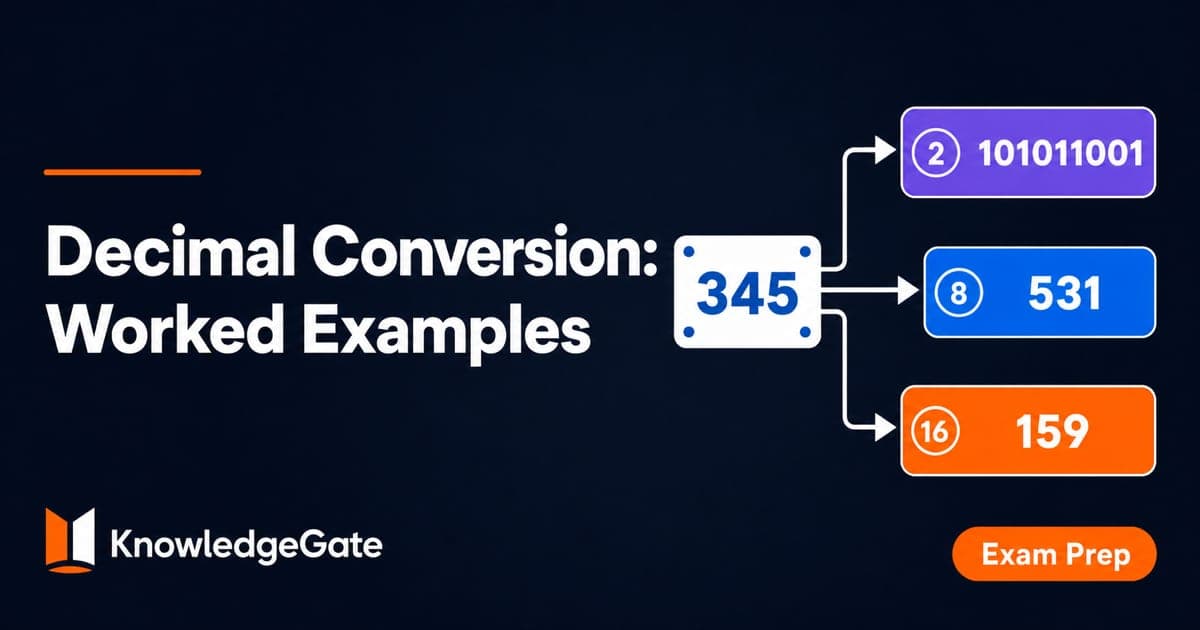
Decimal Conversion Explained: Binary, Octal and Hexadecimal Worked Examples
Learn one dependable method for converting values between decimal, binary, octal and hexadecimal, including fractions, shortcuts and checks.
Updated 11 Oct 20265 min readDigital Logic

Two's Complement Arithmetic Explained: Signed Ranges, Subtraction, Overflow and Worked Examples
Build a reliable 8-bit method for encoding signed values, subtracting with complements, detecting overflow, extending signs and checking every result.
Updated 7 Oct 20266 min readDigital Logic

Functional Completeness in Digital Logic: NAND, NOR and Worked Examples
Learn what makes a Boolean operator set complete, how NAND and NOR recover a standard basis, and how to verify a four-gate NAND construction.
Updated 2 Oct 20266 min readDigital Logic