Statements : Some cars are jeeps. All the boxes are jeeps. All the pens are…
2025
Statements : Some cars are jeeps. All the boxes are jeeps. All the pens are cars.
Conclusions :
I. Some cars are boxes.
II. No pen is jeep.
III. Some boxes are cars.
Answer: A. None of three — Concept: In syllogisms, a conclusion follows only if it is true in every possible Venn diagram consistent with the given statements. If even one valid diagram…
- A.
None of three
- B.
Only (I) and (II)
- C.
Only (I) and (III)
- D.
Only (II) and (III)
Attempted by 4 students.
Show answer & explanation
Correct answer: A
Concept: In syllogisms, a conclusion follows only if it is true in every possible Venn diagram consistent with the given statements. If even one valid diagram breaks a conclusion, that conclusion does not follow. Also, by the conversion rule, "Some A are B" and "Some B are A" always have the same truth value.
Application:
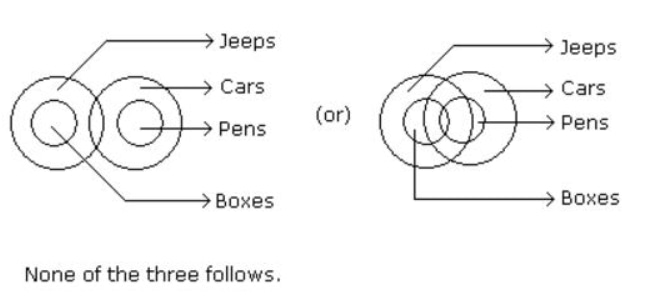
"All the boxes are jeeps" places the Boxes circle entirely inside the Jeeps circle.
"Some cars are jeeps" makes the Cars circle overlap the Jeeps circle only partially, and the statements do not fix where inside Jeeps this overlap falls -- it can be drawn in a region that misses the Boxes sub-circle completely.
"All the pens are cars" places the Pens circle entirely inside the Cars circle.
Conclusion I ("Some cars are boxes") and Conclusion III ("Some boxes are cars") are converses of the same relationship, so they stand or fall together. A diagram exists where the Cars-Jeeps overlap avoids the Boxes region entirely, so Cars and Boxes need not share any region -- I and III are not forced to be true in every diagram.
Conclusion II ("No pen is jeep") would require the Pens sub-circle to always miss the Cars-Jeeps overlap. Since the overlap's position inside Cars is not fixed by the statements, a diagram can equally place part of the Pens circle inside that overlap -- so II is not forced to be true either.
Cross-check: Two different diagrams (shown below) both satisfy all three statements -- in one, the Cars-Jeeps overlap misses the Boxes and Pens regions entirely; in the other, it touches them. Since the truth of I, II and III changes between these equally valid diagrams, none of the three conclusions holds in every case, so none of them follows.