Statements : All the books are papers. Some papers are journals. Some journals…
2023
Statements : All the books are papers. Some papers are journals. Some journals are calendars.
Conclusions :
I. Some journals are books.
II. Some calendars are papers.
III. Some books are journals.
IV. Some books are calendars.
Answer: D. None of the four — Concept: Only a universal statement ("All"/"No") forces a relationship to carry through to another term. Two particular ("Some") statements chained together…
- A.
Only (I)
- B.
Only (II)
- C.
Only (III)
- D.
None of the four
Attempted by 3 students.
Show answer & explanation
Correct answer: D
Concept: Only a universal statement ("All"/"No") forces a relationship to carry through to another term. Two particular ("Some") statements chained together never force a new relationship, because each "Some" can be satisfied by a different, non-overlapping part of the shared middle term.
Application:
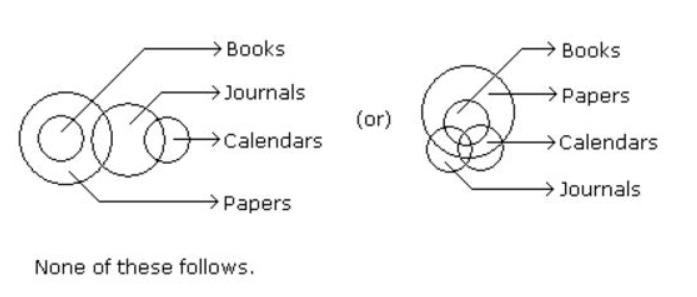
"All Books are Papers" places the Books circle entirely inside the Papers circle - this is the only universal premise.
"Some Papers are Journals" only guarantees a partial overlap between Papers and Journals somewhere; that overlap is free to lie entirely in the part of Papers that is outside Books.
"Some Journals are Calendars" only guarantees a partial overlap between Journals and Calendars somewhere; that overlap is free to lie entirely in the part of Journals that is outside the Papers-Journals overlap.
Conclusion I ("Some journals are books"): since the Papers-Journals overlap can sit wholly outside Books, no journal is forced to be a book.
Conclusion II ("Some calendars are papers"): the Journals-Calendars overlap and the Papers-Journals overlap can occupy different, non-intersecting parts of the Journals circle, so a calendar-linked journal need not also be a paper-linked journal.
Conclusion III ("Some books are journals"): this is the converse of Conclusion I and fails for the identical reason - the Papers-Journals overlap need not touch Books at all.
Conclusion IV ("Some books are calendars"): this would need two independent partial overlaps to chain all the way from Calendars back to Books, which nothing in the statements forces.
Cross-check: draw a single possibility diagram - Books strictly inside Papers; the Papers-Journals overlap entirely in the part of Papers outside Books; the Journals-Calendars overlap entirely in the part of Journals outside the Papers-Journals overlap. Every one of the three statements is still satisfied, yet none of the four conclusions holds, confirming that none of them is logically necessary.
Result: Hence, none of the four conclusions follows from the given statements.