Two statements are given below followed by two conclusions numbered as I and…
2025
Two statements are given below followed by two conclusions numbered as I and II respectively. Consider the given statements as true even if they seem to be not. After reading all the conclusions, confirm which of the given conclusions logically follows, disregarding commonly known facts.
Statements: All the pencils are pens. All the pens are inks.
Conclusions:
i. All the pencils are inks.
ii. Some inks are pencils.
Answer: D. Both (1) and (2) follow — Concept: When two universal statements chain as All A are B and All B are C, transitivity gives All A are C. Under the traditional (existential-import)…
- A.
Only (1) conclusion follows
- B.
Only (2) conclusion follows
- C.
Either (1) or (2) follows
- D.
Both (1) and (2) follow
Attempted by 4 students.
Show answer & explanation
Correct answer: D
Concept: When two universal statements chain as All A are B and All B are C, transitivity gives All A are C. Under the traditional (existential-import) convention used in these syllogism questions, a universal statement All A are B also carries the particular Some A are B, and any particular statement Some A are B converts directly to Some B are A.
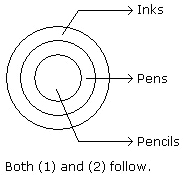
Statement 1 gives Pencils are a subset of Pens (all pencils are pens).
Statement 2 gives Pens are a subset of Inks (all pens are inks).
Chaining the two universal statements: Pencils are inside Pens which are inside Inks, so Pencils are inside Inks -- Conclusion I ('all pencils are inks') follows.
Since all pencils are inks, existential import also gives some pencils are inks; converting this particular statement gives some inks are pencils -- Conclusion II follows as well.
Cross-check: Drawing pencils, pens and inks as three concentric circles (pencils innermost, pens middle, inks outermost, as shown below) shows both relationships holding at the same time -- there is no scenario where one conclusion is true and the other false, so treating them as an either/or alternative is wrong, and picking only one conclusion understates what the diagram actually shows.
Venn diagram representation: