Statements : Some rats are cats. Some cats are dogs. No dog is cow.…
2024
Statements : Some rats are cats. Some cats are dogs. No dog is cow.
Conclusions :
I. No cow is cat.
II. No dog is rat.
III. Some cats are rats.
Answer: D. Only (III) — Concept: A particular affirmative statement ('Some A are B') can always be reversed to 'Some B are A' — this immediate conversion holds no matter how the rest…
- A.
Only (I)
- B.
Only (I) and (II)
- C.
Only (I) and (III)
- D.
Only (III)
Attempted by 3 students.
Show answer & explanation
Correct answer: D
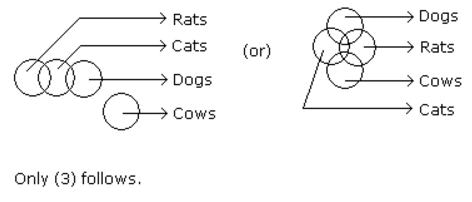
Concept: A particular affirmative statement ('Some A are B') can always be reversed to 'Some B are A' — this immediate conversion holds no matter how the rest of the sets are arranged. When a particular ('Some') premise is combined with a negative ('No') premise through a shared term, the only conclusion that follows for certain is the weaker particular negative ('Some ... are not ...'), never a full universal negative. And two particular ('Some') premises sharing a common term never yield any definite conclusion about their other two ends.
'Some rats are cats' reverses directly to 'Some cats are rats', so Conclusion III holds in every arrangement consistent with the statements.
'Some cats are dogs' and 'Some rats are cats' share the term 'cats', and both are particular statements, so no definite link between dogs and rats can be drawn — Conclusion II does not follow.
'Some cats are dogs' and 'No dog is cow' share the term 'dogs' — one particular, one negative — so the only guaranteed result is the weaker 'Some cats are not cows', not the full 'No cow is cat' — Conclusion I does not follow.
Cross-check: A Venn-diagram check confirms this: a valid arrangement of the four sets satisfying all three statements can be drawn with the cow and cat sets overlapping, and an equally valid arrangement can be drawn with them separate — the same holds for dog and rat. Since both arrangements are possible, Conclusions I and II are not certain, while the cat-rat overlap in Conclusion III is forced in every valid arrangement because it is a direct restatement of the first premise.
Hence, only Conclusion III follows definitely — matching the saved answer, 'Only (III)'.