Statements : All the bottles are boxes. All the boxes are bags. Some bags are…
2024
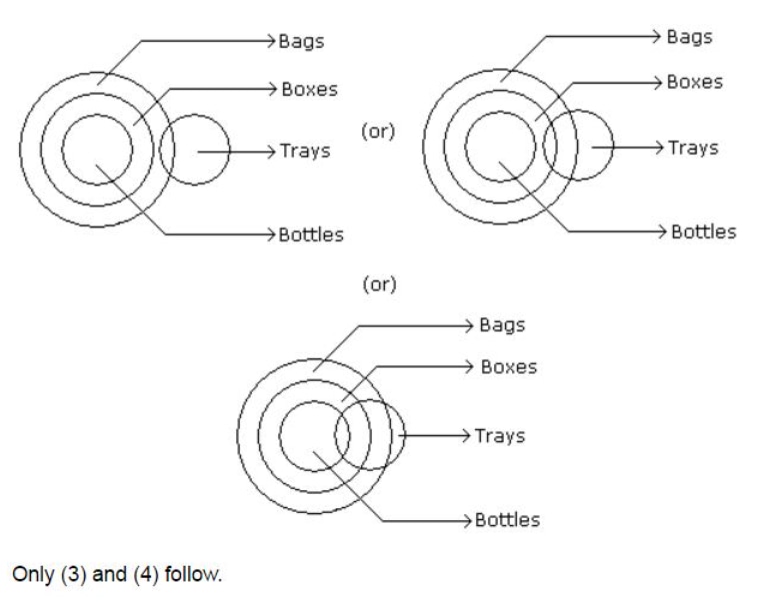
Statements : All the bottles are boxes. All the boxes are bags. Some bags are trays.
Conclusions :
I. Some bottles are trays.
II. Some trays are boxes.
III. All the bottles are bags.
IV. Some trays are bags.
Answer: A. Only (III) and (IV) — ConceptA syllogism chains categorical statements. Two universal premises of the form 'All A are B' and 'All B are C' merge into a valid universal conclusion…
- A.
Only (III) and (IV)
- B.
Only (I) and (II)
- C.
Only (II) and (III)
- D.
Only (I) and (IV)
Attempted by 4 students.
Show answer & explanation
Correct answer: A
Concept
A syllogism chains categorical statements. Two universal premises of the form 'All A are B' and 'All B are C' merge into a valid universal conclusion 'All A are C'. A particular premise 'Some A are B' can always be converted to 'Some B are A', but a 'some' relationship does not automatically extend to a smaller subset nested inside the larger term unless every valid diagram forces it.
Application
Bottles are a subset of boxes, and boxes are a subset of bags, so all bottles are boxes and all boxes are bags chain into all bottles are bags -- this is exactly conclusion III, so III follows.
Some bags are trays converts directly to some trays are bags -- this is exactly conclusion IV, so IV follows.
Conclusion I needs the bags that are trays to also be among the bottles specifically; since bottles form only a part of bags, that overlap can sit entirely outside bottles, so I is not guaranteed.
Conclusion II fails for the same reason -- the bags-trays overlap need not touch the boxes subset, so II is not guaranteed.
Cross-check
Every diagram consistent with the three statements keeps all bottles inside bags, while the bags that are trays can be drawn entirely outside boxes and bottles in at least one valid arrangement -- so only III and IV hold in every case.