Read the following table carefully and answer the question given below. The…
2025
Read the following table carefully and answer the question given below. The table shows the total number of people, the ratio of males to females, and the number of graduate people out of the total people in five different towns.
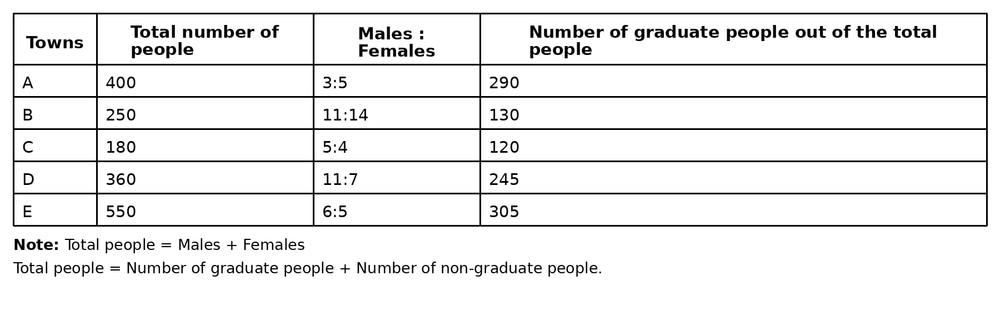
The ratio of non-graduate males to females in Town B is 7:5, respectively. The number of male graduates in Town B is what percentage of the total number of people in Town A?
Answer: E. 10% — Concept: When a total is split by a given ratio, each part equals the total multiplied by that part’s ratio component divided by the sum of the ratio terms.…
- A.
5%
- B.
25%
- C.
20%
- D.
15%
- E.
10%
Attempted by 14 students.
Show answer & explanation
Correct answer: E
Concept: When a total is split by a given ratio, each part equals the total multiplied by that part’s ratio component divided by the sum of the ratio terms. When one category (such as graduates) is known, the complementary category (non-graduates) equals the total minus that category, and any separately given sub-ratio can be used to split the complement the same way.
Application:
Town B has 250 people with Males : Females = 11 : 14 (sum = 25), so Males in B = 250 × 11/25 = 110 and Females in B = 250 × 14/25 = 140.
The table gives 130 graduates in Town B, so Non-graduates in B = 250 − 130 = 120.
The non-graduate Males : Females ratio in Town B is 7 : 5 (sum = 12), so Non-graduate Males in B = 120 × 7/12 = 70 and Non-graduate Females in B = 120 × 5/12 = 50.
Graduate Males in B = Total Males in B − Non-graduate Males in B = 110 − 70 = 40.
The table gives the total number of people in Town A as 400.
Required percentage = (Graduate Males in B ÷ Total people in A) × 100 = (40 ÷ 400) × 100 = 10%.
Cross-check: Graduate Females in B = 130 − 40 = 90, so Non-graduate Females in B = 140 − 90 = 50, which matches the value obtained from the 7:5 non-graduate split in step 3 — confirming the derivation is internally consistent.
Result: Male graduates in Town B are 10% of the total number of people in Town A.