Read the following table carefully and answer the questions given below. The…
2025
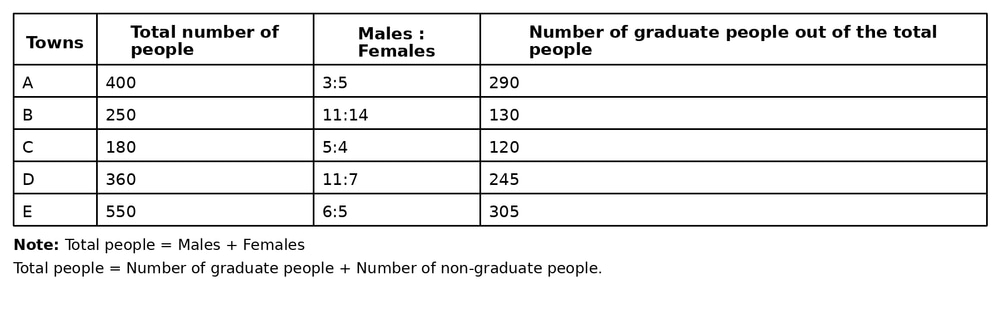
Read the following table carefully and answer the questions given below. The table shows the total number of people, the ratio of males to females, and the number of graduate people out of the total people in five different towns.
If 40% of the number of graduates are male in A, then find the difference between the number of non-graduate males and the number of graduate females in A
Answer: C. 140 — Concept: When a table records, for each group, the total population, the male-to-female ratio, and the count in one status category (here, graduates), every…
- A.
110
- B.
100
- C.
140
- D.
120
- E.
130
Attempted by 10 students.
Show answer & explanation
Correct answer: C
Concept: When a table records, for each group, the total population, the male-to-female ratio, and the count in one status category (here, graduates), every remaining sub-count — non-graduate males, non-graduate females, graduate males, graduate females — can be recovered by first splitting the total population by the given ratio into male and female totals, then splitting the status category (graduates) into its own male and female parts using any extra clue provided, and finally subtracting matching totals to get the complementary sub-groups.
From the table, town A has 400 total people, a males:females ratio of 3:5, and 290 graduates.
Split the total by the ratio: males = (3/8) × 400 = 150; females = (5/8) × 400 = 250.
The question states that 40% of the graduates in A are male, so male graduates = 40% × 290 = 116, and female graduates = 290 − 116 = 174.
Non-graduate males = total males − male graduates = 150 − 116 = 34.
The required difference = female graduates − non-graduate males = 174 − 34 = 140.
Cross-check: non-graduate females = 250 − 174 = 76, so total non-graduates = 34 + 76 = 110, which matches 400 total people − 290 graduates = 110, confirming the gender split is consistent.
As an alternate check, subtracting the total males from the total graduates gives the same result directly: 290 − 150 = 140.
So the difference between the number of non-graduate males and the number of graduate females in town A is 140.