Twelve people sit in two parallel rows of six, facing each other. Row 1 (U, V,…
2025
Twelve people sit in two parallel rows of six, facing each other. Row 1 (U, V, W, X, Y, Z) faces North; Row 2 (M, N, O, P, Q, R) faces South. Seats in each row are numbered 1 to 6 from left to right as drawn, and a seat in Row 1 directly faces (is “opposite” / “parallel” to) the same-numbered seat in Row 2. The following clues describe how they are seated:
O does not sit opposite (parallel to) W.
U sits second from the right end of Row 1.
U sits opposite N, but U does not sit adjacent to V.
Z sits second to the left of V.
R does not sit opposite (does not face) Z, and R does not sit at either end of Row 2.
Q sits third to the left of N.
Y sits at one end of Row 1, but Y is not opposite O.
M sits opposite the person who sits between V and U.
O sits sixth from the right end of Row 2 (that is, at its left end).
X sits between Z and V.
Which of the following pairs is NOT sitting adjacent to each other?
Answer: C. QM — ConceptIn a double-row “facing each other” seating puzzle, first fix seats using absolute clues (“Nth from an end”, “sits at an end”), then place people using…
- A.
WU
- B.
NP
- C.
QM
- D.
XV
Attempted by 9 students.
Show answer & explanation
Correct answer: C
Concept
In a double-row “facing each other” seating puzzle, first fix seats using absolute clues (“Nth from an end”, “sits at an end”), then place people using relative clues (adjacent / between / left-of), and finally link the two rows with the cross-row clues (opposite / parallel). Two people are “adjacent” only when they occupy consecutive seat numbers in the SAME row; they are “opposite” (or “parallel”) when they sit in the same seat-number position across the two rows.
Application
U is second from the right end of Row 1 (6 seats), so U is at seat 5.
U is not adjacent to V, so V cannot be at seat 4 or seat 6. Since Z sits two seats to the left of V (Z = V − 2), V must be at seat 3 or higher; so V is at seat 3 and Z is at seat 1.
X sits between Z (seat 1) and V (seat 3), so X is at seat 2.
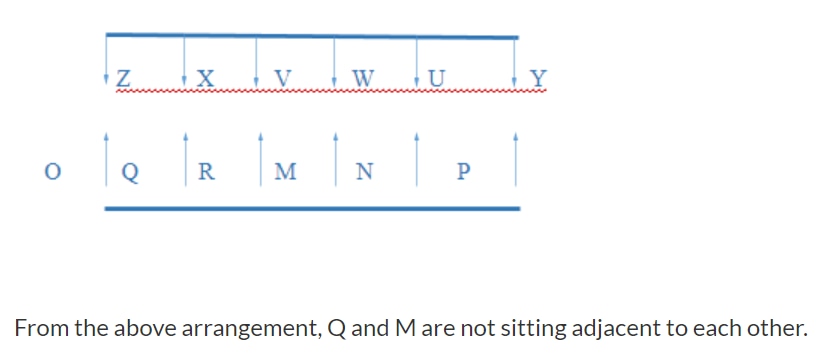
The remaining Row 1 seats, 4 and 6, go to W and Y. Y sits at an end, and seat 1 already belongs to Z, so Y is at seat 6, leaving W at seat 4. Row 1 (left to right): Z, X, V, W, U, Y.
U is opposite N (same seat number across the two rows), so N is at seat 5 of Row 2.
Q sits third to the left of N (seat 5 − 3), so Q is at seat 2.
M sits opposite the person seated between V and U — that person is W (seat 4) — so M is at seat 4.
O sits at the left end of Row 2, so O is at seat 1.
The remaining Row 2 seats, 3 and 6, go to R and P. R does not sit at an end, so R is at seat 3, leaving P at seat 6. Row 2 (left to right): O, Q, R, M, N, P.
Cross-check
Every clue holds against this arrangement: O (seat 1) is not opposite W (seat 4); R (seat 3) is not opposite Z (seat 1) and is not at an end; Y (seat 6) is not opposite O (seat 1). The arrangement is unique. Now checking each pair for adjacency (same row, consecutive seats):
W (seat 4) and U (seat 5) in Row 1 — consecutive seats — adjacent.
N (seat 5) and P (seat 6) in Row 2 — consecutive seats — adjacent.
Q (seat 2) and M (seat 4) in Row 2 — R (seat 3) sits between them — NOT adjacent.
X (seat 2) and V (seat 3) in Row 1 — consecutive seats — adjacent.
So Q and M are the pair that is not sitting adjacent to each other.