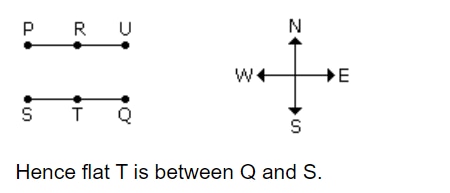
Each of the following questions is based on the following information: Six…
2025
Each of the following questions is based on the following information: Six flats on a floor in two rows facing North and South are allotted to P, Q, R, S, T and U. Q gets a North facing flat and is not next to S. S and U get diagonally opposite flats. R next to U, gets a south facing flat and T gets North facing flat. Whose flat is between Q and S?
Answer: A. T — CONCEPT: In a two-row facing seating puzzle (here, North-facing and South-facing rows of three flats each), two flats are ‘next to’ each other only when they…
- A.
T
- B.
U
- C.
R
- D.
P
Attempted by 9 students.
Show answer & explanation
Correct answer: A
CONCEPT: In a two-row facing seating puzzle (here, North-facing and South-facing rows of three flats each), two flats are ‘next to’ each other only when they sit adjacent within the SAME row. By definition, ‘diagonally opposite’ (like ‘directly opposite/facing’) is always a CROSS-ROW relation — one flat in the North row paired with one in the South row — and never applies to two flats in the same row. In a row of three, only the two end flats are non-adjacent to each other; the middle flat is adjacent to both ends.
T is explicitly North-facing, and Q is North-facing by the first clue; R is explicitly South-facing, so R cannot be in the North row.
Since R is next to U (a same-row relation) and R sits in the South row, U must also be in the South row, alongside R.
S and U are diagonally opposite, and a diagonal relation always crosses rows — so with U already placed in the South row, S must be in the North row.
The North row has exactly three flats, and Q, T and S are the three North-facing occupants identified so far, so the North row is exactly {Q, T, S}; the South row is exactly {R, U, P}.
Q is not next to S. In a row of three, only the two end flats are non-adjacent, so Q and S must occupy the two end flats of the North row, leaving T — the only flat left in that row — for the middle flat.
The middle flat of a three-flat row sits directly between the two end flats, so T is the flat between Q and S.
CROSS-CHECK: The diagonal-opposite clue is only used here to place S and U in different rows; that placement, combined with T and Q already being North-facing, fully determines the North row as {Q, T, S} regardless of the exact left-right seat numbering. Every clue is satisfied without any further branching, so T’s placement between Q and S is forced and unique.
Result: T is the flat between Q and S.