Each of the following questions is based on the following information: Six…
2024
Each of the following questions is based on the following information: Six flats on a floor in two rows facing North and South are allotted to P, Q, R, S, T and U. Q gets a North facing flat and is not next to S. S and U get diagonally opposite flats. R, next to U, gets a South facing flat, and T gets a North facing flat. Which other pair of flats, besides S-U, is diagonally opposite to each other?
Answer: A. QP — Concept: In a two-row, three-seat facing arrangement, the two rows sit opposite each other with one row facing North and the other facing South. Seats sharing…
- A.
QP
- B.
QR
- C.
PT
- D.
TS
Attempted by 8 students.
Show answer & explanation
Correct answer: A
Concept: In a two-row, three-seat facing arrangement, the two rows sit opposite each other with one row facing North and the other facing South. Seats sharing the same position (left-left, middle-middle, right-right) are directly opposite each other, while the two seats at opposite end positions across the rows are diagonally opposite -- so a middle seat never has a diagonal partner, only a direct one. "Next to" is always adjacency within the same row, never across rows.
Application:
R is given a South-facing flat and sits next to U, so U also belongs to the South-facing row (adjacency only happens within one row).
S and U are diagonally opposite, so S must sit in the North-facing row, at the end position diagonal to U's end position.
Q and T are both given North-facing flats, so the North-facing row is exactly {Q, S, T}, and the South-facing row is exactly the remaining three, {P, R, U}.
In a row of three seats, the only two seats that are not adjacent to each other are the two end seats; since Q is not next to S, Q and S must occupy the two ends of the North row, leaving T in the middle seat.
S sits at one end of the North row; its diagonal partner U therefore sits at the opposite end of the South row, matching the given S-U diagonal condition.
In the South row, R must sit next to U; the only South-row seat adjacent to U's end seat is the middle seat, so R takes the middle seat, leaving P at the remaining end seat.
With T (North, middle) and R (South, middle) directly opposite each other, the only unassigned seats are the two remaining end seats, one in each row, and they belong to Q and P -- so Q and P are the "other" pair (besides S-U) that is diagonally opposite.
Cross-check: Swapping which end Q and S occupy only relabels left and right without changing which pair ends up diagonal: Q and P remain the pair left over once the S-U diagonal and R's middle seat are fixed, confirming the result independent of that left-right choice; this also matches the diagram method of laying out both rows and reading the corner pairs directly.
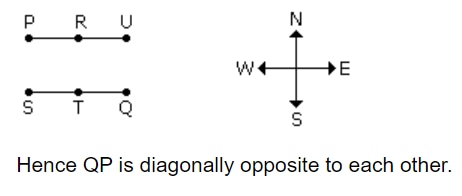
Answer: The pair diagonally opposite each other, other than S-U, is Q and P.