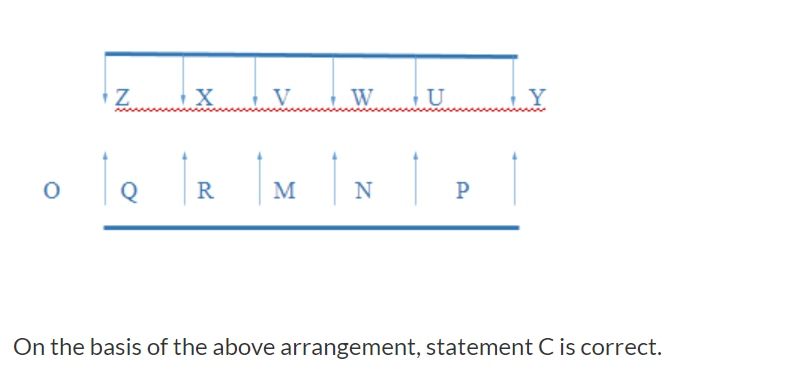
Twelve people are sitting in two different rows facing each other. Row 1 has…
2025
Twelve people are sitting in two different rows facing each other. Row 1 has U, V, W, X, Y and Z, and Row 2 has M, N, O, P, Q and R. People in Row 1 face North and people in Row 2 face South. They are seated according to the following conditions:
O does not sit parallel to W.
U sits second from the right end.
U sits opposite to N but does not sit adjacent to V.
Z sits second to the left of V.
R does not face Z and does not sit at either end.
Q sits third to the left of N.
Y sits at an end but is not parallel to O.
M sits opposite the person seated between V and U.
O sits fifth from the right end.
X sits between Z and V.
What is the position of V?
Answer: C. Fourth from right — Concept: In a double-row “facing each other” seating puzzle, translate every clue into one of three primitive relations before assembling a row: an absolute…
- A.
Second from left
- B.
Immediate partner of Y
- C.
Fourth from right
- D.
Opposite to M
Attempted by 5 students.
Show answer & explanation
Correct answer: C
Concept: In a double-row “facing each other” seating puzzle, translate every clue into one of three primitive relations before assembling a row: an absolute anchor (“nth from the left/right end” fixes one exact seat in a row of n), a relative offset (“second left of X” or “between A and B” fixes a seat only relative to another already-placed person), and a cross-row link (“opposite”, “parallel to”, “faces” ties a seat in one row to the same-numbered seat in the other). When a question only asks about a fact that is already pinned down by one row's own absolute-anchor and relative clues, that row can be solved completely and independently from those clues alone — its arrangement stays valid regardless of how (or whether) the other row's clues resolve.
Application: Row 1 (U, V, W, X, Y, Z) can be solved on its own using only the clues internal to it:
U sits second from the right end — an absolute anchor — which fixes U at seat 5 (out of 6) counting from the left.
Z sits second to the left of V, and X sits between Z and V; together these two clues force Z, X and V into three consecutive seats in that left-to-right order, with V exactly two seats to the right of Z.
U (seat 5) does not sit adjacent to V, so V cannot occupy seat 4 or seat 6; V must also have two seats free to its left for the Z–X block, so V cannot be seat 1 or seat 2 either. The only seat satisfying both restrictions is seat 3, giving Z = 1, X = 2, V = 3.
The two seats left over after placing Z, X, V and U are seats 4 and 6, to be shared between W and Y.
Y must sit at an end of the row; seat 1 is already taken by Z, so the only free end is seat 6 — Y takes seat 6, leaving W at seat 4.
The completed Row 1, left to right, reads: Z (1), X (2), V (3), W (4), U (5), Y (6).
Cross-check: Re-testing every Row-1-internal clue against this order confirms it: U at seat 5 is second from the right end; Z, X and V occupy consecutive seats 1–2–3 with Z two seats left of V; U (seat 5) and V (seat 3) are two seats apart, so not adjacent; Y occupies the seat-6 end. Converting V's position for a row of six: seat 3 from the left end is seat (6 − 3 + 1) = seat 4 counting from the right end. This arrangement is the unique solution to Row 1's own clues, so V's position holds regardless of how Row 2 is eventually seated.
Result: V sits fourth from the right end.