Twelve people are sitting in two different rows, facing each other. Row 1 has…
2025
Twelve people are sitting in two different rows, facing each other.
Row 1 has U, V, W, X, Y and Z, and Row 2 has M, N, O, P, Q and R. People in Row 1 face North and people in Row 2 face South.
They are seated according to the following conditions:
O does not sit parallel to W.
U sits second from the right end.
U sits opposite to N but does not sit adjacent to V.
Z sits second to the left of V.
R does not face Z and does not sit at the end.
Q sits third to the left of N.
Y sits at the end but is not parallel to O.
M sits opposite to the one sitting between V and U.
O sits fifth from the right end.
X sits between Z and V.
Who is sitting next to Y?
Answer: B. U — In a double-row (two rows facing each other) seating puzzle, first anchor any person whose seat is given as a fixed distance from an end. Next, convert every…
- A.
W
- B.
U
- C.
X
- D.
V
Attempted by 7 students.
Show answer & explanation
Correct answer: B
In a double-row (two rows facing each other) seating puzzle, first anchor any person whose seat is given as a fixed distance from an end. Next, convert every relative clue ("second to the left of", "between X and Y", "opposite to") into a fixed block or a paired seat. Finally, use the remaining elimination clues (an end seat, a non-adjacency condition) to fix whatever seats are still ambiguous. Once every seat in the row that holds the person named in the question is fixed, simply reading the seat(s) beside it answers a "who sits next to" question.
Applying this to Row 1 of the given arrangement:
U sits second from the right end of Row 1, so U occupies seat 5 of the 6 seats (seat 6 is the right end).
Z sits second to the left of V, and X sits between Z and V, so Z, X and V form one fixed block of three consecutive seats, in that left-to-right order.
U does not sit adjacent to V. Testing the two positions this block could take around seat 5 (U's seat), only Z in seat 1, X in seat 2, V in seat 3 keeps U away from V; the alternative placement would put V in seat 4, directly beside U, which the condition forbids.
With seats 1, 2, 3 and 5 now fixed (Z, X, V, U), only seats 4 and 6 remain open, for W and Y.
Y must sit at an end seat. Seat 1 is already taken by Z, so Y must occupy the only other end seat, seat 6, which leaves W in seat 4.
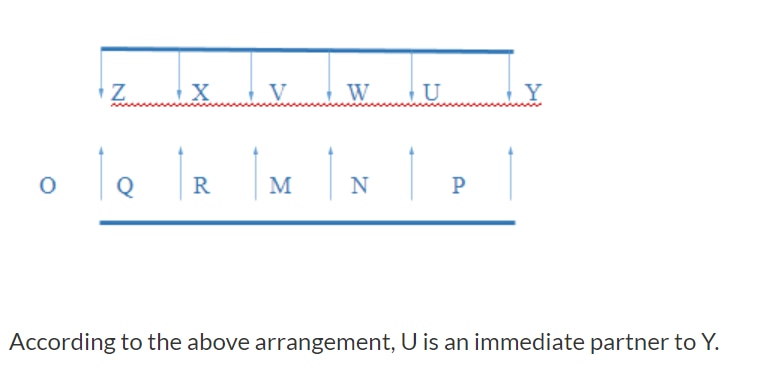
Row 1 is therefore seated, left to right: Z, X, V, W, U, Y.
Seat 6 (Y) has only one neighbouring seat in the row: seat 5, occupied by U. This matches the seating figure supplied with the question, whose own caption independently confirms that U and Y are immediate neighbours, and it is consistent with every Row-1 condition used above — the fixed Z-X-V block, U's distance from the end, and U's non-adjacency to V.
Hence, the person sitting next to Y is U.