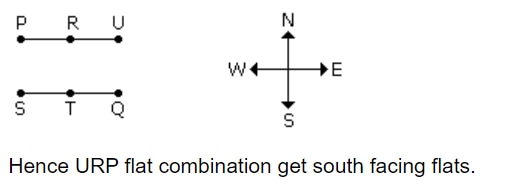
Each of the following questions is based on the following information: Six…
2024
Each of the following questions is based on the following information: Six flats on a floor in two rows facing North and South are allotted to P, Q, R, S, T and U. Q gets a North facing flat and is not next to S. S and U get diagonally opposite flats. R, who is next to U, gets a South facing flat, and T gets a North facing flat. Which of the following combinations get South facing flats?
Answer: C. URP — In a two-row seating puzzle where one row faces North and the other faces South, people described as "next to" each other always sit in the SAME row, while…
- A.
QTS
- B.
UPT
- C.
URP
- D.
Data is inadequate
Attempted by 6 students.
Show answer & explanation
Correct answer: C
In a two-row seating puzzle where one row faces North and the other faces South, people described as "next to" each other always sit in the SAME row, while people described as "diagonally opposite" always sit in DIFFERENT rows. Combining the direct facing-direction clues with these same-row/different-row relationships fixes every person's row uniquely.
Q and T are each directly stated to occupy North-facing flats.
R is directly stated to occupy a South-facing flat, and R is next to U; since "next to" means the same row, U must also occupy a South-facing flat.
S and U are diagonally opposite, so they sit in different rows; since U is on the South side, S must be on the North side.
The North-facing row now holds Q, T and S, which fills that row completely (each row seats three people).
The only person left unplaced, P, must therefore occupy the remaining South-facing flat.
Cross-check: Q and S now sit in different rows, so they cannot be adjacent to each other, matching the clue that Q is not next to S; and R (South) is confirmed next to U (South), matching the given condition. Every person's facing direction (North or South) is uniquely fixed with no contradiction, so the question is fully answerable and the data given is sufficient.
Facing | Occupants |
|---|---|
North | Q, T, S |
South | U, R, P |
Hence, the South-facing flats are occupied by U, R and P.