Each of the following questions consists of two sets of figures. Figures A, B,…
2023
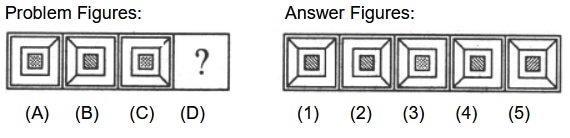
Each of the following questions consists of two sets of figures. Figures A, B, C and D constitute the Problem Set while figures 1, 2, 3, 4 and 5 constitute the Answer Set. There is a definite relationship between figures A and B. Establish a similar relationship between figures C and D by selecting a suitable figure from the Answer Set that would replace the question mark (?) in fig. (D).
Select a suitable figure from the five Answer Figures that would replace the question mark (?).
Answer: A. 1 — Concept: Figure Analogy (Matrix) In a Figure Analogy puzzle, one fixed transformation connects the first pair of figures (A to B). The exact same…
- A.
1
- B.
2
- C.
3
- D.
4
- E.
5
Attempted by 9 students.
Show answer & explanation
Correct answer: A
Concept: Figure Analogy (Matrix)
In a Figure Analogy puzzle, one fixed transformation connects the first pair of figures (A to B). The exact same transformation must then be reapplied to the second pair's starting figure (C) to derive the missing figure (D). Here two independent attributes change together: the corner-line marks rotate one corner anticlockwise and one new corner-line is added, while the innermost square's shading toggles between a dotted/crosshatch style and a diagonal-line style.
Application
Figure A carries a single corner-line at the top-right corner only, and its innermost square is filled with a dotted/crosshatch pattern.
Figure B carries corner-lines at the top-left AND bottom-left corners, and its innermost square shading has switched to diagonal slanting lines.
Comparing A to B: the existing top-right corner-line has rotated one corner anticlockwise to top-left, and a new corner-line has appeared one corner further anticlockwise, at bottom-left. The shading has toggled from dotted/crosshatch to diagonal lines.
Figure C carries corner-lines at the top-right AND bottom-right corners, with dotted/crosshatch shading -- the same starting shading style as Figure A.
Applying the same rule to Figure C: rotate each existing corner-line one corner anticlockwise -- top-right moves to top-left, and bottom-right moves to top-right.
Add one new corner-line at the corner one step further anticlockwise from the leading rotated position (top-left) -- that next corner is bottom-left.
So the missing figure D must carry corner-lines at the top-left, top-right, AND bottom-left corners, with the shading toggled to diagonal slanting lines.
Cross-check
Figure 3 still shows dotted/crosshatch shading, so the required shading toggle never happens -- ruled out.
Figure 2 keeps its corner-lines confined to the same right side that Figure C already used, so no rotation is applied at all -- ruled out.
Figure 4 has the shading toggled correctly but its two corner-lines sit on the left side exactly as in Figure B, i.e. it copies Figure B's layout instead of rotating Figure C's own corner-lines forward -- ruled out.
Figure 5 does grow to three corner-lines with the shading correctly toggled, but its third corner-line lands on the bottom-right rather than following the anticlockwise growth direction traced from Figure C's own corners -- ruled out.
Result
Only the figure with corner-lines at the top-left, top-right, and bottom-left corners, and diagonal-line shading in the innermost square, satisfies both the rotation-and-growth rule and the shading toggle -- Figure 1.