Select a suitable figure from the four given alternatives that will complete…
2023
Select a suitable figure from the four given alternatives that will complete the figure matrix.
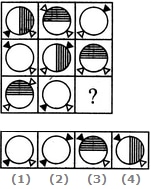
Answer: D. 4 — Concept: In a figure-matrix completion question, every distinguishing visual attribute of the figures must appear exactly once per row, cycling in a fixed,…
- A.
1
- B.
2
- C.
3
- D.
4
Attempted by 8 students.
Show answer & explanation
Correct answer: D
Concept: In a figure-matrix completion question, every distinguishing visual attribute of the figures must appear exactly once per row, cycling in a fixed, non-repeating rotation across the three columns. Here there are three independent attributes: the circle's shading style, which pair of corners carries a triangle marker, and which one triangle of that pair is solid. Solving the matrix means working out each attribute's own row-rule and finding the single figure that satisfies all of them together.
Application:
Shading rule: each row contains the three shading styles - unshaded, top-half horizontal lines, and right-half vertical lines - exactly once. Row 3 already shows top-half horizontal-line shading and an unshaded circle, so the missing figure must carry the remaining style: right-half vertical-line shading.
Triangle-position rule: each row also uses each of three corner pairs exactly once - the two bottom corners, the top-left/bottom-right diagonal, and the top-right/bottom-left diagonal. Row 3's first two figures already use the top-right/bottom-left diagonal and the two bottom corners, so the missing figure must use the remaining pair: the top-left/bottom-right diagonal.
Filled-corner rule: across the whole grid, whichever corner pair a figure uses, the same corner of that pair is always the solid one - the top-left corner is solid whenever the top-left/bottom-right pair appears, with the bottom-right corner left as an outline. So the missing figure's top-left triangle must be solid and its bottom-right triangle must be an outline.
Cross-check (why the other figures fail):
The figure marked (1) is an unshaded circle with only its bottom-left triangle solid. Row 3 already has an unshaded circle, so this repeats a shading that is no longer available.
The figure marked (2) is also an unshaded circle, and it shows both corner triangles solid at once - a combination that never occurs anywhere in the grid, since every figure keeps exactly one triangle of its pair as an outline.
The figure marked (3) correctly places a solid top-left triangle and an outline bottom-right triangle, but its circle repeats the top-half horizontal-line shading already used earlier in row 3.
Only the figure marked (4) satisfies all three rules at the same time: right-half vertical-line shading, triangles on the top-left/bottom-right diagonal, with the top-left one solid.
Hence, the figure marked (4) correctly completes the matrix.