Select a suitable figure from the four alternatives that would complete the…
2025
Select a suitable figure from the four alternatives that would complete the figure matrix .
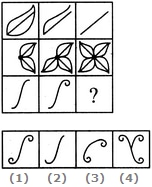
- A.
1
- B.
2
- C.
3
- D.
4
Show answer & explanation
Correct answer: A
Concept: In a figure-matrix (figure-analogy) question, every row of the 3×3 grid follows its own visual rule from left to right — the count of some feature (lines, petals, loops, sides) steadily increases or steadily decreases along that row, independently of the other rows. The missing figure must simply continue the trend already set by the two figures already drawn in its own row.
Application — reading each row's rule:
Row 1: the closed loop around the diagonal line opens into a small hook and then disappears altogether — the curl on the line steadily decreases from left to right.
Row 2: the flower gains one extra petal at each step — two petals, then three, then four — the petal count steadily increases from left to right.
Row 3: the base S-shaped curve stays the same at every step, but a loop is added at one more end each time — no loop, then one loop at the top — so the missing figure must add a second loop, giving a loop at both ends of the curve, continuing the same steadily increasing loop count.
Cross-check: row 2 uses the identical steadily-increasing-count logic (2 → 3 → 4 petals), confirming that a plain +1 step — not a repeat and not a jump — is the rule this puzzle uses in every row. So the missing figure is the S-shaped curve with a small loop at both the top and the bottom end.
The other figures do not fit:
A plain S-curve with no loop at all repeats the first figure of the row exactly, instead of continuing the increasing loop count.
A hook drawn on a more open, arc-shaped stroke with a loop at each end changes the base curve used throughout the row, even though its loop count looks right.
A two-pronged shape with a loop at all four tips changes the base stroke into a different form and adds two loops at once, overshooting the single extra loop this step calls for.