Select a suitable figure from four alternatives that would complete the figure…
2023
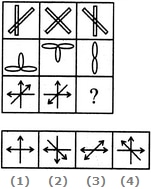
Select a suitable figure from four alternatives that would complete the figure matrix.
- A.
1
- B.
2
- C.
3
- D.
4
Attempted by 1 students.
Show answer & explanation
Correct answer: C
Concept: In a figure-matrix built on the 'missing / non-common parts' rule, the third figure of a row is made only from the parts of the first two figures that are NOT identical between them. A part is common (and is dropped) only when it has the exact same position and the exact same styling — arrow-headed or plain — in both of the first two figures. If a position repeats but its styling changes (an arrowhead in one figure, a plain line in the other), it is not truly common, so it survives; and a position appearing in only one of the two figures always survives.
Row 1 confirms the rule: the first cell has a vertical line plus a diagonal rising from bottom-left to top-right; the second cell has both diagonals crossing. The rising diagonal is identical in both cells, so it cancels, leaving the vertical line (only in cell 1) and the falling diagonal (only in cell 2) — exactly the third cell.
Row 2 confirms it again: the first cell has petals pointing up, left and right; the second cell has petals pointing left, right and down. Left and right repeat identically, so they cancel, leaving only the up petal (cell 1) and the down petal (cell 2) — the two-petal figure that is the third cell.
Row 3, the row with the missing figure: the first cell has arrowheads pointing up, up-right (diagonal) and left, plus plain (arrowless) strokes toward the bottom and the bottom-left (diagonal); the second cell has arrowheads pointing up, right and bottom-left (diagonal), plus plain strokes toward the up-right (diagonal) and straight down.
The up position is an arrow in both cells and the down position is a plain stroke in both cells, so both are identical and cancel completely.
The up-right diagonal is an arrow in the first cell but only a plain stroke in the second cell — its styling is not identical, so it survives; the bottom-left diagonal is the mirror case (plain in the first cell, an arrow in the second), so it survives too. Together they form one full double-headed diagonal line.
Left appears only in the first cell and right appears only in the second cell, so both survive on their own, together forming one full double-headed horizontal line.
So the missing figure must show exactly two straight lines crossing at the centre, each arrow-headed at both ends — one horizontal, one running from bottom-left to top-right — with no separate up or down stroke left over. Only one of the four alternatives is built from just these two clean double-headed lines; the rest are clusters of several single-headed strokes that do not match what the cancellation rule produces here.