Select a suitable figure from the four given alternatives that would complete…
2025
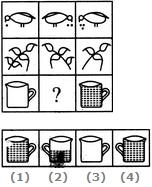
Select a suitable figure from the four given alternatives that would complete the figure matrix.
Answer: B. 2 — Concept: In a figure-matrix (figure analogy) item, each row usually follows two independent rules at once: one feature changes step by step in a fixed…
- A.
1
- B.
2
- C.
3
- D.
4
Attempted by 7 students.
Show answer & explanation
Correct answer: B
Concept:
In a figure-matrix (figure analogy) item, each row usually follows two independent rules at once: one feature changes step by step in a fixed sequence (a count that rises or falls, or shading that builds up), while another feature swaps or mirrors its position from one box to the next. The missing figure must satisfy every rule running through its own row at the same time.
Application:
Top row: the fish outline stays the same in all three boxes; the small circle beside it swaps sides across the row (left, then right, then left), and the number of dots beneath it rises from one to two to three.
Middle row: the pinwheel-like figure keeps the same basic cross shape, but the number of hooked, leaf-like ends falls from four to three to two as plain straight ends take their place instead.
Bottom row (the row with the missing figure): the mug outline stays the same shape throughout. Its handle swaps sides the same way the top row's circle does — right, then (missing) left, then right again, since the first and third mugs both already show the handle on the right. Its checkered shading also builds up the same way the top row's dot count and the middle row's hook count change — the first mug has no shading at all and the third mug is fully checkered, so the missing middle mug must show shading that has started to build up but is not yet complete.
Cross-check:
A fully checkered mug with the handle on the right only repeats the third mug's shading and keeps the handle on the same side across the row, so it ignores both changing rules.
An unshaded mug with the handle on the right only repeats the first mug's shading and again keeps the handle on the same side, so it also ignores both changing rules.
A fully checkered mug with the handle on the left gets the handle side right but jumps straight to complete shading instead of the partial, in-between amount the middle position calls for.
A mug with the handle on the left and shading only in its lower portion matches both running changes at once: the handle has swapped side as required, and the shading has built up partway between empty and full.
So the figure with the handle on the left and partial checkered shading confined to its lower half is the one that completes the matrix.