UPPSC Teaching Subject Weightage: Build a Revision Plan from Syllabus and PYQs
Turn a traceable PYQ sample and your own error log into a revision timetable. This method keeps frequency, foundation value and volatility separate.
KnowledgeGate Team
Exam prep & CS education
Updated 25 Jul 20267 min read
An unsourced weightage chart can take over your week. You follow its top row even when the verified papers and your own error log say otherwise. The method below starts from the current official syllabus, counts only traceable previous-year questions, and keeps apart three things one weightage number blurs: how often an area repeats, how much of the syllabus leans on it, and how fast its content moves. The worked example runs on the UPPSC Polytechnic Lecturer Computer Science subject list, across both Computer papers.
Define what counts as evidence before assigning weightage
Use this source order: the current syllabus or notice on the UPPSC site, then a UPPSC-issued paper and answer key from its previous-year question-paper area, then any copy whose year, page and question text you can check yourself. Memories and unattributed screenshots go in an unverified column and count zero.
For every item, log the title, issuing body, issue date, paper year, page or question number, URL and access date, and exclude anything dated after the notification you are preparing against. When syllabus, pattern, marks or selection details go into your notes, open the line with “UPPSC states” and cite the official page, so you can still tell the commission's claims from your own six weeks later.
Build one syllabus-to-evidence sheet
One row per official syllabus heading. Columns: the heading copied exactly, which paper it sits in, the verified source ID, the 2018 count, the 2022 count, the total, attempts, correct, F, B, V, the composite and the band. Copy headings character for character, so the next syllabus revision shows up as a diff instead of a guess. Two count columns, because there are two previous-year papers to count, 2018 and 2022, both carried in the UPPSC Polytechnic Lecturer CS test series.
Score each dimension from 1 to 5. F is repetition in your own verified count. B is how many other headings need this one first: Data Structures and Algorithms scores 5 because algorithm analysis, database indexing and process scheduling all sit on top of it, while Emerging Technologies scores 1 because nothing waits on it. V is how fast the material moves: Cybersecurity scores 4 and Emerging Technologies 5 because their tools and terminology shift between cycles, while DBMS scores 1 because relational algebra and the normal forms have not moved in decades.
Deduplicate repeated questions and exclude disputed items. Why PYQs Beat Buying Another Question Bank explains why traceability beats volume.
Work a 40-item audit without predicting the next paper
Here is one learner's verified 40-item register, built from the two previous-year papers and tagged by paper. Forty items can rank areas; they cannot forecast the next one.
Subject | Paper | Count | Share in this 40-item sample | F |
|---|---|---|---|---|
DBMS | 1 | 7 |
| 5 |
Operating Systems | 2 | 6 |
| 4 |
Computer Networks | 1 | 6 |
| 4 |
Data Structures and Algorithms | 1 | 6 |
| 4 |
Computer Organization | 1 | 5 |
| 3 |
Software Engineering | 2 | 4 |
| 3 |
Cybersecurity | 1 | 3 |
| 2 |
Emerging Technologies | 2 | 3 |
| 2 |
The counts total 7+6+6+6+5+4+3+3 = 40. In a register this size, map 7 to F=5, 6 to F=4, 4 or 5 to F=3 and 3 to F=2. With a larger register, cut five bands off your own range instead of reusing these thresholds.
Combine frequency, foundations and volatility
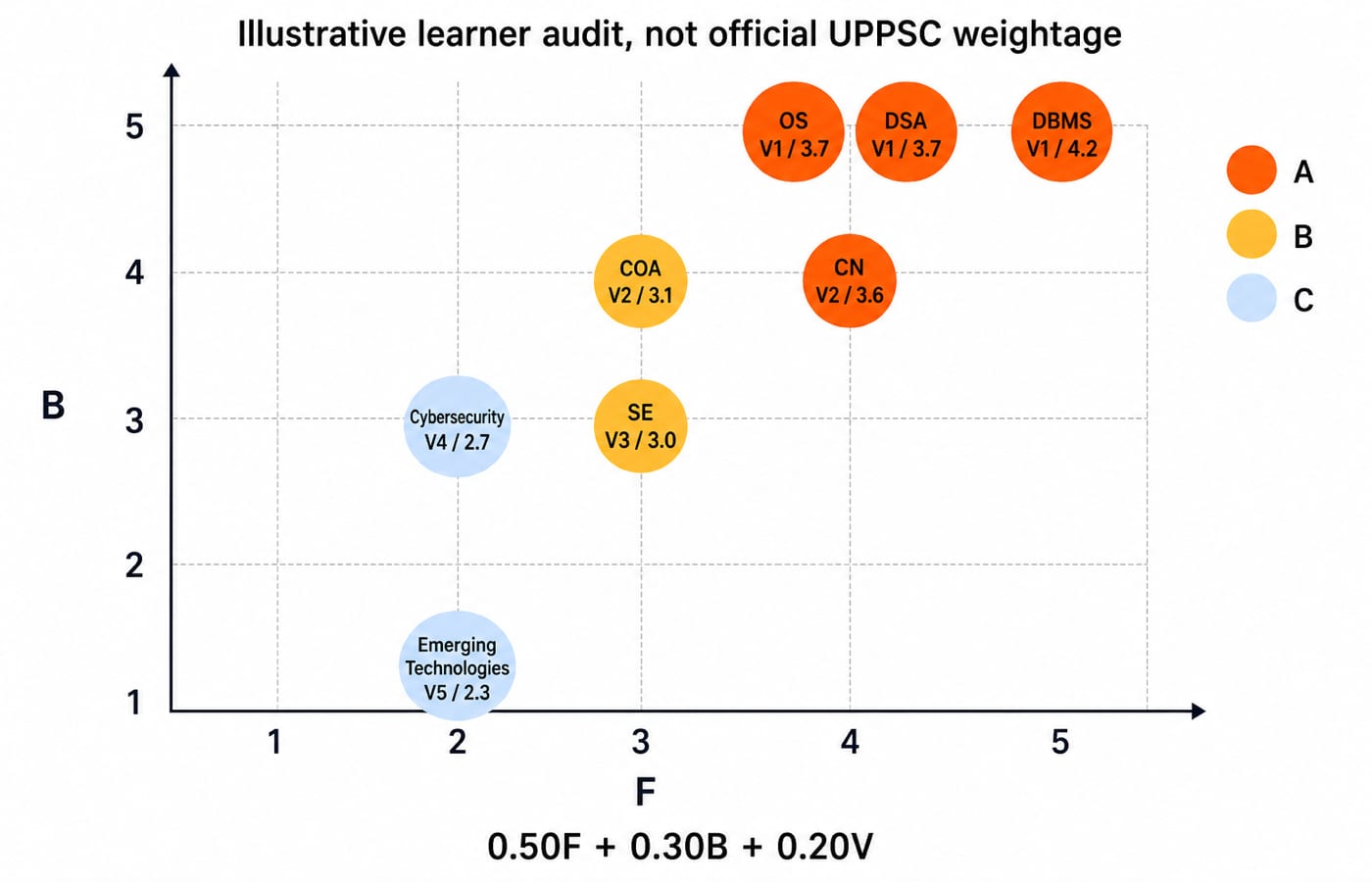
Use priority = 0.50F + 0.30B + 0.20V. The weights are yours: 0.50/0.30/0.20 suits a reader who has finished one full pass, while someone still building prerequisites should raise B and cut F. Band A is 3.6 and above, Band B is 3.0 to 3.59, Band C below 3.0.
Subject | Calculation | Band |
|---|---|---|
DBMS |
| A |
Operating Systems |
| A |
Computer Networks |
| A |
Data Structures and Algorithms |
| A |
Computer Organization |
| B |
Software Engineering |
| B |
Cybersecurity |
| C |
Emerging Technologies |
| C |
Frequency lifts DBMS to the top. Foundation value is what holds Data Structures and Algorithms level with Operating Systems and above Computer Networks, which tied it at six items. Volatility is why Cybersecurity and Emerging Technologies earn weekly contact on the smallest counts here: a term that moved since your notes were written costs a mark as fast as a topic you never read.
Turn the bands into an 18-hour revision week
The 18 hours are the weekly capacity set out in the 16-week UPPSC Polytechnic Lecturer CS plan: five weekdays at two hours plus two weekend days at four. That post divides the week by activity; this one divides it by subject. Rate the subjects, not the bands: 2.5 hours for each Band A subject, 2.0 for each Band B, 1.5 for each Band C. Four A subjects, two B and two C give 10.0 + 4.0 + 3.0 = 17.0 assigned hours, and the eighteenth stays unassigned for spillover. A flat 30% to Band B would instead have given Computer Organization 2.7 hours, more than DBMS gets at the top of Band A, purely because Band B holds two subjects and Band A holds four.
Band | Subjects (paper) | Hours each | Band total |
|---|---|---|---|
A | DBMS (1), Operating Systems (2), Computer Networks (1), Data Structures and Algorithms (1) | 2.5 | 10.0 |
B | Computer Organization (1), Software Engineering (2) | 2.0 | 4.0 |
C | Cybersecurity (1), Emerging Technologies (2) | 1.5 | 3.0 |
Spillover | unassigned | 1.0 |
Now read the table down the paper column. Paper 1 takes 2.5 + 2.5 + 2.5 + 2.0 + 1.5 = 11.0 hours and Paper 2 takes 2.5 + 2.0 + 1.5 = 6.0. Both are full Computer Science papers, so a two-to-one week should be a choice you make rather than one the composite score makes for you. If Paper 2 is the weaker side, park the spillover hour there and look again at Software Engineering's band.
Inside each block, give 40% to closed-book recall and repair and 60% to verified questions and error review. DBMS at 2.5 hours is 150 minutes: 150 × 0.40 = 60 and 150 × 0.60 = 90. Use the UPPSC Polytechnic Lecturer CS course for the repair half and the test series for the timed half.
If three hours disappear, drop the spillover hour first, then take one from Band B and one from Band C: 10.0 + 3.0 + 2.0 = 15.0 hours. Band A holds its full rate. Do not cram the lost hours back in later, and do not zero the volatile subjects to buy the time.
Revise the bands when the diagnosis changes
Every 14 days, add one verified PYQ batch and two mixed tests, then recalculate. Promote a subject only after five traceable attempts with accuracy below 70%, or two wrong answers you had been confident about. Demote only after two consecutive cycles at 85% or above with no repeated concept error.
Say DBMS returns 9/10 = 90% for a second consecutive cycle with no repeated concept error. The demotion rule fires: DBMS moves to Band B and drops from 2.5 to 2.0 hours. Operating Systems returns 5/8 = 62.5% with three concept errors, so it holds Band A and takes the freed half hour, rising to 3.0. The assigned total does not move: 3.0 + 2.5 + 2.5 = 8.0 in Band A, 2.0 + 2.0 + 2.0 = 6.0 in Band B, 3.0 in Band C, 17.0 in all. Only the subject under repair has changed.
Prevent four common weightage mistakes
Counting unverified memories. A recalled question feels like evidence and inflates whatever you remember best. Quarantine them in their own column, score them zero, and move F only when a traceable source turns up.
Ranking on raw frequency. Data Structures and Algorithms and Computer Networks tie at six items, and only foundation value separates them. Keep F, B and V in separate columns so support value can outvote repetition.
Reading the sample as a forecast. Forty items is a ranking instrument, and 7/40 = 17.5% is a property of your register, not of the next paper. Keep “in this 40-item sample” beside every percentage you write down.
Freezing the bands. A band set in month one diagnoses the learner you were then, and the plan drifts from your real errors without ever looking wrong. Write the next recalculation date on the sheet the day you build it.
The short version
Copy the current official syllabus headings, count only traceable previous-year questions, score frequency, foundation and volatility separately, rate each subject by band, check the split across both papers, and recalculate every 14 days.
Give it 30 minutes today: build the register, enter 40 traceable items or all you have, quarantine every doubt, and calculate the first band table. After that it updates itself each fortnight from your own results. The Govt Teaching Jobs category lists the UPPSC Polytechnic Lecturer CS course and its test series if a heading you marked unseen needs a source.
Keep learning
UPPSC Teaching vs UP LT Grade: Choose by Role, Eligibility and Syllabus
Choose between the Polytechnic Lecturer and LT Grade routes by checking the current notice first, then testing role fit, syllabus overlap and available hours.
Updated 7 Aug 20267 min readUPPSC Teaching
UPPSC Computer Science Problem Types: Solve Algorithms, DBMS and OS
Use one four-process dataset to practise insertion-sort traces, candidate-key and 3NF reasoning, and non-preemptive SJF calculations with reliable checks.
Updated 4 Aug 20266 min readUPPSC Teaching

UPPSC Teaching Eligibility and Selection Structure: Verify the Right Post Before Applying
A practical worksheet-based method to check the exact UPPSC post, qualification route, equivalence evidence and notified selection sequence before applying.
Updated 2 Aug 20266 min read62 viewsUPPSC Teaching
UPPSC Teaching PYQ Analysis: Build an Error-Led Revision Plan
Learn a repeatable way to verify teaching PYQs, separate topic from reasoning demand, diagnose errors and convert the evidence into next week's study calendar.
Updated 30 Jul 20266 min readUPPSC Teaching